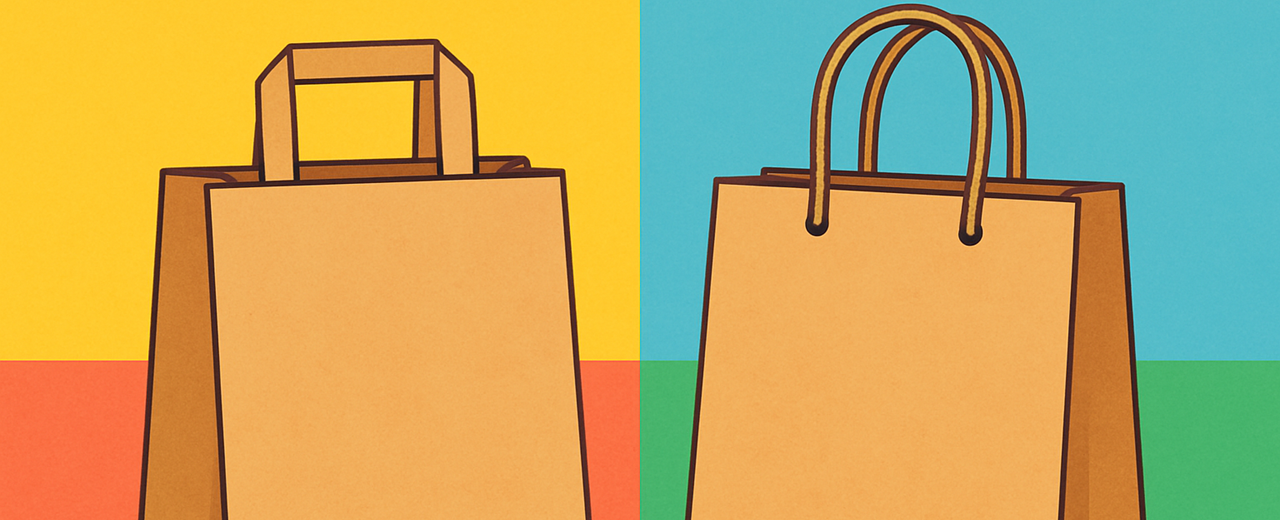
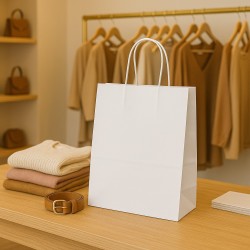
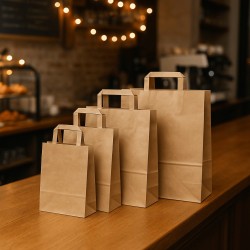
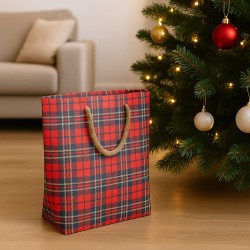
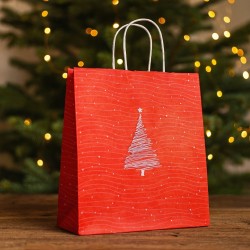
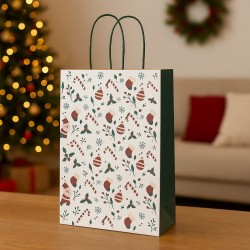
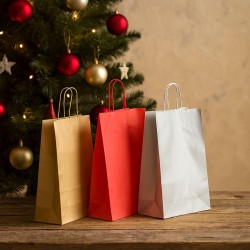
Paper shopping bags are an increasingly popular packaging choice for both image and sustainability reasons. Specifically, there are two main types of handles for these bags: flat handle (a strip of flattened paper) and drawstring handle (a twisted paper cord. Each of these solutions has different implications in terms of brand perception, environmental impact, technical features, and user experience for the customer. Below we explore these aspects to help both companies and consumers understand which solution may be best suited to their needs.
Aspects of Marketing and Brand Image
Packaging is an integral part of a brand's image. The choice of shopper type can influence the public's perception of the brand:
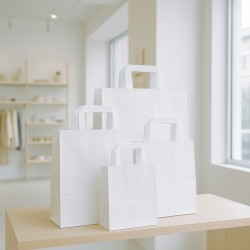
Automatic (machine-made) shopper with a flat handle: they convey asimple and functional image. They are often associated with casual stores, supermarkets, food establishments, and settings whereessentiality and practicality are key values. For example, natural kraft paper bags with flat handles are widely used by fast food, takeout, and restaurant owners. This type of bag immediately communicates practicality and affordability while remaining environmentally friendly and customizable with a logo. Flat-handled shopping bags are a practical and economical solution--functional and durable in short. So the message to the customer is of a brand that is attentive to utility and value for money, with a no-frills appearance that can also emphasize sustainability, especially if the paper is recycled or perhaps natural kraft color.
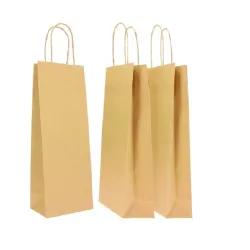
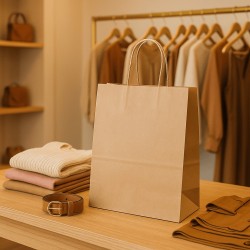
Drawstring handle shoppers (machine-made): add a touch of prestige to the shopping experience. These bags are, as mentioned, produced entirely by machine, and are a much cheaper copy of the handmade shoppers that represent true luxury instead. This type of bag is often used by fashion boutiques, jewelry stores, and mid-range brands. The twisted paper cord immediately recalls the idea of a "boutique" bag, signaling to the customer that the contents are nonetheless special. The drawstring handle lends "a touch of elegance without compromising practicality and durability by returning a great visual impact. The result is that the bag itself becomes part of the shopping experience, increasing the perception of brand value in the eyes of the customer.
A marketing element to consider is also the communication of the brand's eco-friendly values through the shopper. Both flat-handled and drawstring-handled bags made entirely of paper are perceived positively by environmentally conscious consumers. As one industry portal notes, choosing a (recyclable) paper shopper with flat or drawstring handles can even "set you apart from competitors and put a value on your respect for the environment." In summary: the flat-handled bag communicates simplicity, nature and convenience; the drawstring-handled bag communicates quality, attention to detail and more alto brand positioning. The choice will depend on the image the company wants to convey: smart essentiality or more distinctive.
Sustainability and Environmental Impact
Ecologically, both types are preferable to plastic shopping bags, as they are compostable/biodegradable and derived from a renewable source (cellulose). In general, paper shopping bags (including handles) are "biodegradable and recyclable," offering a more sustainable packaging option for companies committed to reducing their environmental impact. However, there are some important differences to highlight regarding handles and the manufacturing process:
Handle composition: both flat and twisted paper handles are almost always made of strips of strong paper, often the same paper as the bag, folded and glued to form a strong webbing. This means that the entire shopper (body + handles) is single-material (paper).
Recyclability: in order to properly recycle a paper shopping bag, it is essential that all components be cellulosic. The recycling guidelines explicitly recommend "removing any handles that are not paper (plastic, ribbons, cords...)" before throwing the bag in the paper collection. Paper handles (flat or twisted) are perfectly fine and can be left attached, while cords made of nylon, polyester or other materials should be detached and disposed of separately. In fact, a shopper with a flat handle and twisted drawstring (precisely twisted) is 100% recyclable with ease, while one with a paperless drawstring handle requires a little consumer intervention to be 100% recycled. In the past, this aspect created a dilemma: luxury bags almost always had cotton or polyester handles, making it "impossible to recycle them completely unless the handles were detached, an impractical operation." The only truly eco-friendly alternative was to fall back on twisted paper handles (less aesthetically valuable), a solution that many luxury brands avoided because it was "not luxurious enough." Today, however, there are innovations: recently some manufacturers have introduced lanyards made entirely from woven paper (woven paper rope). These are thin strands of paper (about 1 mm) woven to form a durable 100% cellulose cord. The advantage is huge: the bag design remains 100% recyclable (and certifiable as such), completely plastic free, but at the same time the handle retains a premium look and a pleasant finish to the touch, "without being as cheap as a traditional twisted paper handle." A case in point is Apple, which has adopted precisely twisted paper rope handles for its shopping bags, demonstrating the effectiveness and durability of this solution. This trend is catching on as brands seek to combine luxury and sustainability, and some governments (e.g., in Asia) are beginning to tax or ban plastic components in bags, incentivizing the switch to woven paper handles.
Production process and impact
Both flat-handled and drawstring twisted paper shoppers generally enjoy a highly automated process. Both the bag and paper handles are produced and assembled in-line, with high speed and little waste. This also makes them energy and cost efficient (see technical section).
Lanyard-handled shoppers, also called manual because they are handmade, on the other hand, may require additional steps: for example, drilling holes in the bag and knotting or securing the lanyards by hand, or gluing the ends of the lanyard inside a flap. Some deluxe versions are even assembled by hand in part (hence the term "manual" in some catalogs) to ensure perfect finishes. Environmentally, these more complex processes can mean more adhesive use and slightly higher energy consumption per pouch. Also, if the pouch is laminated (glossy/opaque laminate) for aesthetic purposes, it will no longer be completely recyclable along with the paper, because the lamination must be separated by special processes. In conclusion, both options can be sustainable choices, especially if they are made entirely of paper and not laminated. The flat-handled shopper offers perhaps the greatest ease of recycling, while the drawstring shopper requires a few more tricks (or the adoption of next-generation paper-woven drawstrings) to achieve the same level of eco-friendliness.
Technical Comparison: Endurance, Comfort of Use, Cost and Capacity
From a technical-functional point of view, flat handle and lanyard handle have pros and cons that it is useful to evaluate according to the intended use. Let us analyze the main factors: strength and carrying capacity, convenience of use, production costs, and available formats.
Strength and Load Capacity: Both paper solutions, when well designed, provide excellent grip even with heavy contents. In general, flat-handle and drawstring bags are considered the strongest of the paper shoppers, suitable for carrying relatively heavy loads without breaking. In fact, flat paper handles offer a large surface area glued to the bag, distributing the weight well; some sources credit them with "considerable weight capacity without breaking," making them a reliable and economical solution for many uses. On the other hand, drawstring handles (especially if they are made of strong fibers) possess high toughness: for example, a thick cotton or polypropylene drawstring can easily hold several pounds without breaking, making it indeed one of the strongest types of handle for shoppers. In practical applications, well-made drawstring bags are also used for heavy or bulky items (wine bottles, jars, catalogs, etc.), often combined with reinforcing cards under the bottom or along the top edge. In summary, for normal or medio-heavy loads both handles are adequate. If exceptional weights are expected, the limiting factor will probably be more the weight and structure of the paper than the handle itself: it is then advisable to choose a high weight shopper and perhaps prefer cord, which gives a margin of safety and a firmer anchorage. For very light loads, however, the difference is negligible-in fact, in cases where minimal bulk is needed (e.g., flat gift bags for a few items), die-cut or absent handles are often opted for.
Comfort of use: Here more pronounced differences emerge. Handles affect the comfort with which the shopper carries the bag, especially if the contents are heavy or if it is a long way to go. Flat-handled shoppers offer a fairly comfortable grip for moderate weights, due to the flat shape that distributes pressure over a larger surface area of the hand. However, if the bag is very heavy, the thin edge of the paper strip may begin to feel sharp on the palm or fingers. In contrast, drawstring handles (especially made of cotton or textile material) tend to be more ergonomic and pleasant to the touch: the round, soft section of the drawstring does not "cut" the hand and makes it easier to carry even heavy objects. In addition, some textile lanyards are slightly elastic, adapting to the hand. According to experts, ribbon or natural rope handles offer the most comfortable grip, while flat handles (or twisted paper cords) are less comfortable while being highly functional. It should be mentioned that compared to cotton cords, flat paper handles have the advantage that they do not cut the fingers as a small-diameter stiff twisted paper cord might. In other words, comparing a flat handle vs. a twisted paper lanyard (both of which are inexpensive solutions), the flat handle might even be perceived as more comfortable to grasp due to its width. It is a different story if the comparison is with a thick cotton cord: the latter clearly wins in comfort. In conclusion, from the customer's point of view, drawstring shoppers generally offer more comfort, a not insignificant detail if the target is to carry valuable or multiple purchases for a stretch.
Cost and production: Flat-handled shoppers are known to be the absolute cheapest option among paper bags with handles. Fully automated production and homogeneous materials keep their unit price down, especially on large runs. They are often chosen when the budget is tight but you still want to offer the customer a personalized and environmentally friendly bag. On the other hand, drawstring-handled shoppers typically cost more. The drawstring itself adds an extra element (in material and workmanship): for reference, a British source indicates that drawstring bags cost more than paper twisted handle bags. Also, as mentioned, the application of lanyards can slow down production (often the production speed for automatic lanyard lines is lower than for flat-handle lines, and some processing may require manual intervention). This results in a slightly more alto cost per unit, however, justified by the aesthetic effect and perceived superior strength. In terms of indicative costs: on the Italian wholesale market, a basic paper shopper (havana or white) with a flat handle may cost a few cents, while one of the same size with a drawstring may have a unit price 20-50% higher, depending on the handle material and finish. Obviously, as customization (color printing, laminations, details) increases, the costs of both types go up. In short, the flat handle is the choice of choice to keep basso the unit cost without sacrificing decent printing and quality, while the lanyard handle represents a slightly higher investment to elevate product presentation.
Sizes and capacity: Both types of pouches are available in a very wide range of sizes (from small boutique shoppers for jewelry or cosmetics, to large clothing boutique bags or takeout sizes for pizza and catering). Flat-handled shoppers are also often offered in wide-bottom, very roomy versions, ideal for holding multiple items or takeout trays side by side. For their part, drawstring shoppers can also be made with a very wide base and wide gussets: this is common, for example, for cake bags, bottle holders, or for packaging flower bouquets, which require precisely drawstring paper bags with a large base. One practical difference to note is the thickness when empty: flat-handled bags, being able to have the handles folded flat against the bag, are very compact to pack and store. Drawstring bags, on the other hand, having stiffer loop handles, do not flatten as much and take up a bit more volume when stacked or piled (a detail to consider for in-store transport and storage). In terms of tightness, as mentioned above, for medio-high weights it is worthwhile to eventually do tests: one manufacturer always suggests "testing a sample to make sure the product has a suitable weight" for the chosen bag, especially for inexpensive flat-handled shoppers, which while sturdy, have limitations when overloaded. In general, however, load capacity and size are not a constraint in choosing between flat or drawstring handle: large and small sizes can be found on the market in both variants. It is more a question of optimal performance: for really heavy objects (e.g., many bottles, thick catalogs, etc.) a drawstring envelope (perhaps combined with 160-200 g/m² thick paper) will offer more security, while for bulky but light objects (e.g., clothing, textiles) the generous size of the envelope matters more than the type of handle.
Comparison table
To summarize the key points, here is a direct comparison of flat-handled and lanyard-handled shoppers:
| Feature
| Shopper with flat handle
| Shopper with drawstring handle
|
| Image and branding | Simple and essential appearance. Communicates practicality and eco-sustainability; often associated with casual stores, grocery stores, and informal settings. | More elegant and premium appearance. Conveys quality and sophistication; used by boutiques, fashion brands, and high-end stores. |
| Handle material | Folded paper strips (all single-material paper) glued to the bag. | Lanyard that can be twisted paper, cotton, polyester or satin. There are 100% woven paper lanyards to combine luxury and recyclability. |
| Sustainability | 100% recyclable with paper (including handles, being paper). Automated production with fewer steps (lower energy footprint per piece). | Recyclable only if the lanyard is paper; with fabric or plastic lanyards they must be removed before recycling. Biodegradable cotton handles (non-polluting if dispersed), but not recyclable with paper. |
| Strength | Excellent strength for weights medio-large, due to the large surface area of the handle that distributes the load. Also used for shopping and take-away (heavy items such as bottles, jars, etc.). | High strength: sturdy cords support heavy loads (even >10 kg when combined with thick paper) without breaking. Suitable for bulky or valuable items that require secure support. |
| Carrying comfort | Wide handle, comfortable enough for moderate weights as it does not immediately cut the hand. May be sharp on edges with very heavy loads or prolonged carrying. | Soft/round handle, very comfortable to hold: does not mark the hand even with weight, especially with cotton rope or similar. More pleasant carrying experience for the customer. |
| Unit cost | Economical: most cost-effective solution for large quantities. Ideal for packaging at basso unit cost, with simple logo printing. | More expensive: higher cost due to materials (lanyard) and insertion process. Used when you want to invest more in packaging to enhance the brand. |
| Typical uses | Grocery stores, delis, take-aways, trade shows, and generalist retail. Great for mass and everyday use, where functionality and budget matter. | Clothing boutiques, luxury cosmetics, jewelry stores, special events. Ideal for gift wrapping and value purchases, where the envelope is part of the experience. |
| Reuse | Often reused for household uses (e.g., as a paper waste bag) or in-store for small purchases. Because it is less attractive, the customer tends to recycle it after a few uses. | Very often reused by the customer (e.g., to carry personal items, as a book holder, lunch box, etc.), due to the increased sturdiness and aesthetics. The drawstring pouch can itself become a welcome item for storage. |
(Key: When paper cord handle is referred to, it usually means the twisted paper cord, similar to a stiff lanyard. It is the intermediate solution often seen in standard shopping bags from retail chains, not to be confused with the cotton cord in luxury bags)
Customer Experience
Finally, it is important to consider thedirect experience of the end user, that is, the customer who uses the shopper to carry their purchases. This aspect combines somewhat all the previous factors (aesthetics, convenience, practicality):
Practicality of use: flat-handled shoppers are often chosen for situations where immediate convenience is paramount, such as in food takeout: the bag easily gussets open, the flat handles protrude little and allow many bags to be stacked one inside the other (facilitating storage near the checkout). Customers can quickly grasp the bag and appreciate its functional simplicity. On the flip side, a drawstring shopper offers a different practicality: perhaps it is less compact to hold under the counter, but it often has a reinforced folded edge that makes it stand open on its own more easily, making it easier to insert items into the store. In addition, the sturdy lanyard gives customers security when carrying important items (there is no fear of it tearing). In general, a consumer expects the lanyard handle when buying a high-end item (part of the "premium" experience), while they expect the flat handle in more everyday settings. Both experiences can be positive if the pouch is well designed for use: a flat-handled pouch that breaks under the weight of bottles, or a drawstring one that is uncomfortable to fill because it is too rigid, will eventually frustrate the customer-so the choice must consider actual use.
Aesthetics and satisfaction: aesthetic impact also influences customer satisfaction. Receiving one's purchases in a curated bag, perhaps matching the brand colors, increases satisfaction and perception of value. A drawstring shopper, perhaps with a glossy finish and well-printed logo, may even inspire pride in the customer carrying it around, itself becoming a means of "free" advertising for the brand (the customer gladly shows the envelope because it looks good). In contrast, a flat-handled, unbleached paper shopper communicates a message of simplicity and sustainability: some customers greatly appreciate this ecological consistency and prefer it to "richer" appearance bags if they are very environmentally sensitive. In any case, both types can be personalizzati with eye-catching graphics and thus enhance the visual experience (a paper bag, whether flat-handled or lanyard, becomes part of the store's identity when it carries a logo and design). Industry studies highlight how personalization and the perceived quality of the bag influence the positive memory of the purchase: a beautiful bag can induce customers to return or keep the shopper as a small brand souvenir.
Preferences and reuse: many consumers reuse paper shopping bags, especially those that are sturdier and more pleasing. Here we notice a trend: drawstring shoppers, being often more sturdy and finished, are reused more often (to carry other items, for packed lunch, to store documents, etc.), extending their useful life and giving the brand additional visibility over time. Flat-handled shopping bags, if of good quality, can also be reused (e.g., as a bag for other errands or for paper waste at home), but because they are perceived as more disposable, a customer is less likely to keep them for a long time if they wear out soon. In terms of stated preferences, customers tend to like comfortable handles-no one likes a bag that cuts their hands or breaks halfway through. So, if they know they will have to carry weights, they are likely to look favorably on a thick, strong lanyard. Conversely, for small, everyday expenses, a flat-handled envelope is just fine and indeed communicates the idea of not wasting resources on unnecessary packaging. In conclusion, the customer experience will be positive when the type of shopper is appropriate to the context: an elegant envelope for a luxury product increases satisfaction, just as a simple but sturdy envelope reassures the everyday shopper.
So: which one to choose?
There is no one-size-fits-all answer to the question "better flat handle or lanyard handle?" - the choice depends on a number of factors related to brand identity, type of product sold, budget, and the values you want to communicate. In summary:
If your primary goal is economic convenience and immediate sustainability, flat-handle paper shopping bags are probably the ideal choice. They cost less, are fully recyclable without the need to separate components, and convey a simple, green image perfect for informal, food or consumer settings. They are the reliable "workhorse" of packaging: they do their job with minimal investment, and customers associate them with convenience and environmental care.
If, on the other hand, you are aiming for amore memorable and refined unboxing or shopping experience, and you want the packaging to reflect a higher-end positioning, it is worth investing in drawstring handles. These add an element of perceived prestige: the pouch almost becomes part of the product, the customer will keep it more easily, and your brand will have extra visibility. On the technical side, a good lanyard also instills confidence in terms of hold. You just have to be careful, from a green perspective, to opt for recyclable materials or to educate customers on proper disposal (e.g., by pointing out on the label that the lanyard should be removed if it is not paper).
Many brands find a smart compromise: use flat-handled shoppers for basic lines or volume sales, and reserve drawstring shoppers (perhaps with more elaborate designs) for premium products, Christmas periods, or special events. In any case, it is critical to choose reliable suppliers and quality materials, because a faulty or undurable shopper can negate the image benefits of any choice.
Ultimately, the choice between flat and lanyard handle should align with both brand identity and the intended use of the envelope. Consider the message you want to give (luxury vs. simplicity), environmental impact, and budget. With the above information, both marketers and consumers can better understand the differences and make a more informed choice. Well thought-out packaging makes a difference: whether it is basic or elegant, the important thing is that it reflects the brand's values and meets the customer's expectations.