Window dressing is one of the most powerful tools to attract customers' attention and invite them to discover what the store has to offer. A well-designed showcase is not just a display of products, but a real business card that communicates the style, values and novelties of the brand. In addition to being a powerful visual vehicle, a successful storefront creates emotions, tells stories, and stimulates the curiosity of passers-by, turning them into potential buyers. Learn how to best arrange items to maximize visual impact and make your display case irresistible.
1. The power of visual focus
The focal point of a shop window is the element that immediately catches the attention of the passer-by. In a hectic urban context, where people often walk quickly and are distracted, it is essential that your window has a clear and attractive "visual center", capable of stopping the gaze and enticing to discover more.
How to create an effective visual focus:
Choose a protagonist: Select a product or group of items to feature. This could be a flagship item in the collection, a trending product, or something that represents the best of your store. For example, if you are promoting a new line of winter clothing, a stylish, well-lit garment placed in the center of the window becomes the point of attraction.
Use contrasts and colors: Color plays a vital role in guiding the eye. A product with a color that stands out from the background or surrounding items immediately stands out. Playing with contrast, such as using neutral tones in the background and bright colors for the main products, helps bring out the focus.
Keep the background neutral: Avoid overloading the display case with too many decorative elements or backgrounds that are too complex. The background should support the focal point without stealing the scene. Simple or solid colors work best because they don't distract the eye from the products on display.
Strategic placement: The focal point should be placed at eye level to ensure that it is noticed by anyone passing by the window. Place the main product centrally or slightly off-center to create a dynamic effect, but always in such a way that the eye is naturally guided towards it.
Play with asymmetry: A slight imbalance in the arrangement of products can make the storefront more interesting. For example, placing the focal point slightly to the right or left of the center of the window, instead of perfectly centered, creates a sense of movement that visually stimulates the passerby.
Focused lighting: Good lighting is essential for emphasizing the focal point. Use directional lights that highlight the main product, making it shine in comparison to the other items. Soft lighting can be used to keep the atmosphere around you more discreet, focusing attention on focus.
Creating a strong visual focus is the first step in transforming a storefront into an effective sales tool. Once the attention of passers-by has been captured, the job of the window becomes to intrigue them and invite them to discover the entire assortment of the store.
2. Play with height and proportions
A dynamic and captivating showcase cleverly exploits the height and proportions of the products on display. Using layers and differentiating item sizes allows you to guide the customer's eye through the entire scene, making the window more interesting and enjoyable to look at. The variety in heights avoids monotony and helps to create a more balanced visual composition.
How to make the most of height and proportions:
Create visual layers: Using stands of different heights, such as displays, boxes, pedestals, or coffee tables, helps create a multi-story layout. This approach gives depth to the showcase and facilitates the visibility of all products. By placing smaller items in alto and larger items in basso, you prevent larger items from covering smaller ones, and you ensure that each piece has its own visibility.
Taller items at the back, lower at the front: A basic but effective rule is to place taller or bulkier items towards the bottom of the display case, while smaller or lower items should be in the foreground. This creates a kind of "bleacher effect", where all products are visible and nothing is obscured. In addition, this system helps to give a feeling of depth and three-dimensionality to the composition.
Product size variation: If your storefront features items of various sizes, use this diversity to your advantage. Larger objects can act as a visual anchor, while smaller ones can fill the surrounding space to add detail and complete the scene. For example, in a home improvement display case, a large decorative vase may be the focal point, while small knick-knacks or accessories may be arranged around it on various levels.
Use aspect ratio to tell a story: Differentiating between large and small products can help reinforce the visual storytelling of the storefront. If you're telling a story, such as a winter setting for the Christmas window display, you could have a larger artificial Christmas tree in the background and arrange smaller decorations, such as baubles and gifts, on different levels to give a feeling of perspective.
Balance with symmetry and asymmetry: A symmetrical arrangement is pleasing to the eye and conveys a sense of order, but it can be predictable. On the contrary, a touch of asymmetry, with elements arranged in a slightly irregular way, can give a more lively and natural look to the window. For example, you can alternate a group of taller objects on one side with a more basso one on the other, creating a balance without rigidity.
Make use of vertical space: Don't limit yourself to the horizontal surface of the storefront. Vertical space can be exploited by hanging objects, using backgrounds that rise towards the alto or inserting column displays. This allows you to make the most of the available space, especially if your display case is limited in width but has a alto ceiling.
Transparent or neutral media: When creating layers with supports, opt for materials that don't distract from the attention on the products, such as plexiglass or minimalist metal. The goal is for the stand to elevate the item without stealing the show or altering the overall aesthetic of the storefront.
Playing with height and proportions allows you to create a balanced, eye-catching and easy-to-read window display case for passers-by. The tiered layout makes the storefront more dynamic and keeps the interest going, ensuring that every product, regardless of its size, gets noticed.
Curiosity: The Scientific Study of Proportions
Proportions are not just a matter of aesthetics: there are scientific theories that show that certain ratios between dimensions are perceived as particularly pleasing to the human eye. One of the most fascinating discoveries in this field is the concept of the golden ratio, a mathematical ratio that has inspired artists, architects and designers for centuries.
The golden ratio: the harmony of nature
The golden ratio, also known as the golden ratio, is a ratio of about 1:1.618 that is often found in nature, art, and architecture. This ratio describes a proportion in which the smallest part of an object is to the largest part as the latter is to the whole. We can observe it in shells, flowers, galaxies and even in the human body. Numerous studies have shown that people tend to perceive objects organized according to the golden ratio as more harmonious and pleasing to the eye.
The application of the golden ratio in shop windows
In display cases, the golden ratio can be used to determine the arrangement and size of products. For example, placing the most important object (the focal point) according to the golden rule creates a balanced and visually appealing composition. It can also be useful for deciding the distance between items and the relative size of the items on display. This proportion guides the passer-by's gaze in a natural and fluid way, making the composition visually satisfying.
Proportion in human faces and marketing
Another interesting aspect concerns the study of proportions in human faces. Scientific research has shown that faces perceived as "beautiful" or "attractive" tend to respect certain proportional ratios that approach the golden ratio. This explains why many advertising campaigns and shop windows include images of faces that meet these canons: these elements, placed next to the products, subconsciously evoke a sense of perfection and desirability.
Proportions and psychology
Proportions also affect consumer psychology. Several visual psychology studies have shown that the human mind is attracted to balanced proportions and symmetry. In display cases, this results in a well-balanced arrangement that does not overload or confuse the viewer. On the contrary, a messy window or with "wrong" proportions can cause a feeling of disharmony that drives customers away.
Historical curiosities
The concept of perfect proportions has been studied since ancient times. The ancient Greeks had already theorized the mathematical beauty of the golden ratio and applied it in architecture, as in the famous Parthenon in Athens. Leonardo da Vinci also explored the concept of proportions in his famous "Vitruvian Man", where he demonstrates how the human body follows precise mathematical rules.
Integrating this knowledge into the layout of the windows can give a competitive advantage, making the displays more eye-catching and attractive, because they are unconsciously aligned with what our brain perceives as beautiful and balanced.
3. Tell a story
The most effective window displays don't just display products: they create a visual narrative that captures the imagination and emotionally engages passers-by. Telling a story through the arrangement of products in the window is one of the most powerful ways to attract attention and entice customers to enter the store. This strategy not only makes the showcase memorable, but also creates an emotional connection with the viewer, inviting them to be part of that story.
How to create a visual narrative in the storefront:
Choose a central theme: Every story has a theme, and the same goes for your storefront. The theme can be seasonal, such as Christmas, summer, or spring, or it can reflect a special event such as the launch of a new collection, the sales period, or a holiday. Define a clear idea that acts as a common thread and guides all the exhibition choices. For example, a Christmas window could tell the magic of the holidays, while a spring window could evoke the awakening of nature and the change of season.
Use products to illustrate the story: Products should not simply be displayed, but should become an integral part of the narrative. If the theme is, for example, "a winter's day," you could create a scene where a mannequin wears a warm coat while holding a cup of chocolate, and arrange other winter items, such as scarves and gloves, around it. Each product should play a role in the story, reinforcing the message you want to communicate.
Props and decorations: In addition to products, use props and decorations that support the story. These can be simple objects such as trees, artificial snow, flowers, books or thematic accessories. For example, a summer storefront might include sand, shells, and umbrellas to create a holiday atmosphere. These details not only visually enrich the storefront, but also help to contextualize the products, making them part of a larger experience.
Play with emotion: The most memorable stories arouse emotions, and this also applies to shop windows. Think about what you want passers-by to feel: nostalgia, joy, curiosity, desire to escape? A display case that evokes a strong emotion is more likely to leave a lasting impression. For example, a window display that tells the story of a romantic autumn evening can include candles, warm tones, and snug clothing, making the passerby feel comfortable and intimate.
Create a visual sequence: A story has a beginning, a development, and an end, and the same principle can be applied to the showcase. You can structure the arrangement of the items in such a way as to create a visual journey that guides the customer's gaze through the narrative. For example, starting with a mannequin that represents the beginning of the story (such as a woman getting ready for an elegant evening), you can then continue with accessories and other details that complete the scene (bags, shoes, jewelry) and end with the surroundings, such as an elegant table set or a vintage car as a backdrop.
Play with the change of season or trends: Window displays are perfect for introducing new trends or seasonal transitions. A narrative could revolve around the evolution of the wardrobe from autumn to winter, showing garments that adapt to the change of the weather, or it could tell how a single accessory (such as a trendy bag) can revolutionize an entire look.
Include written messages: Signs, slogans, or quotes can help reinforce the narrative. Short, well-thought-out texts that are strategically placed can give additional context to the story. For example, a winter window display might include a phrase like "Cozy like a warm cuddle," creating an immediate connection between the image on display and the emotion you want to convey.
Emotional customer engagement: A well-structured storefront should not only tell a story, but should invite the customer to become a part of that story. Make sure that the passer-by can identify with the scene: what attracts him? How would you feel wearing those garments or using those products? This personal connection is what turns a simple observer into a customer.
Creating a visual narrative in the window is a powerful way to communicate not only the products, but also the identity of the store and its values. Each window thus becomes a unique story, capable of fascinating and involving passers-by, transforming their shopping experience into something more exciting and memorable.
4. Strategic Lighting
Lighting is one of the most crucial elements in creating a successful storefront. No matter how beautiful or well-arranged your products are, without proper lighting they could go unnoticed. Light, in fact, not only makes the items on display visible, but also has the power to create atmosphere, evoke emotions and guide the gaze of passers-by towards the focal points. Well-thought-out lighting can transform a simple shop window into an irresistible attraction, capable of making anyone stop in front of your shop.
How to use lighting strategically:
Illuminate the focal point: The first goal of lighting is to highlight the key products in the storefront. Use directional lights to create concentrated lighting that immediately guides the eye to the item or group of items you want to make stand out. This is the most effective way to draw attention to a specific product, especially in the evening hours or in environments with little natural light. Spot lights can be directed directly to the top items, emphasizing shapes, colors and details.
Play with light and shadow: The right combination of light and shadow can create depth and make the showcase more visually interesting. Brightly lighting some areas while others remain in shadow creates a contrast that highlights the products and adds dynamism to the scene. Shadows can also be used to highlight textures or to create a dramatic effect that catches the eye.
Use warm or cool lights based on the theme: The temperature of the light has a significant impact on the atmosphere of the storefront. Warm lights (with a more yellow hue) convey feelings of comfort, intimacy and cosiness, perfect for winter themes or settings that recall domestic warmth. Cool lights (with a more white or blue hue), on the other hand, evoke modernity, cleanliness and freshness, and are ideal for more technological or summery themes. Choosing the right color temperature helps to reinforce the emotion you want to convey through the window.
Use diffused lighting for a uniform effect: While directional lights are great for highlighting particular products, diffused lighting is important to ensure that the entire storefront is clearly visible and uniform. Using soft lighting or light panels behind objects creates a homogeneous glow that avoids overly strong shadows and makes everything more harmonious. This type of light is perfect for creating a warm and inviting background.
Create a hierarchy of light: A good lighting strategy involves creating different levels of light, with a well-defined hierarchy. The focal point should be the brightest, followed by the surrounding products with a softer light, and finally the background or decorative elements, which can be illuminated with an even softer light. This technique naturally guides the gaze of passers-by from the main product to the other items on display.
Dynamic lighting to capture attention: In some situations, especially during special times such as holidays or sales, the use of dynamic lights, such as flashing lights or colored LED lights, can be very effective in attracting the attention of passersby. Moving lights, when used sparingly, create a sense of movement and vibrancy that makes the window more interesting and memorable. For example, a light light animation that simulates the movement of snow in a Christmas window can give a magical touch without being too intrusive.
Beware of natural lighting: If your display case receives a lot of natural light during the day, it is important to consider how this will affect the products on display. Sunlight can cause uncomfortable reflections or cause colors to fade over time. In these cases, it may be useful to integrate light curtains or filters to control the amount of natural light entering the window. In the evening or on cloudy days, on the other hand, you will have to compensate for the lack of natural light with effective artificial lighting.
Mood lighting: In addition to lighting products, you can create an immersive atmosphere by using lighting to evoke a certain mood. For example, a window displaying summer clothing can be illuminated with soft and yellow lights to evoke the warmth of the sun and the feeling of vacation. If, on the other hand, you sell jewelry or luxury items, the lighting can be brighter and cooler, to create an effect of brightness and sophistication that recalls the idea of value.
Common mistakes to avoid:
Avoid glare: A common mistake in window lighting is positioning the lights in such a way that they reflect directly off the glass, causing annoying reflections that make it difficult to see the products. Make sure the lights are angled correctly to avoid this effect and maintain a clear view of the display case.
Too much or too little lighting: Too much lighting can be blinding and make it difficult to see details, while too much light can not make your products stand out. Finding the right balance is key to ensuring that the storefront is visible without being intrusive.
Maintain consistency: Finally, it's important that your storefront lighting is consistent with the overall image of your store. If the interior of the store has a certain light atmosphere (e.g., warm and welcoming), window lighting should reflect this style to avoid dissonance between what customers see from the outside and what they find once they enter.
In summary, a well-planned lighting strategy can make the difference between a window that goes unnoticed and one that attracts the attention of passers-by. The conscious use of lights, together with the arrangement of the products, helps to create an engaging visual experience, capable of exciting and pushing the customer to cross the threshold of the store.
5. Less is More: The importance of simplicity
When it comes to window displays, the old adage "less is more" is a golden rule. While it may seem counterintuitive, overloading a storefront with too many products, decorations, or messages can confuse and disorient passersby, reducing the effectiveness of your display. A neat and minimalist window display, on the other hand, draws attention to key products, makes it easier for customers to focus on what is really important, and conveys an elegant and polished image of the store.
Why "less is more" works:
Visual clarity: An overcrowded shop window can overstimulate the senses and be difficult for passers-by to "decipher". When there are too many items or too many decorative elements, the eye does not know where to rest and can easily lose sight of the main message. Keeping the storefront simple, with a few well-chosen and ordered items, allows customers to immediately grasp the message you want to communicate and focus on the main items.
Focus on key products: Displaying a small number of items allows you to highlight your top products. When there are few products, each of them has more room to shine, both in terms of visibility and impact. Careful selection also allows you to better guide the passer-by to the item you want to sell the most, conveying a clear and targeted message.
Elegance and professionalism: Simplicity is often synonymous with elegance. A neat and well-structured display case, with a few well-placed products, conveys a sense of professionalism and attention to detail. Conversely, a cluttered or crowded window display might give an impression of neglect, making the store look less well-maintained.
Breathing blanks: Blanks, when used well, can be just as important as the products themselves. In a minimalist display case, the empty spaces give breath to the composition, creating a visual rhythm that allows the eye to rest. These spaces help direct attention to the items on display, emphasizing their importance and making the window easier to "read." In addition, the empty spaces convey a sense of luxury and exclusivity, as is often the case in the windows of high-end brands.
Immediate communication: A minimalist storefront conveys the message quickly and directly. Passersby only have a few seconds to decide whether to stop and take a look, so it's essential that your storefront immediately communicates the theme, focus, or promotion. A small selection of products and decorations facilitates this process, ensuring that the message is clear and effective in a matter of moments.
How to apply the "less is more" principle in your storefront:
Choose a few top items: Rather than trying to showcase everything you have in store, select only the items that best represent your offering or that you want to push the most. For example, in a seasonal window dedicated to fall fashion, you could display a high-quality coat, scarf, and pair of boots, creating a clear and coherent composition that tells the story of a complete style without overwhelming the scene.
Minimize decorations: Decorations in the window should serve to enhance the products, not compete with them. Use few decorative elements, but which are meaningful and in harmony with the chosen theme. For example, in a Christmas shop window, rather than filling the space with lights, ribbons and various objects, you could opt for a stylized Christmas tree and some essential decorations that create atmosphere without overpowering the products on display.
Keep things tidy: Every item in the storefront should have a specific purpose. Avoid stacking products or arranging them randomly. Each piece should be placed so that it looks carefully chosen and enhanced. A few well-organized items convey a sense of order and care, making the window more attractive and welcoming.
Play with blanks: Don't be afraid to leave large gaps in your storefront. These spaces help to make the products on display stand out, creating a visual balance that draws the eye to key points. For example, if you have displayed a luxury bag, leave a blank space around it to ensure that all the gaze is focused on it, giving it an aura of exclusivity.
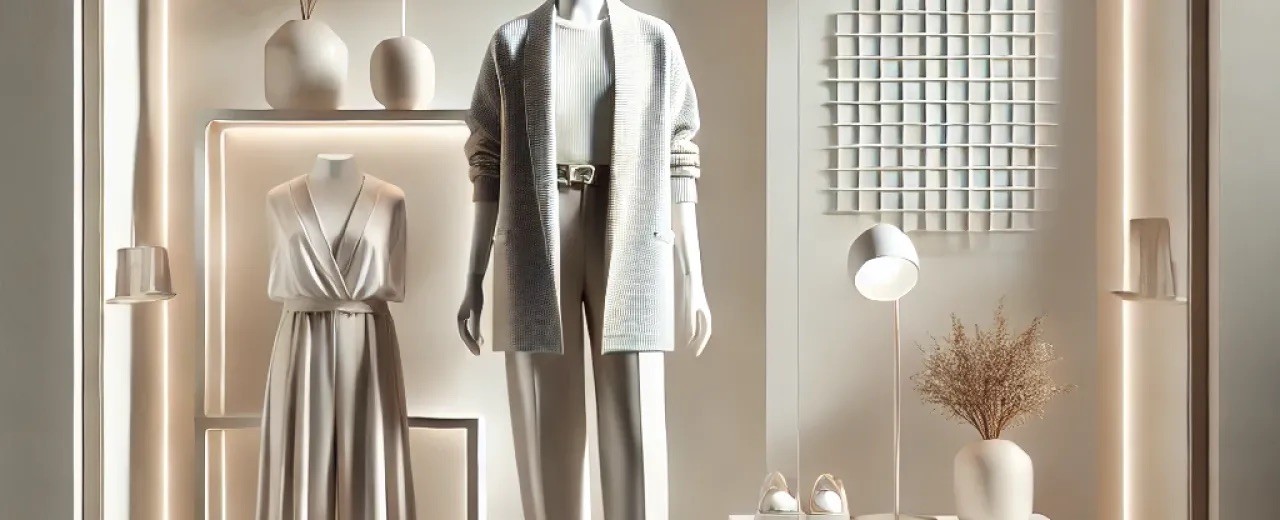
Create visual consistency: Consistency is essential for a successful minimalist storefront. Use a few colors, materials, and textures that harmonize with each other. For example, choose a limited color palette (such as white, black, and gold for a sleek display case) and keep all elements of the display case consistent with this palette, from products to decorations. This visual uniformity creates a relaxing and pleasant effect for those who observe the window.
Frequent product rotation: Another key to keeping a minimalist storefront interesting is to change the products on display frequently. Even if you choose to display a few items, regularly updating your selection helps keep your window fresh and appealing to regular passers-by. This approach ensures that there is always something new to discover, without having to overfill the space.
Practical examples:
Clothing Showcase: Instead of displaying an entire outfit with dozens of accessories, choose just one flagship item, such as a stylish winter coat. Place it in the center of the display case with a neutral background and limit yourself to adding just a couple of details, such as a silk scarf or bag. This allows the customer to focus on the main garment without distractions.
Jewelry showcase: In jewelry, there is often a tendency to display a multitude of pieces. But to create impact, it's best to focus on a few flagship pieces of jewelry, placing them on sleek stands with direct lighting to make them shine. The empty spaces around the jewels emphasize their value and rarity.
In conclusion, the "less is more" principle does not mean impoverishing the shop window, but making the most of every single element on display. The simplicity, order and targeted selection of products allow you to create an elegant, clear and irresistible showcase, capable of attracting the attention of customers and conveying a strong and consistent message.
6. Regular Rotation: Keeping Customers' Curiosity Alive
A static display case, no matter how well set up, can lose its impact if it remains unchanged for too long. The regular rotation of the products on display and the frequent updating of the window are essential to keep the attention of customers, especially regular ones. Changing the layout not only stimulates curiosity and invites passers-by to stop, but also allows you to reflect new trends, seasonality and current Sale.
Why it's important to rotate your display case regularly:
Grab the attention of repeat customers: Customers who frequently walk past the store may become less inclined to linger on a window that never changes. An updated window, on the other hand, keeps their curiosity high and invites them to find out what's new inside the store. The regular rotation of the items on display creates a kind of "visual deadline", in which passers-by get used to constantly seeing something different, stimulating them to stop and look more closely.
Reflects seasons and trends: The windows are the mirror of the seasons and fashions of the moment. Updating your storefront to reflect the shift from summer to fall collections, or to introduce new trends in fashion, design, or technology, is one way to stay relevant in the eyes of customers. A window that follows the rhythm of seasonality and trends communicates that the store is up-to-date, fashionable and always able to offer something new.
Promotes special events and sales: The window rotation can be synchronized with special events such as sales, holidays, or the launch of new collections. Creating a display dedicated to a specific promotion helps to make it stand out and communicate it clearly. For example, a window display focused on end-of-season sales could be more minimalist and focused on a few items with signs highlighting discounts, while a Christmas window display could be full of decorations and warm tones that evoke the festive atmosphere.
Optimal inventory management: Regularly rotating the products on display allows you to showcase items that may have been inconspicuous within the store or that have remained in stock. Giving them new visibility in the window can stimulate interest and help sell items that may otherwise be overlooked. In addition, this allows you to present customers with a wider range of products, increasing the possibilities of satisfying different tastes and preferences.
Create the surprise effect: Rotating the storefront allows you to create a surprise effect, which is especially important in building customer loyalty. Passersby never know what they'll find new, and this creates a sense of anticipation. The ability to amaze the customer with a window that is always fresh and captivating makes them come back more often, even if only to see what's new.
How to effectively manage storefront rotation:
Plan a rotation calendar: To ensure that your storefront is updated regularly, it's helpful to plan a rotation calendar in advance. This calendar should include major holidays, shopping events such as Black Friday, the change of seasons, and new collection launches. Each rotation can be coordinated with promotional campaigns and sales needs, so that the storefront is always in line with the store's activities.
Rotate products without distorting the display case: You don't have to completely change the entire setup every time. You can simply replace some products or small decorative details to give an air of freshness to the display case. For example, if you have a winter display case that works well, you can keep the background and change only a few items or accessories, or replace the Christmas decorations with more wintery details once the holiday season is over.
Take advantage of seasonality: Seasonality is a key factor in deciding when and how to update your storefront. As the seasons change, the tastes and needs of customers change. For example, in autumn, you could focus on warm shades and products such as wool coats and accessories, while in spring, you can opt for bright colors and light fabrics. Each season has its own trends and atmospheres to enhance, and changing the window display accordingly helps to stay relevant.
Incorporate local events and holidays: Not only global holidays like Christmas or Valentine's Day, but also local events can be a great opportunity to update your storefront. Local fairs, city events, festivals or other celebrations are perfect opportunities to create a connection with the community, setting up a showcase that reflects the local atmosphere. This strategy increases engagement and makes the store an integral part of community life.
Maintain visual consistency: Even when updating your storefront, it's important to maintain visual consistency with your store's image. This means that even if products change, the overall design, style, and values of the store must remain clear and recognizable. For example, if your store is characterized by a minimalist and elegant style, even when you rotate products, you should maintain this approach in the set-up.
Engage your audience with teasers: Another effective strategy is to create anticipation before a storefront change. You can use social media to launch teasers and engage repeat customers by showing them a preview of what's going to be on display. This can generate interest and make customers come back specifically to see the new storefront.
Mistakes to avoid when rotating the storefront:
Don't change too often: While it's important to update your storefront regularly, doing so too often could confuse customers and give the impression that your store is disorganized or inconsistent. Excessive turnover risks making it seem like products have no value or that there is a continuous attempt to "empty" the stock.
Don't neglect your target audience: When rotating products, make sure that new proposals are always relevant to your audience. For example, if your store is primarily aimed at a young audience, updating the storefront with items that are too classic or formal could alienate the regular clientele.
Don't ignore sales figures: Storefront rotation should always be based on a clear strategy and sales figures. If a featured product is performing particularly well, don't rush to change it just for the sake of it. Use sales data to understand which items rotate and which to keep in the foreground.
In conclusion, regular window rotation is a powerful tool for keeping passersby's attention and pique their interest. Changing the set-up strategically, following the seasons, Sale and events, can make the difference between a showcase that goes unnoticed and one that generates a constant flow of customers interested in finding out what's new.
7. Use proper materials and backgrounds
The choice of materials and backgrounds for a shop window is a crucial element for its success. It's not just about showcasing products, but about creating a context that enhances them, captures the attention of passers-by and communicates the desired message. The backgrounds and materials must work in harmony with the items on display, without overloading the scene or distracting the viewer too much. A careful choice consistent with the theme of the showcase can make the difference between a simple display and an engaging visual narrative.
Why materials and backgrounds are important:
They reinforce the theme of the storefront: The backgrounds and materials used in the storefront help to tell the story you want to convey. If the theme is summery, for example, the use of natural materials such as light wood, sand or light fabrics can immediately evoke a sense of lightness and vacation. If you're promoting a winter collection, materials such as wool, velvet or snow-effect surfaces can recreate the warm and welcoming atmosphere typical of the season.
They create an environment that enhances the products: Backgrounds and materials should be chosen so that they highlight the products without obscuring them. For example, a background that is too colorful or complex could distract attention from the items on display, while a neutral and understated background can make product details stand out better. Choosing materials that contrast or harmonize with the colors of the products can also help guide the eye to what is most important.
They add texture and depth: Clever use of materials with different textures can add an extra layer of visual interest to your storefront. For example, combining smooth, glossy surfaces with rougher or more matte materials creates a visual contrast that makes the set-up more intriguing and stimulates the client's mental touch, evoking different sensations. This effect can be particularly useful when you want to give a sense of luxury or craftsmanship to the products on display.
How to choose suitable materials and backgrounds:
Natural or man-made materials based on the theme: If your storefront is based on a theme that recalls nature or craftsmanship, natural materials such as wood, cotton, linen, or recycled paper can be perfect. These materials create a sense of authenticity and warmth, ideal for shop windows that want to convey a message of sustainability or comfort. On the contrary, if the theme is more modern and technological, materials such as metal, glass or plexiglass can give a touch of futurism and minimalism, emphasizing the innovation of the products on display.
Choose backgrounds that do not compete with the products: The background of the storefront should be chosen carefully, so that it complements the products without distracting the eye. Backgrounds that are too elaborate or too brightly colored can take away attention from the items on display. On the contrary, a neutral background, such as a white, gray or light pattern wall, can give the products breath and make them stand out. Even using pastel tones or simple textures can add a subtle touch, without overpowering the whole scene.
Reflective or transparent materials to create lightness: If the window has a lighter and more airy style, transparent materials such as glass or plexiglass can give a sense of lightness, letting light pass through the setting without creating visual barriers. Additionally, the use of reflective surfaces such as mirrors or shiny metal panels can amplify the light and give a sense of spaciousness, making the display case appear larger than it really is.
Use fabrics to create movement and warmth: Fabrics are excellent materials for bringing warmth and movement to a display case. A curtain made of light fabric can sway gently, creating a dynamic effect that attracts the attention of passers-by. In addition, the use of warm fabrics such as velvet or wool in winter window displays helps to evoke a sense of comfort and cosiness. Fabrics can also be used to create soft, wraparound backgrounds that frame products in an elegant way.
Add contrasting elements to create visual interest: Contrast between different materials is a powerful way to capture attention. For example, the combination of rough and smooth, matte and glossy, natural and artificial materials can create a play of contrasts that makes the window more intriguing. A practical example could be the use of a raw wooden base on which refined jewelry or metal accessories are displayed: this contrast enhances the refinement of the items.
Consider the effect of light on materials: Some materials respond particularly to light. Glass and metal reflect light, while wood and textiles absorb some of the lighting. When choosing materials for your display case, consider how they will react to the lights you have decided to use. For example, a direct light on a matte fabric will give a soft and enveloping effect, while a light aimed at a metal surface will create shimmering reflections that attract the eye. Use these effects to emphasize your products and create an atmospheric atmosphere.
Practical examples of using materials and backgrounds:
Winter fashion showcase: For a showcase that enhances a winter collection, you can use a white background with snow-like textures, adding decorative elements such as dry branches and small soft light details. Products, such as coats, scarves and gloves, could be displayed on light wood supports or next to velvet fabrics that evoke the warmth and comfort of the season.
Technology showcase: For a storefront that features tech products, such as smartphones or electronic accessories, you can use modern materials like glass, plexiglass, and metal panels. The background could be minimalist, in neutral shades such as charcoal gray or bright white, and the lighting could point directly at the products to highlight them without distractions.
Eco-friendly display case: If the focus is on sustainable products, you can use recycled or natural materials such as kraft paper, raw wood, or organic cotton fabrics. The background could be enriched with plants or elements that recall nature, such as stones or leaves, to emphasize the idea of sustainability and respect for the environment.
Mistakes to avoid:
Materials that are too dominant: Avoid materials that dominate the scene and compete with products. The goal is to enhance the items on display, not obscure them. An overly elaborate background or too bright colors can make the window look chaotic and distract attention from the main products.
Inconsistency with the store's image: Make sure the materials and backgrounds you choose align with the overall store's image. If your store comes across as sophisticated and minimalistic, using materials that are too rustic or over-the-top decorations could create a dissonance that confuses customers.
Flat and uninspiring backgrounds: While backgrounds should not overpower products, they should also not be too flat or boring. A background that is too simple, without textures or variations, can make the showcase uninteresting. Try to strike a balance between simplicity and elegance, using materials that add a touch of visual interest without going overboard.
In conclusion, the strategic use of proper materials and backgrounds is crucial for creating an eye-catching and engaging storefront. With the right combination of textures, colors, and materials, you can enhance the products on display, convey a clear message, and create an atmosphere that draws customers in and invites them to enter the store.
8. Attention to detail: Perfection is in the small details
Details make all the difference, and this is especially true when it comes to setting up a shop window. Even the most creative and eye-catching design can lose impact if you don't pay attention to the small details that contribute to the overall quality of the display. A well-kept window display not only conveys an image of professionalism, but also reflects the attention and care that the store dedicates to its products. From cleaning the glass to the exact location of each item, every single item must be flawless.
Why attention to detail is essential:
Conveys professionalism and quality: A well-designed window display communicates to customers that the store is professionally managed and that the products on display are of high quality. Any small imperfection, such as a crooked tag or dirty glass, can reflect negatively on the perception of the store. On the contrary, a tidy window with attention to every detail suggests that the store takes care of what it offers and pays attention to every single aspect, from the product to the customer experience.
Improve product visibility: Details such as the angle of products, the distance between items, or the arrangement of price labels can greatly affect the overall visibility of the storefront. A cluttered or chaotic window display can hide certain items or make them look less appealing. Paying attention to these details means making sure that each product is visible and enhanced in the right way, increasing the chances that it will capture the customer's attention.
Avoid unwanted distractions: Small flaws, such as visible threads, poorly placed stickers, visible price labels, or overly obvious media, can distract attention from the main products. A display case with attention to the smallest details avoids these distractions and allows the customer to concentrate completely on the items on display. Every element in the display case should be intentional and in harmony with the overall design, with no elements to spoil the visual experience.
Invite customers in: Customers are more likely to enter a store if the window looks neat and welcoming. On the contrary, a neglected or disordered window can discourage passers-by, making them think that the inside of the store is poorly organized or that the products are not of quality. The attention to detail in the window gives a precise idea of what customers can expect once they cross the threshold of the store.
How to take care of the details of your showcase:
Flawless glass cleanliness: One of the most noticeable aspects in a display case is the cleanliness of the glass. The glass in the display case must always be perfectly transparent and free of stains, halos or fingerprints. Even the slightest trace of dirt can ruin the overall appearance and make it difficult to see the products on display clearly. Be sure to clean your glass regularly, especially during rainy or dusty seasons, to maintain a neat and professional image.
Precise placement of products: The arrangement of products must be accurate and well thought out. Even a small difference in the position of the items can alter the visual balance of the display case. Make sure that each product is strategically placed, maintaining symmetry or asymmetry, depending on the desired design. Regularly check that the products do not accidentally move and that they always maintain their original position.
Price labels and information: Price labels should be visible, but discreet. If placed incorrectly or too intrusively, they can distract attention from the products. Try to place labels in strategic places, keeping them well aligned and consistent with the style of the storefront. Use fonts that are legible but not too large, to prevent them from becoming the dominant element of the scene.
Well-regulated lighting: Light is a key element, but lighting must also be taken care of down to the smallest detail. Make sure that the lamps are always clean and free of dust, and that there are no burnt out or malfunctioning lights. Adjust the intensity of the light so that it highlights the products without dazzling or creating annoying reflections on the glass in the display case. Also, check that the cables and light mounts are well hidden and not visible to the public.
Consistency in the arrangement of decorative elements: If your storefront includes decorative elements, make sure they are arranged in a consistent and orderly manner. Props, such as plants, flowers, textiles, or thematic objects, should be placed carefully to prevent them from overpowering the main products or creating confusion. For example, a plant that is too large could cover part of the products on display or distract the eye. Maintain a balance between products and decorations, so that each element has its proper space.
Monitor the storefront regularly: A perfect storefront can be compromised if it is not monitored regularly. Check often that everything is in place, that there are no products out of position or overlooked details. Make sure your store staff knows how to keep things tidy and takes care of any necessary corrections or adjustments throughout the day.
Invisible but essential details: There are often details that customers don't see immediately, but that affect the overall impression of the storefront. For example, electrical cables should be neatly hidden, item holders should be stable and invisible, and any small accessories, such as hooks or ribbons, should be carefully chosen to blend into the overall design. The use of glue or tape to attach elements should also be discreet and invisible to passers-by.
Common mistakes to avoid:
Neglecting glass maintenance: Even the most elegant display case loses value if the glass is dirty or scratched. Never put off cleaning the glass, especially after rainy or windy days, when dirt can build up quickly.
Too much haste in the set-up: The preparation of a shop window requires time and precision. Setting up your storefront in a hurry can lead to mistakes such as poorly placed labels, misaligned products, or overlooked details. Take the time to take care of every single aspect.
Don't update details in real-time: If products change or if there are new Sale, make sure that the storefront details are also updated accordingly. Outdated information or information that doesn't align with your store's current offering can confuse customers and compromise your store's image.
Excess of decorative elements: Decorative details should also be used sparingly. Too many decorative elements can create clutter and distract attention from the products. Maintaining the balance between decorations and items on display is essential for an effective display case.
In conclusion, attention to detail is the secret to a perfect display case. Every single element, from the cleaning of the glass to the position of the products, must be studied and maintained with precision. A showcase with attention to the smallest details not only attracts customers, but conveys a message of professionalism, quality and attention, making the shopping experience more pleasant and engaging.
9. Interactive elements: Engage passersby and create a unique experience
In an increasingly digital and connected world, customers are looking for experiences that go beyond just displaying products. The integration of interactive elements into store windows offers a unique opportunity to attract the attention of passers-by, actively engage them and make them connect with the brand in an innovative way. Interactive displays transform the storefront from a simple static display to a dynamic and immersive experience that can leave a lasting impression.
Why integrate interactive elements into a storefront:
Capture attention: In a fast-paced urban environment, where people walk quickly and are often distracted, interactive displays are able to stop the eye and create curiosity. The interaction invites passers-by to explore the store and live a different experience, more engaging than the classic static window. The element of surprise and the playful aspect of interactivity are irresistible, especially if the experience is unique and personalized.
Increase engagement: An interactive storefront is not just something you look at, but something that the customer can actively interact with. This creates a deeper connection with the brand, as the passer-by becomes an integral part of the experience. The interaction generates curiosity and entices customers to discover more, transforming the simple act of looking at the window into a memorable experience.
Encourage social media sharing: Interactive storefronts provide a perfect opportunity to create content that passersby can share on social media. A particularly interesting or innovative interactive installation can go viral, helping to give visibility to the store and reach a wider audience. The "wow" effect can prompt customers to take photos or videos of the showcase and share them on their social channels, increasing the reach of the brand.
They encourage entry into the store: Interactivity creates a bridge between the outside and inside of the store. Once you have captured the attention of passers-by with an interactive installation, they are more likely to be enticed to enter to continue the experience. Additionally, many interactive installations can be designed to provide a taste of what customers will find inside, thus increasing the expectation and desire to explore the store.
Types of interactive elements to include in a showcase:
Interactive touch screens: Touch screen displays offer a wide range of possibilities for interacting with passersby. You can use them to browse digital catalogs, watch how-to videos, or explore products and collections. Touch screens can also be used to provide additional information about the products on display, offering technical details, explanatory videos or reviews. This interactivity creates an experience similar to that of browsing a website, but with a much stronger visual impact.
Moving installations: Installations that react to the movement of passers-by are another innovative way to capture attention. Motion sensors can be used to trigger lights, sounds, or visual effects that change based on how people move in front of the window. These installations surprise passers-by and engage them intuitively, without the need to touch anything. For example, a storefront can activate with bright lights and color changes when a person approaches, creating a dynamic and eye-catching effect.
Magic mirrors or virtual fittings: Interactive mirrors are an increasingly popular innovation, especially in clothing stores. These "magic" mirrors allow passers-by to see themselves virtually wearing the garments on display, without having to physically try them on. This type of technology engages the customer in a whole new way, providing a fun and hands-on experience that increases interest in the products.
Augmented reality (AR) experiences: Augmented reality allows you to create immersive experiences in your storefront. For example, passers-by can use their smartphones to view digital content superimposed on the actual objects on display. This can include animations, additional product information, or even the ability to virtually "try on" products, such as accessories or glasses, using AR. This technology transforms the storefront into a 360-degree interactive experience, merging the real world with the digital one.
Interactive games and prizes: Another winning idea to engage passers-by is to create interactive games that allow you to win small prizes or discounts. This type of interaction creates a playful bond with the brand, making the experience fun and memorable. A simple trivia game, a digital wheel of fortune, or an interactive challenge can attract attention and spark curiosity, encouraging customers to participate and enter the store to claim their prize.
Interaction with social media: Another increasingly popular interactive mode is the one that connects the storefront to social media. Customers can be invited to post photos or hashtags on their social media accounts to unlock special offers or receive rewards. An example would be a storefront that changes or comes alive every time someone shares a post with a dedicated hashtag. This integration between the real and digital worlds drives engagement on social media, increasing store visibility.
How to effectively implement interactive elements:
Brand consistency: Interactive elements should be consistent with the brand's image and values. If the store focuses on a minimalist and refined aesthetic, the interactivity must be discreet and elegant. If, on the other hand, the brand is aimed at a young and dynamic audience, elements of play and fun interaction can be particularly suitable. Make sure interactivity adds value to the customer experience and doesn't feel forced or out of context.
Ease of use: An interactive element should be intuitive and easy to use. Passers-by have a few seconds to decide whether to interact with the window, so the experience must be simple and immediate. If a display is too complicated or takes too long to understand how it works, customers may lose interest. Focusing on simple and engaging mechanisms is the key to successful interaction.
Keep the interaction short and engaging: The interaction should not be too long. Most people walk past window displays quickly, so it's important that the interactive experience is short but memorable. Offer instant gratification, such as the ability to get useful information right away or play a fun game, without requiring too much time or effort.
Constant maintenance and updating: Interactive elements, being technological, need regular maintenance to avoid technical problems. Make sure your installations are always up and running. In addition, it is important to vary the interactive content regularly to keep the attention of regular passers-by. A game or experience that stays the same for too long is likely to become less appealing.
Mistakes to avoid:
Too much complexity: An interaction that is too complex or difficult to understand can put passers-by off. Avoid overloading your storefront with interactive elements that require complicated instructions or too much time to complete.
Interactivity for its own sake: Interactivity should have a clear purpose and bring value to the customer experience. Don't introduce interactive elements just because they're trendy, but make sure they enrich the experience and are relevant to the product and the message you want to communicate.
Unresolved technical issues: Nothing is more frustrating than an interactive element that doesn't work properly. Make sure the interaction is always smooth and smooth by performing regular checks and resolving any technical issues quickly.
In summary, integrating interactive elements into shop windows can transform an ordinary display into a memorable and immersive experience. With the right combination of technology, creativity and ease of use, you can create a stronger bond with customers and make your shop window a real attraction, capable of surprising and engaging.
Setting up an effective shop window requires creativity, strategy and great attention to detail. Every aspect, from the choice of products to the layout, from the lighting to the use of interactive elements, contributes to transforming an exhibition space into a powerful form of visual communication. A well-designed window display does not just display items, but tells a story, emotionally engages passers-by and invites them to enter the store.
The principles we explored, such as visual focus, playing with proportions, the importance of simplicity, and integrating innovative technologies, are essential to capture attention and keep customers interested. However, attention to detail and regular rotation of the display are equally crucial to maintaining a fresh and attractive display case over time.
In conclusion, a successful storefront is one that manages to balance aesthetics and functionality, providing customers with a memorable visual experience that inspires, engages, and invites them to explore what the store has to offer. Investing time and resources into window design will not only improve the perception of the store, but it will also result in more sales opportunities and customer loyalty.
Domenico Colucci
At! D Rossi Carta