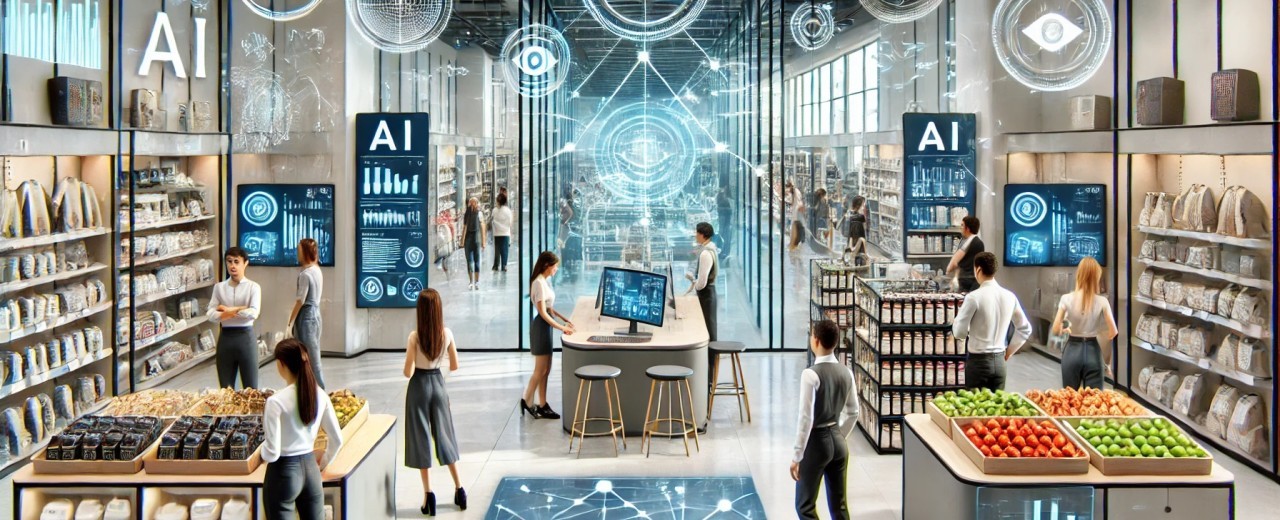
Artificial intelligence (AI) in the Physical Store.
20 things that large retailers are already doing. In the retail world, large chains are using artificial intelligence and data analytics to improve every aspect of their business. While these technologies are often out of reach for small stores, it's helpful to understand how retail giants are using innovation to stay competitive and optimize every step of their operations. This article is not intended to depress us by thinking we have no chance, but it should stimulate us to find another way to the advantage of our shop. The worst thing is often not knowing.
Chapter Summary
1 Store Layout Monitoring and Optimization
How AI can analyze customer flow and suggest layout changes to maximize efficiency and improve the shopping experience.
2 Smart Inventory Management
Use AI to predict replenishment needs, reduce waste, and prevent stock-outs by optimizing inventory management.
3 Customer Support through In-Store Chatbots
Implementation of virtual assistants in physical stores to answer customer questions and guide them to the products they are looking for.
4 Personalization of the Shopping Experience
How artificial intelligence can personalize the shopping experience of customers in real time, offering tailored recommendations and Sale based on their interests.
5 In-Store Customer Behavior Analysis
The use of smart sensors and cameras to collect data on customer behaviors within the store and improve product placement.
6 Optimization of Personnel and Work Shifts
Using AI to analyze in-store traffic and optimize staff distribution, reducing wait times and improving customer service.
7 Safety and Loss Prevention
Artificial intelligence systems to detect suspicious behavior, prevent theft, and monitor security in real time inside the store.
8 Automated Payments and Checkouts
How AI can streamline the checkout process with self-checkout solutions or automated payment systems, reducing queues and improving customer satisfaction.
9 Product Recommendations Based on In-Store Behavior
AI systems that monitor customer behavior and suggest related products in real-time, improving cross-selling and upselling.
10 Feedback Management and Service Optimization
How AI can collect and analyze customer feedback to identify areas for improvement in service and products.
11 Augmented Reality Integration for Immersive Shopping Experiences
Using artificial intelligence combined with augmented reality to offer interactive shopping experiences, such as "virtual try-on" of products.
12 Trend Forecasting and Purchasing Planning
Artificial intelligence to analyze market data and predict emerging trends, helping the physical store stay competitive and up-to-date.
13 Reduction of Waiting Times and Optimization of Queues
AI systems to manage queues and reduce waiting times dynamically, optimizing the flow of customers during peak hours.
14 Automation of Return Management
How AI can facilitate the management of returns, simplifying procedures for both customers and store staff.
15 Purchasing Preference Detection Systems
Using AI to track customer preferences during their in-store stay, offering personalized Sale directly to their apps or mobile devices.
16 Demand Forecasting and Inventory Planning
AI systems that predict peaks in demand during special events or holidays, optimizing inventory management and improving product availability.
17 Analyzing Foot Traffic Around the Store
Artificial intelligence to monitor foot traffic outside the store, optimizing opening, Sale, and marketing based on footfall.
18 Prevention of Technical Problems or Malfunctions
AI systems for proactive monitoring of store systems and equipment, predicting and preventing technical failures that could slow down operations.
19 Creating Live Data-Based Real-Time Sale
How AI can create Personalized offers and discounts based on data collected in real time on customer preferences and behaviors in the store.
20 Data Analysis for the Continuous Improvement of the Point of Sale
Artificial intelligence to collect and analyze data on an ongoing basis, allowing managers to constantly improve store efficiency and customer experience.
1. Store Layout Monitoring and Optimization
Artificial intelligence (AI) is revolutionizing the way physical stores organize and optimize the layout of the store, improving the shopping experience and increasing sales. Layout optimization is crucial because the organization of spaces directly affects customer behavior, product visibility, and ease of navigation within the store. AI, through a combination of advanced technologies such as sensors, cameras, and data analytics, provides a scientific and data-driven approach to making more informed decisions.
How AI Helps in Tracking Customer Behavior
AI uses motion sensors, smart cameras, and other technologies to monitor traffic and customer behavior within the store in real-time. Some key aspects that are monitored include:
Paths taken by customers: AI tracks customer movements, analyzing which paths are busiest and which areas of the store are avoided. This helps managers understand how customers navigate the store and which areas need improvement.
Points of interest: AI can identify where customers tend to linger the most. For example, if a product or promotion attracts a lot of customers, you can replicate that pattern in other parts of the store.
Product interaction: Smart cameras can monitor how many customers touch or pick up a product, providing useful data to understand real interest, even if the product is not purchased.
Data-driven layout optimization
Once data on customer behaviors is collected, AI uses analytical models to suggest improvements to the store's layout. Some of the common optimizations include:
Product placement: AI can suggest the optimal placement of high-turnover or higher-margin products in high-traffic areas. For example, seasonal or promotional products could be moved to the busiest areas to maximize their visibility and encourage impulse buying.
Promotion zones and hot spots: The "hot" areas of the store, where most of the traffic is concentrated, can be identified and optimized for Sale or new product launches. This allows the store to make the best use of spaces with greater visibility.
Traffic flow: Analyzing customer flow data helps design logical and fluid routes that improve navigation, reduce "bottlenecks," and encourage customers to visit more sections of the store, thereby increasing dwell time and likelihood of purchase.
Using heatmaps to visualize data
One of the most powerful applications of artificial intelligence in monitoring behavior is the use of heatmaps, visual representations that show the areas of the store with more or less traffic. Heatmaps allow you to clearly see where customers are concentrated and which sections are less attractive. This visual data is critical to:
Identify weak areas: Areas of the store that receive less traffic can be reorganized or turned into promotional areas to attract more attention.
Improve display efficiency: By placing products strategically in areas with the highest traffic, the store can improve sales and optimize space utilization.
Customize the layout according to the target customers
AI can also segment audiences based on purchasing behavior and customize the layout to better suit the preferences of target customers. For example, a store that has a young, tech-savvy customer base might favor more open, minimalist layouts, while a high-end store might create more experiential journeys focused on premium products.
Predictive analytics for events and peak attendance
AI can use predictive analytics to prepare your store for special events or busy periods, such as holidays, sales, or product launches. By monitoring historical data and external factors (such as weather conditions or local events), AI can suggest changes to the layout to better manage the flow of customers during critical times. For example, during Black Friday, AI might suggest reducing barriers to make it easier for customers to move and increasing the number of checkouts to handle the increased footfall.
Continuous monitoring and continuous improvement
Once a data-driven layout is implemented, AI continues to monitor customer behavior and can provide suggestions for continuous improvements. This cycle of monitoring and optimization ensures that the store remains dynamic and can respond quickly to changes in shopping habits or new market trends.
Key Benefits of AI-Powered Layout Optimization
Increased sales: An optimized layout based on customer behavior data leads to increased sales, positioning products in the most effective way.
Improved customer experience: Smoother navigation and well-thought-out journeys make the shopping experience more enjoyable, incentivizing customers to explore the entire store.
Increased operational efficiency: By reducing unused or underexposed areas, stores can maximize the use of space, reducing operating costs and improving overall efficiency.
Optimizing the layout of a physical store using artificial intelligence represents a strategic opportunity to improve the customer experience, increase sales, and optimize operational efficiency. By monitoring customer behavior and using data to make more informed decisions, stores can adapt in real-time to consumer needs and remain competitive in an ever-changing market.
2. Smart Inventory Management
Effective inventory management is crucial to the success of a physical store. Balancing between having enough products to meet demand and not stockpiling unsold stock is a constant challenge. Artificial intelligence (AI) is transforming inventory management through the use of predictive algorithms, automation, and advanced data analytics, enabling stores to optimize inventory, reduce costs, and improve customer service.
Accurate Demand Forecasting
One of the most powerful applications of AI in inventory management is demand forecasting. By analyzing historical sales data, seasonal trends, and external factors such as weather or local events, AI is able to accurately predict which products will be most in demand during a given period. This allows stores to plan orders accordingly, reducing the risk of:
Stockouts: AI can predict spikes in demand in advance, allowing products to be replenished in a timely manner before they run out. This is especially useful during periods of high demand such as Black Friday, holidays or sales.
Inventory overload: Similarly, AI helps to avoid excess inventory by suggesting limiting orders for products that may have declining demand, thereby reducing storage costs and the risk of having to discount unsold products.
AI forecasts are based on advanced models that take into account a wide range of variables, including past sales, market trends, product life cycles, and even external factors such as economic data and weather conditions.
Automation of Stock Reordering
Another key benefit of AI is the ability to automate the reordering process. With an AI-powered inventory management system, stores can set inventory thresholds for each product. When stocks drop below a certain level, the AI can automatically trigger reordering, without the need for human intervention. This significantly reduces manual errors and ensures that critical products are always available on the shelves.
Automating reordering not only improves operational efficiency, but also customer satisfaction, as it reduces the chances that the required products will be out of stock. In addition, AI can optimize reordering based on variables such as:
Procurement costs: AI can account for fluctuating supplier costs and order products at times when prices are lower, reducing operational costs.
Warehouse optimization: AI can manage warehouse space, avoiding over-ordering bulky products that could limit storage capacity for items that are faster to sell.
Waste Reduction
Smart inventory management is not only about avoiding stock shortages, but also about reducing waste. This is especially important for products with a limited shelf life, such as foods or fashion products that are subject to trend changes. AI can monitor the life cycle of products and suggest actions to reduce waste, such as:
Targeted Sale: When AI detects that a certain product is nearing the end of its life, it can suggest discounts or Sale to incentivize sales before it becomes obsolete or expires.
Optimized restocking: For products with a short shelf life or limited seasonality, AI can limit reordering, ensuring that there is no excess stock that could depreciate quickly.
This approach not only reduces the operational costs associated with inventory management, but also contributes to greater sustainability by minimizing waste and environmental impact.
Real-time monitoring
AI provides real-time visibility into the status of stock in every store and warehouse. Thanks to the integration of advanced sensors and monitoring systems, the system can provide continuous updates on warehouse stocks, allowing managers to make informed decisions at all times. This continuous monitoring offers several benefits:
Immediate identification of discrepancies: If there are discrepancies between recorded and actual stock, the system can report them immediately, allowing you to take early action and prevent potential losses or supply issues.
Centralized inventory management: Particularly for stores with multiple locations, AI allows for centralized inventory management, allowing you to balance stock across different stores and optimize product distribution.
Warehouse and Logistics Optimization
AI can optimize not only in-store inventory management, but also warehouse logistics. Using optimization algorithms, the system can determine how to better organize warehouse space, ensuring that the most popular products are easily accessible and reducing the time required for picking and replenishing shelves. Some of the optimizations include:
Strategic product placement: AI can analyze how often products are requested and suggest their placement in the warehouse or warehouses, reducing order preparation time.
Optimizing delivery routes: For stores that handle frequent deliveries or replenishments, AI can optimize delivery routes, reducing transportation times and fuel costs.
Reduced Operating Costs
One of the most obvious benefits of adopting AI-powered inventory management systems is the significant reduction in operational costs. Here are some ways AI contributes to this:
Fewer human errors: Automation dramatically reduces the chance of human errors in stock tracking, such as miscounting or misregistering items.
Reduced storage costs: By avoiding the accumulation of excessive inventory and optimizing procurement, AI allows you to reduce costs related to warehouse space and transportation.
Minimizing forced discounts: By predicting demand and acting proactively, the store reduces the need for drastic discounts to free up space from unsold products.
Integration with other Management Systems
An added benefit of AI-powered inventory management systems is their ability to integrate with other management systems, such as order management, logistics, and sales systems. This creates an integrated ecosystem that allows store managers to have a global and accurate view of all operations. The integration allows for smooth and seamless management of the entire supply chain, from demand forecasting to order fulfillment.
Intelligent inventory management through artificial intelligence brings significant benefits in terms of efficiency, cost reduction, and improved customer service. Through accurate forecasting, reorder automation, waste reduction, and real-time monitoring, AI enables stores to remain competitive in an increasingly dynamic and unpredictable market. Adopting these advanced technologies means ensuring that the right products are available at the right time, improving customer satisfaction and optimizing operations.
3. Customer Support through In-Store Chatbots
The implementation of artificial intelligence (AI)-powered chatbots within physical stores is one of the most exciting innovations in customer service management. In-store chatbots improve the shopping experience by providing customers with instant information, Personalized advice, and quick answers to their questions, reducing staff workload and improving operational efficiency.
What are in-store chatbots?
Chatbots are AI-powered virtual assistants designed to interact with customers through natural language, simulating human conversations. In physical stores, chatbots can be integrated into different platforms:
Interactive totems: Installed in various points of the store, they allow customers to search for information on products, find Sale or get purchase advice.
Mobile: Customers can interact with the chatbot via their smartphone, using store-specific apps, or scanning QR codes that link them directly to the virtual assistance service.
Self-service kiosks: These devices allow customers to perform tasks on their own, such as searching for products or completing purchases.
These chatbots work through the use of artificial intelligence and machine learning algorithms, which analyze user questions and provide relevant answers in real-time, constantly improving their learning and adaptation capabilities.
Benefits of using in-store chatbots
The introduction of chatbots in physical stores has several advantages, both for customers and for store managers.
Immediate and ongoing support Chatbots can provide immediate, 24/7 assistance, eliminating the wait times that often occur when requesting help from human staff. Customers can get quick answers to frequently asked questions, such as:
Where a specific product is located in the store.
Details on offers and Sale.
Information on the technical characteristics of the products.
Advice on which products to buy based on their preferences or needs.
Reduced staff workload In physical stores, especially during peak footfall, staff can be overloaded with demands. Chatbots make it possible to alleviate some of this burden by automatically answering common questions and leaving staff to manage more complex tasks, such as personalized advice or solving specific problems.
Personalization of the customer experience Thanks to artificial intelligence, chatbots can offer a highly personalized experience. By analyzing data about the customer's previous purchases, preferences, and previous interactions, the chatbot can provide tailored suggestions. For example, if a customer has purchased a certain type of product, the chatbot might recommend related accessories or discounts on complementary products.
Ease of browsing and product research In large stores, finding a specific product can be difficult. Chatbots can guide customers to the exact location of items within the store. Some advanced chatbots can also provide interactive maps of the store, helping customers find their way around more efficiently and quickly find what they need.
Real-time Sale and offers Chatbots can be programmed to inform customers about current Sale or new offers as soon as they enter the store. These alerts can be Personalized based on the customer's previous behaviors, ensuring that the offers are relevant and attractive. For example, a customer who has purchased sports shoes might receive suggestions for discounts on related clothing or accessories.
Immediate feedback and service improvement Chatbots can collect feedback from customers discreetly and immediately. After completing a transaction or obtaining support, customers may be invited to rate the service they received or provide suggestions. This allows the store to constantly improve its service, monitoring customer satisfaction in real time.
Types of in-store chatbots
There are different types of chatbots that can be implemented in physical stores, each of which offers specific functionality:
Product Research Chatbots These chatbots are designed to help customers find products in the store. They analyze the customer's requests and provide a detailed response, indicating the department or shelf where the product is located. Some systems can even provide a guided tour inside the store, using an interactive map.
Chatbots for technical support In stores that sell complex or technological products, chatbots can offer real-time technical support, providing answers to common questions or technical details about products. For example, in an electronics store, the chatbot could help customers choose the right smartphone model according to their needs or compare the technical specifications of different models.
Order Management Chatbots These chatbots can help customers check the status of an online order or manage the pickup of previously placed orders. For example, in a store with a "click and collect" option, the chatbot can guide the customer through the product pickup process, reducing wait times and improving operational efficiency.
Chatbots for personalized Sale and offers Some chatbots are designed to manage special offers and Sale. They can send notifications to customers when there are new Sale available or suggest special offers based on previous purchases. For example, a customer who has purchased a certain type of product in the past might receive a promotion on a related product as soon as they enter the store.
Integration with other technologies
The effectiveness of in-store chatbots increases when they are integrated with other technologies, such as speech recognition, augmented reality (AR), and indoor location. Some examples of integrations include:
Speech recognition: Chatbots can be activated via voice commands, allowing customers to ask questions without having to type, further simplifying interaction.
Augmented reality (AR): In combination with augmented reality, chatbots can provide additional information about products when the customer frames them with their smartphone, such as reviews, technical specifications, or suggestions for related items.
Beacons and indoor location: Using Bluetooth beacons, chatbots can provide contextual information based on the customer's exact location within the store, further improving the personalization and relevance of recommendations.
Examples of using in-store chatbots
Some concrete examples of using in-store chatbots include:
Walmart: The supermarket chain has been testing chatbots in its stores to provide customers with quick assistance in finding products and managing online orders.
Sephora: Uses chatbots both online and in-store to offer Personalized beauty product recommendations based on customers' preferences and previous purchases.
Decathlon: The sporting goods store chain has integrated chatbots into its interactive kiosks to help customers find products and receive suggestions Personalized.
Challenges and limitations of in-store chatbots
Despite the many benefits, there are some challenges to using in-store chatbots:
Understanding complex questions: While AI can understand simple or frequently asked questions, it may struggle to answer complex or overly specific questions.
Customer acceptance: Some customers may prefer to interact with human staff, especially in settings that require personalized assistance or in-depth advice.
In-store chatbots are an innovative solution to improve customer service in physical stores. With their ability to provide quick responses, personalize the experience, and reduce wait times, they help create a smoother and more satisfying shopping experience. Integrated with other advanced technologies, such as augmented reality and indoor localization, chatbots can become a critical component for stores that want to offer high-quality service and remain competitive in an increasingly digitized market.
4. Personalization of the Shopping Experience
One of the main goals of every physical store is to create a unique and personalized shopping experience for its customers. With artificial intelligence (AI), stores can deliver highly personalized experiences that go beyond standard interactions. AI analyzes customer data to provide tailored suggestions, targeted Sale, and a service that adapts to individual needs, thereby increasing customer satisfaction and the likelihood of conversion.
What is personalization of the shopping experience with AI?
Personalization of the shopping experience involves adapting the interaction with each customer based on their behaviors, preferences, and historical data. Artificial intelligence makes this process possible through the use of data analysis techniques, machine learning and predictive models. AI processes vast amounts of information, such as past purchases, in-store behavior, and online interactions, to anticipate customer needs and provide targeted solutions.
AI can be integrated into different stages of the customer experience, from the moment they enter the store through to the after-sales service. This allows you to create a seamless and personal buying journey that increases customer engagement and improves sales.
How AI personalizes the shopping experience
Customer data analytics AI leverages data collected from different sources, such as loyalty programs, purchase history, and online interactions, to create a detailed customer profile. This profile may include:
Previous purchases: What has the customer bought in the past? Which product categories do you prefer? This data can be used to suggest related items or new arrivals.
In-store behavior: AI can track the customer's journey through the store, identifying which sections they visit most often and which products they view, allowing the store to adjust its offering accordingly.
Buying preferences: AI can detect whether a customer prefers certain brands, colors, or price points, and use this information to offer more precise recommendations.
Product Recommendations Personalized Based on the data collected, AI can provide Personalized suggestions in real-time, improving the shopping experience. For example:
Complementary products: If a customer purchases a certain item, the AI can suggest accessories or related products that could complement the purchase. If a customer is buying a pair of shoes, the AI could suggest socks or shoe care products.
New arrivals: AI can send notifications about new arrivals in the store that match the customer's preferences, anticipating their interests and making the experience more engaging.
Tailor-made Sale: Thanks to the data collected, the store can send personalized offers directly to the customer, both during their visit to the store and through after-sales messages. For example, a customer who frequently visits the sportswear section may receive a discount on items in that category.
Built-in omnichannel experience AI also allows you to create a seamless omnichannel experience that bridges the physical and digital worlds. For example, a customer who has browsed the store's website may receive targeted product recommendations when they physically visit the store. AI can:
Connect online and offline business: If a customer searched for a product online but didn't buy it, the AI can suggest that product or similar items when the customer enters the store.
Save the cart from one device to another: If a customer has added items to an online cart, they can receive a reminder about those items when they visit the physical store, thus encouraging the purchase.
Recognition of VIP or recurring customers AI can recognize VIP customers or those who make recurring purchases and offer them priority service. For example, a customer who regularly spends in a certain category might receive exclusive Sale or invitations to special events. Some of the technologies used include:
Facial recognition: If the customer has consented, the AI can use facial recognition to identify them when they enter the store, allowing staff to offer a highly personalized service.
Advanced loyalty programs: AI can monitor loyalty program members' shopping habits and offer personalized rewards or discounts based on their spending patterns.
Proactive messages and real-time recommendations During the store visit, AI can provide proactive recommendations in real-time via apps or mobile devices. For example, a customer who is browsing a certain section of the store might receive notifications about discounts or current offers for the products they viewed. This type of personalization creates a more dynamic and stimulating shopping experience.
Assisted navigation and product search In large stores, AI can assist customers in finding products and navigating the retail space. Using interactive kiosks or smartphone apps, AI can guide customers to the correct section or provide a map of the store. Not only does this improve the efficiency of the buying journey, but it also reduces the time wasted searching for items.
Technologies used for personalization
To offer this type of advanced personalization, artificial intelligence uses several technologies:
Machine Learning Machine learning algorithms analyze customer data to identify patterns of behavior and preferences. These algorithms become more and more accurate as they receive more data, improving AI's ability to predict what the customer wants.
Natural Language Processing AI uses natural language processing techniques to understand and respond to customer requests. This allows chatbots and virtual assistants to interact with customers in a natural way, understanding their queries and providing relevant answers.
Augmented reality (AR) AR allows customers to virtually "try on" products. For example, in clothing stores, AR can be used to show how a garment would look worn, or in furniture stores, AI can help customers visualize how furniture would look in their homes.
Beacons and indoor location Bluetooth beacons or other location technologies can identify a customer's exact location within the store. This allows the AI to provide contextual notifications and location-based suggestions, such as section-specific Sale or nearby product recommendations.
Examples of using AI personalization
Amazon Go In Amazon Go stores, artificial intelligence plays a key role in the personalized shopping experience. Customers can take items off the shelves and leave the store without going to the checkout, as the AI tracks purchases and charges them automatically. In addition, AI can suggest items based on past purchases.
Nike Nike uses personalization to offer a unique shopping experience both online and in physical stores. Using customer data, the AI suggests Personalized products based on style and performance preferences, as well as offering exclusive Sale for loyalty program members.
Zara Zara has introduced an augmented reality tool in some stores that allows customers to view models wearing the clothes displayed in the store, providing an immersive and personalized experience.
Challenges of personalizing the customer experience
While AI-powered personalization offers numerous benefits, it also comes with some challenges:
Privacy and personal data: To effectively personalize the experience, AI must collect and analyze a large amount of personal data. This can raise privacy concerns, especially if customers are unaware of how their data is being used.
Accuracy of recommendations: While AI is constantly improving, there may be situations where recommendations are not accurate or relevant, reducing the effectiveness of personalization.
Customer acceptance: Some customers may feel uncomfortable receiving a highly personalized experience, or they may prefer a less automated and more human interaction.
Personalization of the shopping experience through artificial intelligence is one of the most powerful tools available to physical stores to create a deeper connection with customers, increase loyalty and improve sales. By using accurate data and advanced technology, stores can offer tailored experiences that make shopping more enjoyable, efficient, and engaging. While there are challenges to be faced, the adoption of these technologies presents a great opportunity for stores to remain competitive and relevant in an increasingly digital world.
5. In-Store Customer Behavior Analysis
Analyzing customer behavior within a physical store has become one of the most advanced areas of application of artificial intelligence (AI). This technology allows stores to monitor how customers interact with the physical space, which products attract their attention the most, and how they navigate between different areas of the store. The data collected can be used to optimize the layout of the store, improve the shopping experience, and increase sales. In this chapter, we'll dive deeper into how AI is used to monitor and analyze in-store customer behavior and the benefits that come with it.
How does AI customer behavior analysis work?
AI uses a combination of sensors, cameras, and analytics technologies to collect data on customer behavior within the store. This data is processed by AI and machine learning algorithms to provide detailed insights into:
Navigation paths: How customers move around the store.
Points of interest: Which sections of the store attract the most customers and where they linger the most.
Product interaction: Which products are picked up, examined, or discarded, even without being purchased.
Dwell time: How much time a customer spends in a certain area or interacting with a product.
Analyzing this data provides valuable insights to store managers, allowing them to make changes based on real-world customer behaviors.
Key technologies for in-store behavior analysis
Computer Vision and Smart Cameras Smart cameras are one of the leading technologies for monitoring customer behavior. Strategically placed in the store, these cameras use computer vision algorithms to track customers' movements and identify the products they interact with. Unlike traditional security cameras, these cameras don't just surveil, they collect anonymous data about behaviors, such as:
The time spent in a specific area.
The products that are examined or picked up.
The directions and paths preferred by customers within the store.
Motion Sensors and Beacons Motion sensors and beacons are another technology used to monitor customers' movements. These devices track traffic within the store and can also interact with customers' smartphones, if they have activated Bluetooth or the store app. With beacons, you can detect a customer's exact location and send personalized notifications in real time (such as Sale or product suggestions), based on where they are or what products they are viewing.
Heatmaps One of the most powerful visualizations of in-store behavior analysis is the use of heatmaps, which graphically show the areas of the store with the most or least traffic. Heatmaps allow managers to view:
The "hot" areas of the store, where most of the traffic is concentrated.
Less frequented areas, which may require redesign or promotion to attract more attention.
The sections where customers tend to linger the most, providing indications on the products that attract the most interest.
Heatmaps provide an easy-to-understand visual representation and are used to optimize store layout, improve product ranking, and increase visibility of strategic items.
RFID (Radio Frequency Identification) RFID tags can be applied to products to track which items are touched, picked up, or placed on shelves without being purchased. This data can provide useful information about the products that generate interest, but not enough to be purchased, allowing managers to make strategic decisions, such as changing prices or position.
Benefits of In-Store Customer Behavior Analysis
Store layout optimization Customer behavior analysis allows you to optimize product layout and store layout. For example:
If an area of the store has little traffic, managers can rearrange the space or place more attractive products in that section.
If a particular section of the store is heavily attended, you can add Sale or strategic items to maximize sales.
AI also provides insights into the best positioning for seasonal or promotional products, maximizing their exposure in high-traffic areas.
Increased sales and cross-selling Customer behavior analysis helps stores identify opportunities for cross-selling and up-selling. For example, if the AI detects that many customers who buy a certain product tend to visit a related section as well, it can suggest that the store place those products close together or create combined Sale to incentivize the purchase of both. This approach not only increases the value of the medio cart, but also improves the customer experience, who finds complementary products more easily.
Real-time experience personalization With the use of sensors and beacons, AI can personalize the customer experience in real-time. For example, if a customer lingers in a certain section for a long time, the system could send them an app notification with a special discount for the products displayed. This type of dynamic interaction not only incentivizes purchase, but makes the shopping experience more engaging and personalized.
Efficient staff management Analyzing customer behavior not only improves layout and sales, but also helps optimize staff management. The data collected can be used to identify the busiest times and better distribute human resources:
If the AI detects that there is high traffic at certain times or areas of the store, the store can assign more staff to those areas or times.
Conversely, at times of low turnout, staff can be redeployed to optimize operational efficiency.
Improving merchandising and Sale AI helps monitor how customers interact with the products on display, offering valuable insights for merchandising improvement. If the AI detects that a certain product receives a lot of attention but few sales, the store can assess whether the problem is with the price, location, or effectiveness of the promotion. This allows you to quickly correct sales strategies and maximize results.
Concrete examples of in-store customer behavior analysis
Nike Nike has implemented RFID technology in its stores to monitor customer behavior with products. With the data collected, Nike can optimize the placement of items and suggest complementary or similar products based on customer preferences. In addition, the data is used to personalize Sale and improve the assortment in stores.
Walmart Walmart uses smart cameras and AI-powered analytics to monitor customer behavior in its supermarkets. AI-generated heatmaps show which sections of the store receive the most traffic and how customers interact with various products. Walmart uses this data to improve the layout and placement of goods.
Sephora Sephora uses artificial intelligence to monitor how customers navigate the store and which products capture their attention. Using beacons and sensors, Sephora sends personalized Sale directly to customers' mobile devices, based on their in-store behaviors and previous purchases.
Ethical challenges and considerations
While AI customer behavior analysis offers numerous benefits, there are some ethical challenges and considerations that stores need to keep in mind:
Data privacy: The collection of customer behavior data must comply with privacy regulations and obtain informed consent. It's important for customers to know what data is being collected and how it will be used.
Interpretation of data: The analysis of the data collected must be accurate and contextualized. It's easy to fall into misinterpretation if data isn't analyzed correctly or if critical information is missing.
Customer acceptance: Some customers may be skeptical or uncomfortable knowing that their movements are being tracked. It is essential to ensure transparency and give customers the choice of whether to participate in these monitoring initiatives.
Analyzing in-store customer behavior using artificial intelligence represents a significant opportunity for brick-and-mortar stores to optimize layout, improve customer experience, and increase sales. By using technologies such as computer vision, motion sensors, and heatmaps, stores can make decisions based on hard data and real-world behaviors, ensuring that retail space is used as efficiently as possible. While there are challenges to be addressed, the benefits offered by AI in monitoring customer behavior far outweigh the risks, allowing stores to remain competitive and innovative in the modern marketplace.
6. Optimization of Personnel and Work Shifts
Optimizing staff is key to ensuring high-quality service and improving operational efficiency in a physical store. Artificial intelligence (AI) has revolutionized this, providing advanced tools to predict labor demand, optimize shifts, and distribute staff at the right times and in the right areas of the store. With predictive models and data analytics, AI can improve productivity, reduce operational costs, and ensure that customers receive the attention they need at all times.
Why is it important to optimize staff?
Properly managing staff is essential for the success of a store. Adequate staff in number and expertise ensures that customers receive prompt assistance, reducing wait times and improving their overall experience. However, ineffective personnel management can lead to:
Undersizing shifts: Few employees can create long queues, slow customer service, and a negative visitor experience.
Oversized shifts: Too many employees during periods of low attendance increase operating costs without a real return in terms of sales or productivity.
AI helps to strike the right balance, ensuring that staff are optimally utilised, with the right number of employees assigned at the most appropriate times and places.
How does artificial intelligence optimize personnel management?
Artificial intelligence uses historical data analysis, predictive models, and machine learning to optimize personnel management. Let's see the main aspects of how this happens:
Forecasting Labor Demand AI can predict spikes in store footfall based on a number of variables, such as:
Historical sales data: AI analyzes past sales to identify periods of higher or lower footfall, helping to understand when more or less staff is needed.
External conditions: AI may consider external factors such as weather conditions, local events, or holidays, which can affect in-store traffic. For example, during a rainy day, a clothing store may see an increase in purchases of raincoats or accessories.
Sale and sales: If there are any Sale or discounts, the AI can predict an increase in customer traffic and suggest increasing the number of employees for that period.
With these predictions, AI can generate shifts that better fit real-world demand, reducing periods of oversizing or undersizing staff.
Shift optimization One of the biggest challenges in personnel management is shift planning. Traditionally, planning is based on subjective decisions or incomplete data, leading to inefficiencies. Artificial intelligence automates this process, creating optimized schedules that take into account:
Staff availability: AI can create shifts based on employees' reported availability, respecting their preferences, days off, and labor laws.
Store needs: AI adapts shifts to the specific needs of the store based on peak times, such as opening hours, weekends, or busy periods.
Work-to-rest balance: AI ensures that employees have balanced shifts, adhering to rest regulations and reducing the chance of burnout.
This automated scheduling not only improves efficiency but also ensures that employees are satisfied with their scheduling, improving productivity and morale.
Dynamic staff distribution Artificial intelligence not only optimizes shifts, but also helps manage the dynamic distribution of staff within the store. With real-time analysis of customer flow, AI can suggest where and when to assign more employees based on specific needs:
Busy areas: If one area of the store is receiving a higher volume of customers than others, the AI can alert the manager to redeploy staff, to ensure that customers receive the attention they need.
Checkout management: AI can monitor traffic at checkouts and flag the need to open new checkout stations to avoid long queues. This dynamic distribution reduces wait times and improves store efficiency.
Customer support: During busy periods, such as sales or holidays, AI can suggest increasing the presence of qualified staff to provide customer service, improving the shopping experience.
Reduced operational costs By optimizing shifts and staff distribution, AI reduces the operational costs associated with workforce management. With AI, stores can:
Avoid oversizing: By reducing the number of employees during periods of low turnout, the store avoids paying unnecessary wages, keeping the workforce proportionate to demand.
Minimize undersizing: By accurately forecasting demand, AI ensures that the store always has enough staff to avoid queues, customer dissatisfaction, and lost sales.
Performance monitoring and staff analytics AI can also monitor staff performance in real-time, providing insights into how to improve productivity. Some of the performance indicators monitored by AI include:
Speed of service: AI can analyze how quickly employees complete transactions or serve customers, identifying any areas where staff may need training or support.
Customer interaction: AI can monitor the quality of interactions between employees and customers, suggesting opportunities for improvement or recognizing employees who excel in customer service.
This data allows managers to make informed decisions about how to improve staff effectiveness by identifying any gaps and providing personalized support.
Automation of shift management Another great benefit of AI is the ability to automate shift management, making managers' lives much easier. AI algorithms can automatically create weekly shifts, taking into account all the previously mentioned variables, such as:
Personal preferences of employees.
Legal restrictions on working and rest times.
Store Operational Needs.
Automated shift management reduces human error and ensures that the workforce is always optimally distributed.
Benefits of AI Workforce Optimization
Improve the customer experience With the right staff distribution at busy times, customers receive timely, high-quality support. Waiting times are reduced, customers easily find the support they need, and this translates into a more satisfying and engaging shopping experience.
Increased productivity AI allows you to optimize shifts so that employees are always used to their full capacity. Thanks to the dynamic redistribution of staff, the store can operate more smoothly, with resources allocated to the right areas and at the right times.
Increased employee satisfaction Fairer, data-driven shift planning leads to higher staff satisfaction. Employees who work in optimal conditions, without being overworked or underutilized, are more likely to be motivated and productive. In addition, transparency and fairness in the distribution of shifts help to create a positive work environment.
Reduced operating costs By optimizing staffing, stores can significantly reduce operating costs, using resources only when needed and reducing wasted labor. This leads to more efficient budget management and improved operational sustainability.
Examples of application of AI in personnel optimization
Zara Zara uses artificial intelligence to optimize shift planning in its stores. By analyzing historical data and predicting customer footfall, AI ensures that there are always enough employees during peak times, reducing costs during quieter periods.
Walmart Walmart implemented an AI-powered personnel management system to optimize the distribution of employees across departments based on customer traffic patterns. The system helps to better manage peak footfall, ensuring that critical areas are always manned and improving overall efficiency.
Sephora Sephora uses AI to monitor employee performance and optimize employee distribution across different sections of the store. This allows the brand to provide a high-quality service, especially during Sale or special events.
Challenges in Implementing AI in People Management
While AI offers numerous benefits, there are some challenges to be faced in implementation:
Resistance to change: Some employees may feel uncomfortable with the idea of an algorithm determining their shifts or tracking their performance. It is important to educate and raise awareness among staff about the benefits of these technologies.
Personal data management: AI requires the processing of personal data, such as shift preferences and job performance. It is essential to comply with privacy regulations and ensure that data is treated securely.
Staff optimization via artificial intelligence is a powerful tool that improves both store operational efficiency and customer satisfaction. With AI's ability to predict demand, dynamically manage shifts, and redeploy staff in real-time, stores can operate more smoothly and productively, reducing costs and improving the overall customer experience. While there are some challenges to be addressed, implementing these technologies presents an opportunity to modernize people management and ensure a competitive advantage in the retail market.
7. Security and Loss Prevention
Security and loss prevention are crucial aspects for any physical store. Every year, theft and fraud are one of the leading causes of lost profit in the retail industry. However, thanks to the advancement of artificial intelligence (AI), loss prevention and security management within physical stores have undergone a radical transformation. AI can monitor suspicious behavior in real-time, identify potential theft, and provide advanced tools to improve the overall security of the store.
Why is safety and loss prevention crucial for a store?
Every store is vulnerable to a variety of security risks, including customer theft (shoplifting), internal fraud, product tampering, and external criminal activity. These issues can not only reduce profits but also damage the store's reputation and customer trust. AI technologies offer a proactive, automated approach to reducing these risks by providing advanced monitoring tools that allow you to spot suspicious behavior in real time and take timely action.
How AI Improves Safety and Loss Prevention
Real-time monitoring through smart cameras Smart cameras, powered by artificial intelligence, are one of the most effective technologies for monitoring security within a store. These systems don't just record images, they use computer vision algorithms to analyze people's behavior in real-time. Some key features include:
Detecting suspicious behavior: AI can identify anomalous actions that could indicate potential theft, such as fast movements, repeated interactions with the same product, hiding items, or leaving the store without going through the checkout.
Real-time alerts: When suspicious behavior is detected, AI can send immediate alerts to security personnel or store manager, allowing them to take timely action before theft occurs.
This type of proactive monitoring helps reduce in-store theft (shoplifting) and ensures that staff are informed in real-time, improving overall security.
Facial recognition and blacklisting of individuals Another advanced tool that AI makes available is facial recognition. This technology makes it possible to identify in real time individuals who have previously been flagged as potential threats, such as:
Customers who have committed theft in the past: The system can compare the faces of people in the store with a blacklist of individuals already known to have committed crimes or attempted to steal.
Suspicious people: AI can analyze the faces of people who exhibit suspicious behavior and compare them to internal or external security databases.
While facial recognition is a powerful technology for improving security, its use requires careful privacy management and compliance with current regulations on the protection of personal data.
Predictive Analytics for Loss Prevention AI can use predictive analytics models to prevent losses before they occur. By analyzing historical data on in-store losses, sales, and behaviors, AI can identify recurring patterns and provide predictions about when and where theft attempts or fraudulent activity might occur. For example:
Theft during peak footfall: AI can detect that thefts are more likely to occur during busy periods when staff are busy serving many customers. In this case, the system may suggest increasing surveillance or staff presence at certain times or days.
Internal fraud: AI can identify suspicious behavior by staff, such as unauthorized changes to cash registers or unauthorized access to restricted areas.
With predictive analytics, stores can take targeted preventative measures to reduce losses and improve safety.
Prevention of theft at checkouts Artificial intelligence can also be used to monitor transactions at checkouts and prevent payment-related fraud. Some examples include:
Suspicious transaction monitoring: AI can analyze transactions in real-time to identify anomalies, such as suspicious item cancellations or incorrectly applied discounts. If it detects abnormal behavior, it can alert the manager or security personnel.
Automated item verification: In self-checkout systems, AI can compare the weight of scanned items to the actual weight to ensure that customers aren't trying to defraud the system by passing items without paying for them or substituting higher-priced products for cheaper ones.
This will allow you to