From origins to style icons
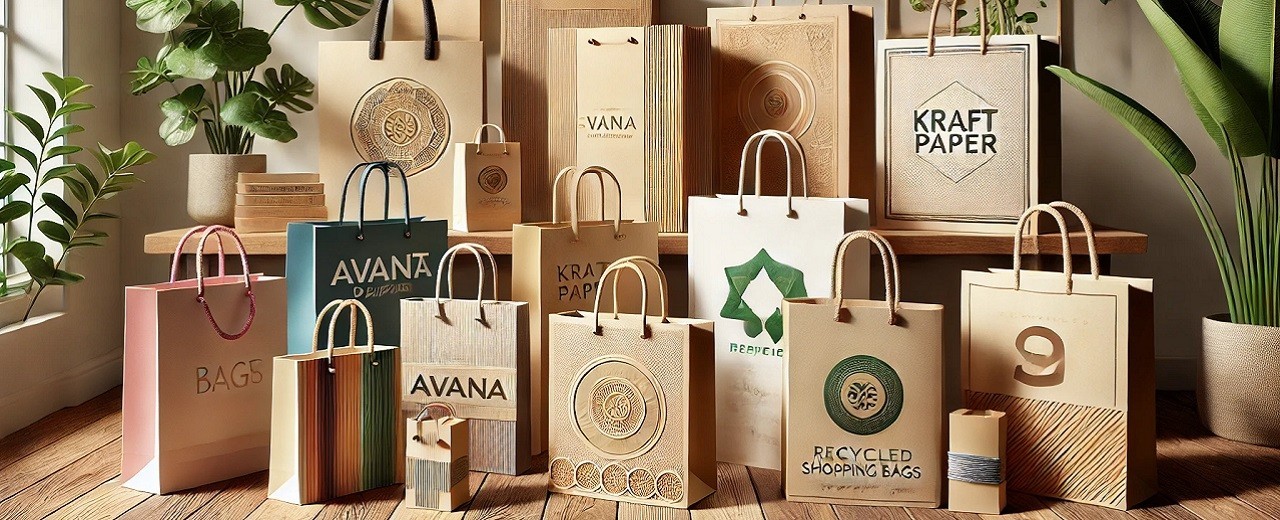
The history of shopping bags has its roots in the early twentieth century, when the first machines for automatic production were introduced. These paper bags began to spread as a cheap and sustainable alternative to cloth and plastic bags, offering practicality and convenience. In recent decades, the growing interest in sustainability has led many companies to prefer recyclable or eco-sustainable materials, reducing the use of single-use plastics and marking an important step towards more responsible packaging.
At the same time, the evolution of marketing has transformed shopping bags into essential branding tools. Logos, corporate colors and Personalized messages have become fundamental elements to distinguish a brand and communicate its visual identity. Today, shopping bags represent a symbol of style, sustainability and quality.
Shopper and branding: an essential link
Every detail of a shopper – from design to material – communicates a specific message to the consumer. Eye-catching colors and graphics, strategic logo placement, and the use of biodegradable or recycled materials are all elements that strengthen the brand identity and create added value.
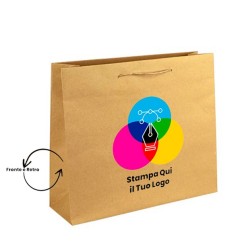
For example, luxury brands use high-quality shopping bags, enriched with fine materials such as laminated paper, hot stamping and refined rope handles. These details not only convey exclusivity, but also reinforce the association between the brand and the perceived quality.
Manual or automatic: two worlds compared
Shopping bags are divided into two main production categories: manual and automatic. This distinction not only affects the production process, but also affects the perception of the product.
Manual shopping bags
Made with craftsmanship, manual shopping bags are synonymous with quality and attention to detail. They can be customized with fine printing techniques such as screen printing and hot stamping, making them perfect for boutiques, luxury brands and bespoke projects. However, the higher costs and longer production times make them mainly suitable for short runs.
Automatic shopping bags
Automatic shopping bags, produced with high-speed machinery, offer a balance between efficiency and low costs. These bags are ideal for retail chains and large retailers, thanks to the possibility of customization with techniques such as flexographic or digital printing. Although they are less exclusive than manuals, they guarantee uniformity and resistance, meeting the needs of high volumes.
Materials and technologies: the heart of shopping bags
The choice of material is crucial to determine the aesthetic appearance, functionality and sustainability of the shopping bag. Among the most common materials we find:
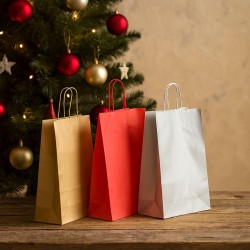
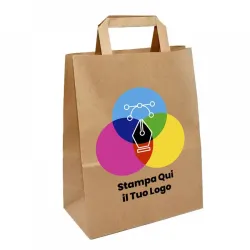
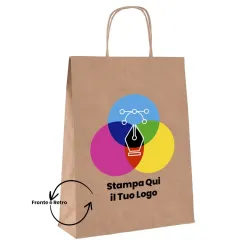
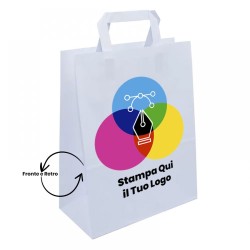
White and Havana kraft paper
-
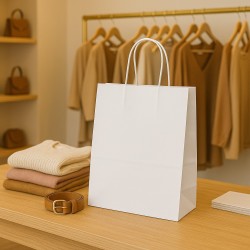
White Kraft: Stylish and versatile, ideal for detailed prints and vibrant colors.
-
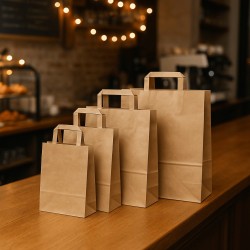
Havana Kraft: Natural and resistant, perfect for communicating craftsmanship and sustainability.
Pulp-dyed paper
A premium material that guarantees uniform color and resistance, avoiding signs of wear. Ideal for high-end shopping bags.
Recycled paper
A symbol of sustainability, recycled paper reduces the consumption of natural resources. Although it has a less uniform texture, it is appreciated for its authentic appearance.
Protective laminations
The shopping bags can be enriched with glossy or matte laminations that improve the aesthetic appearance and protect against humidity. Eco-friendly laminations are an increasingly popular choice.
Handles: a strategic element
Handles influence the aesthetics and functionality of shoppers. The main types include:
-
Rope: Natural or synthetic material for a premium look.
-
Twisted: Economical and recyclable, ideal for large volumes.
-
Flat Plate: Sturdy and comfortable, perfect for heavy items.
Customization techniques
Personalization techniques are one of the key elements in enhancing shoppers, transforming them into communication and branding tools. These techniques are linked to printing systems, which are essential to guarantee a high quality result.
Printing systems: technologies and operational details
Printing systems are at the heart of the shopper personalisation process. There are a number of different printing technologies, each with its own unique characteristics, benefits and associated costs. Let's see in detail:
Flexographic printing
Flexigraphic printing is ideal for large print runs, due to its speed and cost-effectiveness.
-
Features: Uses engraved flexible cylinders to transfer ink onto paper.
-
Advantages: Perfect for repetitive patterns and simple graphics; it guarantees excellent resistance over time.
-
Costs: Initial implants may be more expensive, but they are amortized by high volumes.
Offset printing
This technique is known for its accuracy and superior color quality.
-
Features: Uses rigid plates to transfer the image with great accuracy.
-
Benefits: Ideal for detailed graphics and rich colors.
-
Costs: It requires more expensive systems than flexography, but is suitable for medium runs.
Digital printing
Perfect for short runs and dynamic customisation, digital printing is a versatile technology.
-
Features: It does not require initial installations, allowing a quick start of the process.
-
Benefits: Allows you to customize each unit with unique graphics, adapting to creative or targeted marketing projects.
-
Costs: Higher per unit than other techniques, but cost-effective for small quantities.
Screen printing
This technique is particularly suitable for tactile and decorative effects.
-
Features: Uses silk looms or synthetic materials to apply thick, opaque inks.
-
Advantages: It guarantees results with a strong visual impact, ideal for luxury shoppers.
-
Costs: High for small runs, but justified by the quality obtained.
Hot stamping
Hot stamping gives a touch of exclusivity, thanks to the use of metal films applied with pressure and heat.
-
Features: Ideal for gold, silver or glossy details.
-
Advantages: Gives shopping bags a refined and luxurious look.
-
Costs: Higher than other techniques, but perfect for limited runs and high-end products.
Cost and benefit considerations
The choice of printing technique and equipment depends on several factors:
-
Production volume: Long runs favor techniques such as flexography and offset, while small quantities benefit from digital printing.
-
Desired quality: Luxury shopping bags require techniques such as hot stamping or screen printing for a distinctive look.
-
Available budget: Digital technologies offer flexible solutions for those with budget constraints on short runs, while the initial costs of offset or flexographic systems are justified by large volumes.
Practical applications
The printing systems allow you to create unique shopping bags, adaptable to every market need. From company logos to promotional campaigns, every technique can be chosen to enhance brand identity and improve the customer experience. As technologies evolve, it is now possible to combine multiple methods to achieve extraordinary and innovative results.
Printing and decoration techniques transform a shopper into a distinctive element. Some of the most common options include:
-
Flexography: Ideal for large runs, it uses eco-friendly inks.
-
Offset: Perfect for detailed graphics, offers premium quality.
-
Digital: Suitable for limited runs, allows dynamic customizations.
-
Screen printing: It guarantees unique tactile effects and the use of special inks.
-
Hot stamping: Gives a touch of luxury with metallic finishes.
Printing systems: technologies and costs
Printing systems are at the heart of the personalisation process, allowing logos, graphics and distinctive messages to be added to shoppers. Key technologies include:
Flexographic printing
Flexography is the most widely used technique for large volumes, due to its speed and cost-effectiveness.
-
Features: Uses flexible cylinders and water-based inks.
-
Applications: Ideal for simple graphics and repetitive patterns.
-
Costs: Economical systems for high runs; Perfect for orders over 5,000 units.
Offset printing
Offset offers superior quality, suitable for complex graphics and rich colors.
-
Features: Rigid implants with high color accuracy.
-
Applications: Perfect for medium runs (1,000-5,000 units).
-
Costs: Higher than flexography, but with high-quality results.
Digital printing
Digital printing is ideal for short runs and dynamic customizations.
-
Features: No implants required, reducing start-up time.
-
Applications: Perfect for one-off projects and prototypes.
-
Costs: Higher per unit, but affordable for limited orders.
Screen printing
Screen printing allows for unique tactile and decorative effects.
-
Features: Ideal for visually striking details.
-
Applications: Luxury shopping bags and artistic customizations.
-
Costs: High, suitable for small and medium runs.
Hot stamping
The hot stamping adds a luxurious touch with metallic finishes.
-
Characteristics: Uses decorative films applied with pressure and heat.
-
Applications: Perfect for exclusive details.
-
Costs: Higher, but ideal for premium shoppers.
Innovations and the future
The shopping bag industry is constantly evolving, driven by advanced technologies and sustainable solutions. Among the most relevant innovations we can include:
-
Advanced digital printing: Thanks to technological advancements, it is now possible to use eco-friendly inks that offer a wider color gamut and higher quality. Digital printing also allows for dynamic customizations, such as names, unique graphics, and individualized QR codes, making it a perfect fit for targeted marketing campaigns.
-
Dynamic personalization technologies: Some intelligent systems allow elements such as RFID and NFC chips to be integrated into shopping bags, improving interaction with consumers. For example, a customer can scan a QR code on the shopper to access exclusive content or information about the product they purchased.
-
Compostable and biodegradable materials: Research into materials has led to the development of treated papers to ensure biodegradability without sacrificing aesthetic and structural quality. These innovative materials respond to the growing demand for sustainable packaging.
-
Blockchain and traceability: The use of blockchain to monitor the production chain ensures transparency and sustainability. Consumers can verify the origin of materials and production processes simply by scanning a code integrated into the shopping bag.
-
Multifunctional designs: Some shopping bags are designed to be reused in different contexts, such as shopping bags or containers for personal items, extending their useful life and reducing their environmental impact.
These innovations not only improve the customer experience, but also allow brands to stand out in an increasingly competitive and sustainability-conscious market.
The shopping bag industry is constantly evolving, thanks to sustainable and technological innovations. Among the most relevant innovations we find:
-
Compostable materials: Paper treated to ensure biodegradability.
-
Smart technologies: QR code and blockchain for traceability and interactivity.
-
Multifunctional shopping bags: Innovative designs that enhance the customer experience.
Shopper Buyer's Guide: Where to Start?
If you have a business and want to buy shoppers but don't know where to start, follow these steps to make informed decisions:
-
Define your needs and budget: Plan your supply in advance, avoiding hasty decisions. Good organization ensures better choices.
-
Study the industry: Read guides and insights, such as this document, to understand the options available and current trends.
-
Choose a reliable provider: Partner with an experienced provider who can advise you ethically and listen to your needs. A competent supplier is a valuable resource.
-
Request samples of previous work: Viewing concrete examples can inspire you and help you clarify your preferences.
-
Compare multiple options: Ask for quotes for at least two different solutions, evaluating materials, printing techniques and overall costs.
-
Consider digital printing for emergencies: If you're on a tight schedule, digital printing offers speed and high quality for short runs.
-
Check for split delivery options: Ask your supplier if they can offer staggered deliveries over time, especially if you have limited space for storage.
Today, shopping bags are much more than just a tool for transporting products. They embody the essence of branding and customer experience, becoming a powerful means of communication for brands. The choice between manual and automatic shopping bags, for example, reflects the brand's intent to focus on craftsmanship and exclusivity or on efficiency and uniformity, responding to different target and market needs.
The importance of printing systems, such as flexographic, offset and digital ones, allows you to achieve unprecedented levels of customization and quality, adapting to every creative and commercial need. Techniques such as screen and hot stamping offer additional opportunities to stand out through refined and luxurious details, enhancing the brand's identity.
Finally, the adoption of sustainable materials and innovative technologies, such as advanced digital printing and blockchain for traceability, marks the future of the industry. Shoppers are not just functional tools, but real ambassadors of a brand's values, able to respond to an increasingly demanding public, attentive to quality and sustainability.
Thanks to quality materials, attractive designs and innovative solutions, shopping bags have become powerful marketing tools, responding to the needs of an audience that is increasingly attentive to sustainability and the value of the shopping experience.
Today, shopping bags are much more than just a tool for transporting products. They embody the essence of branding and customer experience, becoming a powerful means of communication for brands. The choice between manual and automatic shopping bags, for example, reflects the brand's intent to focus on craftsmanship and exclusivity or on efficiency and uniformity, responding to different target and market needs.
The importance of printing systems, such as flexographic, offset and digital ones, allows you to achieve unprecedented levels of customization and quality, adapting to every creative and commercial need. Techniques such as screen and hot stamping offer additional opportunities to stand out through refined and luxurious details, enhancing the brand's identity.
Finally, the adoption of sustainable materials and innovative technologies, such as advanced digital printing and blockchain for traceability, marks the future of the industry. Shoppers are not just functional tools, but real ambassadors of a brand's values, able to respond to an increasingly demanding public, attentive to quality and sustainability.
Shoppers are much more than just containers: they represent an opportunity for brands to communicate their values and stand out in the market. Thanks to quality materials, attractive designs and innovative solutions, these bags have turned into powerful marketing tools, responding to the needs of an audience that is increasingly attentive to sustainability and the value of the shopping experience.