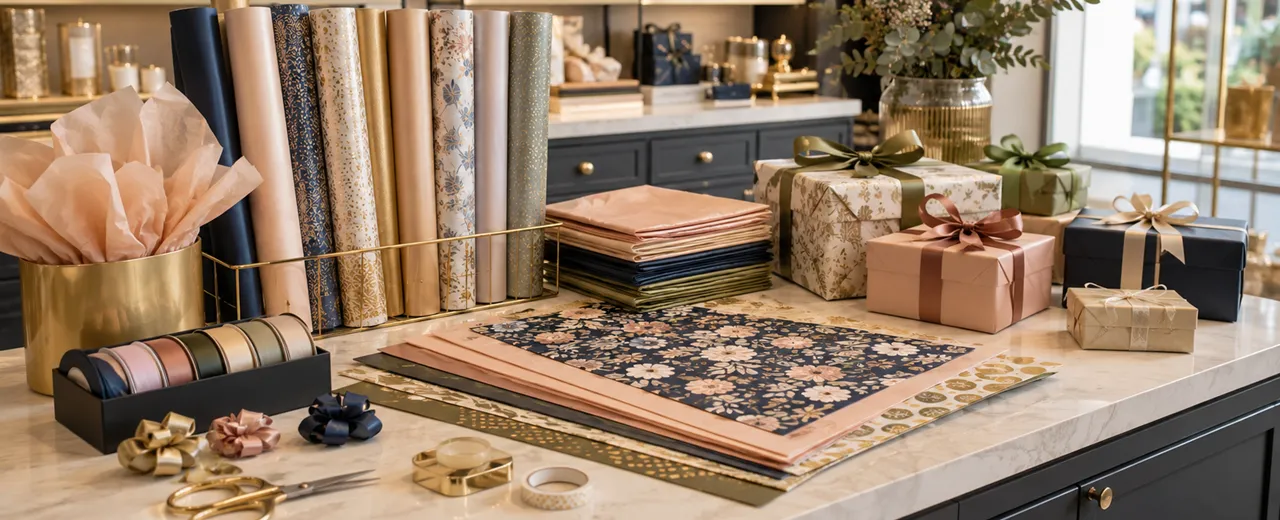
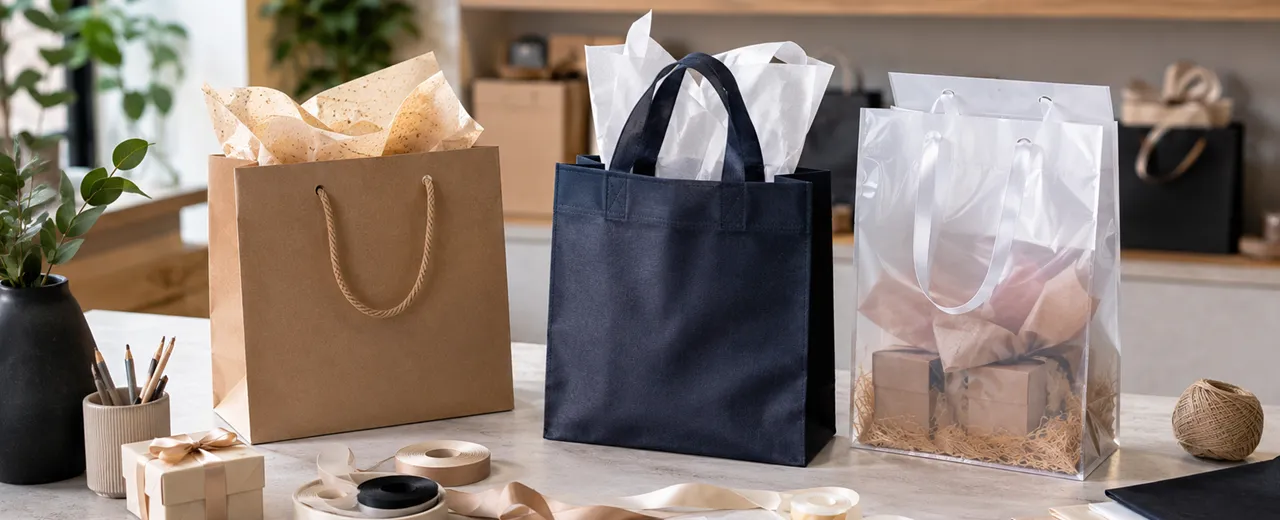
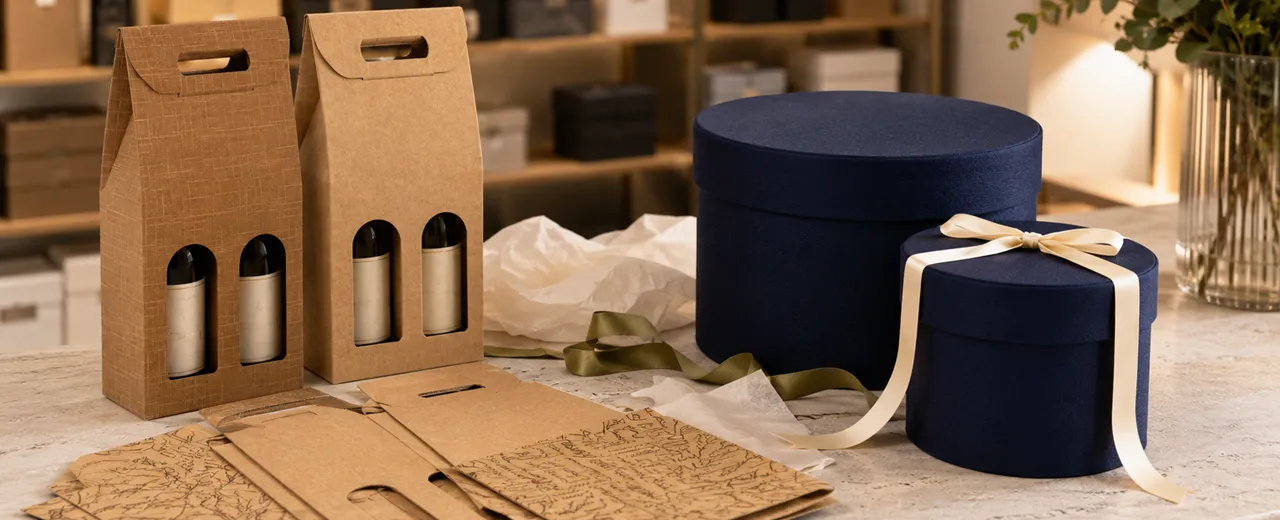
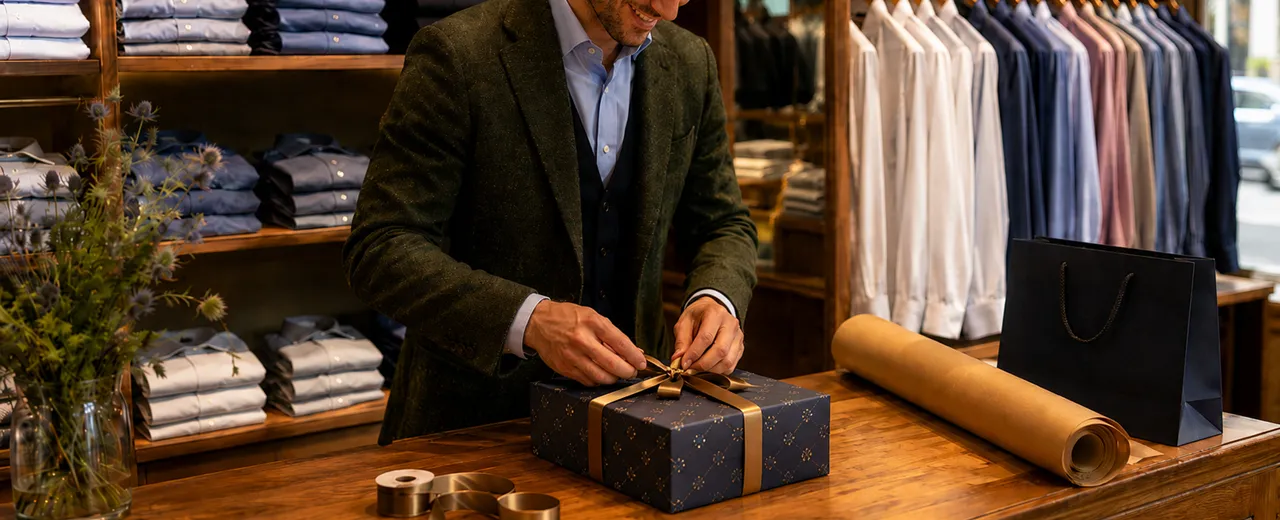
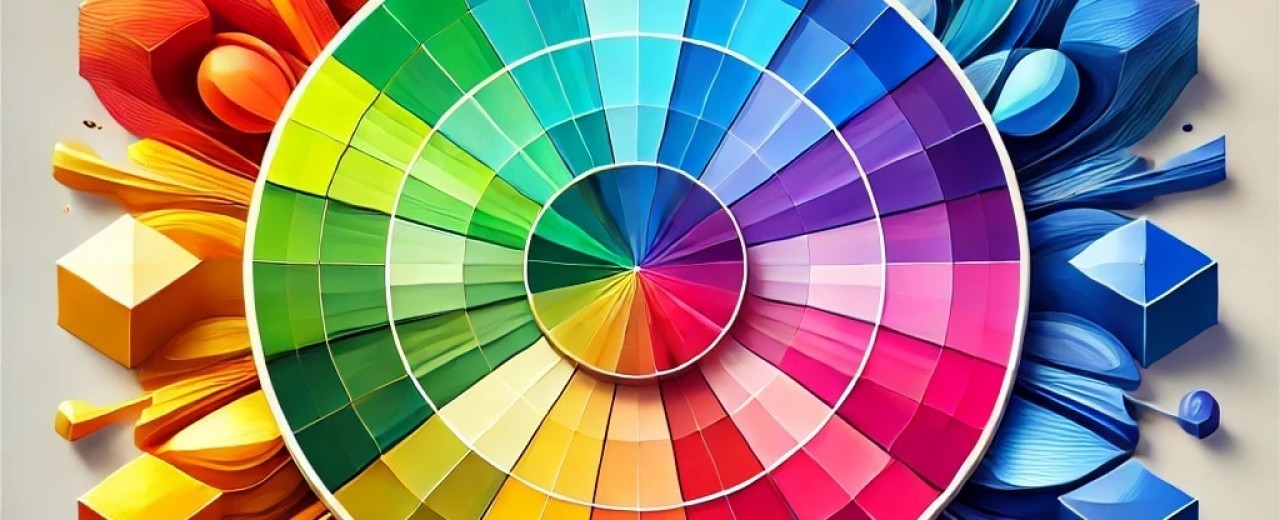
When a customer receives a purchase, the color of the wrapping speaks even before the words. It is a silent and immediate message, which does not require explanations and does not allow replicas: in a fraction of a second it suggests whether what we are about to open is precious or ordinary, curated or improvised, contemporary or out of time. This happens because color is not a decorative detail, but a perceptual code that the brain interprets with extreme speed. In retail and gifting it is, to all intents and purposes, a positioning tool. It can raise the perception of the price without changing the product, it can add that idea of attention that transforms a purchase into an experience, it can anchor the object to a specific season, making it consistent with the emotional climate of the moment and with the customer's expectations.
Talking about color psychology in wrapping means entering the most strategic area of the presentation: the one where aesthetics and value meet and where every color choice becomes a commercial decision. It is no coincidence that the most attentive brands do not entrust color to a generic taste or personal preference; They design it as one designs a shop window or a visual identity, because they know that the perception of quality is a complex and, above all, contextual phenomenon. A deep black can sound like authority and luxury, but it can also look cold if it's not backed up by matching materials and finishes. A white can communicate purity and precision, but it risks becoming anonymous if it is not built on a palette that gives rhythm and hierarchy. A red can ignite emotion and celebration, but it can slip into the predictable if it is not calibrated in saturation, brightness and combinations. Color does not have an absolute meaning, but a meaning in relation. To the light. To the texture. To contrast. At the time of the year. To the product sector. To the sales channel. And, above all, to the story we want to make perceived.
Inside a gift wrap, inside a tissue, inside a ribbon or a label, the palette is a direction. There are colors that, by cultural convention and visual memory, immediately activate the idea of seasonality; and there are colors that suggest it in a more sophisticated way, without repeating stereotypes. There are chromatic choices that make you perceive care because they "put order" to the eye, guiding it with elegant contrasts and consistent proportions; And there are combinations that, while beautiful in the abstract, generate visual noise and lower the impression of quality because they appear random. Color psychology is not magic, it is not manipulation: it is understanding how humans read signals, evaluate consistency and place value on what they see. In a competitive context, where the product often competes with similar products and where the choice is made in a few seconds, the difference is made by the perceived quality. And perceived quality is a sensory fact before being rational.
Today, then, the wrapping no longer lives only at the moment of delivery to the counter. It lives in photographs, videos, shared stories, unboxing. It is communication material, often involuntary, but very powerful. A well-designed palette not only makes the brand recognizable, but makes the "after-sales" experience desirable enough to be shown. On the contrary, an incoherent or chromatically weak wrapping breaks the thread of the story: the product may be excellent, but the whole does not support the promise. In terms of marketing, it means missing out on a loyalty opportunity. In terms of margin, it means giving up that subtle leverage that allows you to sustain a price without having to justify it with discounts or concessions.
When we talk about palettes that convey price, care and seasonality, we are therefore talking about a system of decisions, not a single color. We are talking about hues and undertones, saturation and brightness, combinations that work because they create harmony or because they introduce a controlled contrast. We are talking about materials that change the color rendering and finishes that transform a color from flat to "rich", from common to memorable. We are talking about a visual language applied to after-sales packaging, with a precise goal: to make the customer feel inside a coherent, curated and relevant experience at the time of year, so that the value of the purchase appears natural, fair, even inevitable.
This is where color psychology stops being an interesting theory and becomes a concrete advantage. Those who design the wrapping with color awareness create a recognizable signature, build continuity between product and presentation, shorten the distance between what is sold and what the customer perceives. And, above all, he makes a strategic choice: to use color as an ally to transform a daily gesture, deliver a purchase, into a brand moment. In these pages we will go into "how" to really do it, with a rigorous and applicable approach, because an effective palette is not an inspiration of the moment, but a project that can be replicated, measured and grown season after season.
Color as a "price signal"
Color is the first price the customer "sees," even when no one declares it. Before even touching the paper, before feeling the consistency of the ribbon or noticing a finishing detail, the eye builds an expectation: how much is what I am about to receive worth? It is a powerful perceptual mechanism, because it arises from the need to quickly interpret the signals of the environment. In retail, this speed becomes decisive: wrapping is not an embellishment, but an indicator of positioning. It can raise the perceived value, it can make it credible, it can reinforce the feeling that the price paid is consistent with what the brand promises. Likewise, it can sabotage everything, even when the product is excellent.
When we talk about a "price signal", we are talking about a system of clues that the brain translates into an overall judgment. Color is among the most immediate and among the most difficult to counterbalance. If the wrapping appears cheap, the material quality and design must work twice as hard to regain credibility. If, on the other hand, the color communicates value, the wrapping becomes a frame that legitimizes the price and makes it natural, almost taken for granted in the best sense of the term: not as an economic discount, but as evidence of consistency. This is where color psychology comes into play with a strategic role: not to "deceive", but to align perception with a precise intention, because after-sales packaging is part of the shopping experience and, therefore, of the product itself.
The market has taught us that there is no single "premium" color at all. There are color codes that, in the collective memory and in visual habits, are more often associated with the value alto: deep tones, sophisticated neutrals, controlled and not shouted palettes, combinations that seem designed and not improvised. But this association is not a fixed formula; It depends on how the color is modulated. The same color family can speak opposite languages depending on saturation, brightness and temperature. A blue can be institutional or precious, sporty or ceremonial, technological or tailoring. A red can be iconic and authoritative or promotional and noisy. A beige can be warm and textured or dull and "tired". The wrapping communicates price when the color is governed with intention and when it dialogues with the context of the brand.
There is an unwritten rule that applies in almost all sectors: the "easier" the color choice, the more it risks appearing cheap. Easy does not mean wrong, it means predictable, standardized, without a signature. Colors that are too primary and too saturated, if not supported by a project, are often read as immediate and unsophisticated. Not because they are ugly, but because they are common and because, over time, the market has also used them for promotional communication and mass sales. This is not to say that saturation and full color are forbidden; it means that they must be treated as a strong ingredient: dosing it and giving it structure. When color "screams" without direction, the perceived value drops. When it's put into a system, even a bold tint can become premium and distinctive.
The premium, in fact, is often built by subtraction. Not necessarily with minimalism, but with the feeling of control. A palette that makes you perceive alto price is a palette that seems decisive, not random. It conveys the idea that every element is in its place. This is where neutrals and desaturated tones come into play, not as a forced choice, but as a tool. Warm grays, ivorys, taupes, dusty greens, inky blues, deep browns, softened blacks and not "flat" often create a more stable, more mature, more "expensive" field of view because they reduce noise. But be careful: if you slip into anonymity, the perceived value does not rise, it flattens. The neutral communicates price when it is a "thought" neutral, when it is supported by an evident materiality, when it coexists with a calibrated accent or with a detail that declares its intention.
Another crucial aspect is brightness. The perception of price is very sensitive to the relationship between light and dark, between light and depth. Dark tones, especially when they are deep and not "dull", tend to evoke density and importance. It is no coincidence that they are often chosen for high-end packaging, from cosmetics to jewelry. But depth is not just "dark". It is the ability of color to have body. Absolute black on glossy paper can be harsh and industrial; A warm black on matte paper can become enveloping and sophisticated. A saturated burgundy can appear festive and common; a more closed burgundy, with a brown component, can become rich and classic. In other words, the perceived price is not made by the name of the color, its construction does.
At this point, a useful distinction comes into play: full luxury and affordable luxury do not speak the same color language. The former tends to favor quieter choices, deep tones, more measured contrasts, palettes with few voices but a lot of character. The latter can allow himself more brightness and more energy, but he must do so with clear rules, because the boundary between "lively" and "commercial" is thin. Affordable luxury, if well designed, gives the feeling of generosity and modernity; if improvised, it risks resembling a promotion. It's the same reason why some pastel palettes are refined and others childish: the undertone changes, the amount of gray changes, the way the color is staged changes.
The sales channel amplifies these dynamics. In a store, the color of the wrapping dialogues with lights, furnishings, uniforms, shop windows, the real season. Online, it communicates with a screen, a camera and the social media algorithm. A premium palette must also work in photography: it must withstand exposure, not "burn" the light, not transform the dark into an indistinct mass. If a color loses its elegance in photos, it also loses its function as a price signal, because today much of the perceived value passes through the shared image. A wrapping that seems alto of range live but mediocre in photos interrupts the continuity of the experience. On the contrary, a well-chosen color can become a communication asset: not only does it envelop a product, but it generates content, recognizability, desire.
In this sense, color is an economic lever. Not in an abstract way, but in a measurable way: it affects the perception of the margin, the willingness to pay, the feeling of "good purchase" even when the price is important. If the customer perceives that what they receive is consistent with a certain level of quality, the price stops being an obstacle and becomes part of the promise. If, on the other hand, the wrapping sends inconsistent signals, a friction arises: the customer does not always verbalize it, but records it. It is the difference between an experience that confirms and one that casts doubt.
For this reason, choosing the color of the wrapping is not choosing a flavor. It is to choose a placement. It is deciding what kind of value we want to perceive and how we want the customer to tell it to himself and to others. Color alone doesn't do everything, but it does set the tone of the conversation. If it is wrong, it forces materials and finishes to chase. If it's right, it makes them shine. And when a wrapping "sounds" alto of the range from the first glance, the price no longer has to defend itself: it is accepted, because it appears exactly where it should be.
Care, cleanliness, order: the psychology of "precision"
Care is not an abstract concept: it is a physical sensation, almost immediate, which arises when the gaze meets order, coherence and precision. In wrapping, the psychology of color works exactly on this point: it does not limit itself to "making it beautiful", but builds an impression of control, cleanliness and attention to detail. It is the difference between a package that seems to be prepared in a hurry and one that seems designed for that person, for that product, for that moment. And what makes this difference so powerful is that it often doesn't depend on how much you spend, but on how you design perception. Color, when guided by logic, becomes the quickest language to declare: here nothing is left to chance.
The customer reads the cure as a set of converging signals. The first is visual legibility: if the wrapping "breathes", if it does not crowd, if it does not confuse. Palettes that communicate attention are palettes that do not require effort, because they guide the eye naturally. This does not mean using a few colors necessarily; It means assigning light roles to the chosen colors. A dominant color establishes the tone, a supporting color structures the whole, a detail makes the signature. When this hierarchy does not exist, the wrapping appears random, and randomness, in the context of retail, is often translated as less professionalism. The brain does not think "they have chosen too many colors", it thinks "there is no project". And without a project, the perceived care is weakened.
Cleanliness, in particular, does not necessarily coincide with white. White is a powerful symbol of hygiene and order, but only when it is handled well. A "cold" white on poor materials can become sterile, a white that is too bright can seem technical and impersonal, an off-white can appear neglected if it is not clearly intentional. Care comes from the relationship between shade and context, not from the single color. A warm ivory on matte paper communicates delicacy and attention because it resembles a conscious choice. A pure white on a high-quality support communicates precision and rigor. A pearl gray, a cream, a barely hinted powder pink can evoke the same feeling of cleanliness, but with a softer and more human register. In other words, cleanliness is not a color, it is a chromatic direction that gives the customer an idea of order and reliability.
A decisive element is contrast, because contrast is a form of visual discipline. A wrapping with too aggressive contrasts risks appearing "shouted", and what screams is rarely read as cured. A wrapping with too weak contrasts, on the other hand, can be flat, unintentional, without "focus". Perceived care often arises from controlled contrast: a balance in which the elements are distinguishable, but none dominates excessively. Here color works like an orchestra conductor: it decides what should emerge and what should remain in the background. A ribbon in a darker or more saturated tone than paper can become a sign of precision, because it draws a structure. A label in an elegant neutral can give a point of order. A metallic accent or a glossy finish, if dosed, can add that sense of "detail" care that the customer recognizes as quality, not as ornament.
Then there is an aspect that is often underestimated: care is also consistency. And consistency, in packaging, is played on controlled repetition. When paper, tissue, ribbon, label and shopping bags belong to the same color family or dialogue with clear rules, the whole looks professional and reliable. When each element is "cute" but disconnected, the wrapping becomes a collage. Collage can be creative, but it rarely looks premium or curated, unless it's a collage designed with great expertise. In most cases, the customer does not reward disordered creativity; rewards the feeling that there is a system. A system means time invested, attention, identity. And this is precisely what care communicates: not only that the product is good, but that the brand knows how to take care of it down to the last gesture.
The psychology of color, here, meets a decisive theme: trust. When a wrapping appears to be curated, the client transfers that care to the contents. It is an effect of "positive contamination": if the outside is controlled, the inside will be up to par. If the exterior is improvised, something may be overlooked on the inside as well. This mechanism is particularly strong in sectors where quality is difficult to assess immediately, such as cosmetics, perfumery, gifts, but it also applies to fashion and high-end food. The wrapping, in essence, anticipates the promise of the product and makes it credible. And color is the first signature of this promise, because it is the most immediate and universal component of visual language.
The "softness" or "hardness" of the color also affects the perception of care. Palettes with a slightly dusty, desaturated component often communicate attention because they are more difficult to improvise: they seem to be thoughtful, calibrated, refined choices. Colors that are too bright and full can be perfect for a young and pop identity, but they must be balanced by impeccable materials and proportions, otherwise they slip into the commercial. In this sense, care is a balance between energy and control. A brand can be lively and well-finished at the same time, but it must demonstrate it rigorously: in the choice of tones, in the consistency of combinations, in the precision of details. Colour, on its own, does not save a neglected gesture; however, if well designed, it amplifies the feeling of precision and makes the intention visible.
Finally, there is a factor that matters more than ever today: care must also be recognizable in photography. The wrapping is seen and judged not only by the recipient, but by those who watch it on social media or in a chat, often in less than perfect lighting conditions. A "clean" and coherent palette photographs well because it maintains legibility, does not generate strange dominants, does not flatten volumes. It is a cure that can also be seen through the screen, and this increases the strength of the message: it is not just a package, it is a proof of identity. In a time when experience is shared, care becomes reputation. And reputation is built with repeated, credible, recognizable signals.
When the wrapping communicates care, the customer does not simply feel that he has bought an object; he feels that he has been considered. Color contributes to this feeling because it creates an atmosphere, a promise of attention, a frame that says "we have dedicated time to you". It is a subtle but decisive advantage, because it does not limit itself to making people perceive quality: it makes us perceive relationship. And in retail, the relationship is often what turns a purchase into a return.
Seasonality and commercial calendar: palettes that "click" at the right time
Seasonality, in wrapping, is a promise of relevance. It's that immediate sense of "this is exactly the right time" that the customer perceives without having to rationalize it. A well-chosen color hooks the purchase to a precise emotional climate, makes the object consistent with what happens outside and with what the customer expects inside. Yet, precisely because seasonality seems intuitive, it is one of the areas in which it is easier to fall into the already seen: tired codes are repeated, the obvious is replicated, the season is confused with a cliché. Color psychology, applied to after-sales packaging, serves instead to make seasonality a contemporary and credible language, capable of communicating moment and intention without transforming the wrapping into a disguise.
To really build an effective seasonal palette, it is necessary to distinguish between two concepts that often overlap in retail, but are not identical. There is a natural seasonality, linked to light, temperature, landscape, materials that we "feel" consistent with the time of year. And there is a commercial seasonality, which follows a calendar of occasions and micro-seasons: holidays, anniversaries, gift periods, capsules, campaigns, sales, back to work, ceremonies. The wrapping is located at the meeting point between these two floors. When it harmonizes them, it creates meaning. When it confuses them, it generates a weak or inconsistent message. Packaging that speaks "spring" in a natural way, for example, may not automatically be suitable for a corporate gifting campaign, where the expected code is often more institutional. Similarly, a perfectly Christmassy palette can look out of place if used too early or too long, because the customer perceives a dissonance between real time and commercial time.
Seasonality, in fact, is not just a choice of color: it is timing. In the retail world, the customer is extremely sensitive to the "when". If a color arrives early, it risks being perceived as forced; if it arrives late, it appears as a replica. This is where a subtle lever comes into play: progression. The smartest palettes don't change abruptly, but they evolve. Signals are introduced that anticipate the season without openly declaring it, then the intensity of the codes is increased when the moment is full, finally a return to a more neutral base when the emotional wave wanes. This progression is fundamental because seasonality must not crush the brand identity; he must dialogue with it. A recognizable brand does not disguise itself on every occasion: it remains itself and interprets the season with its own voice.
This is where the ability to avoid stereotypes without losing recognizability becomes decisive. The most common risk, especially in emotionally dense holidays such as Christmas, is to reduce the season to an obligatory pair of colors. Red and green work because they are universal codes, but precisely for this reason they can be predictable and, if managed without refinement, lower the perception of quality. The point is not to give up codes, but to sophisticate them. A full, bright red immediately communicates celebration, but it can sound promotional if it's not contained. A bright green can appear childish. If, on the other hand, the red becomes deeper, with a warm undertone and controlled saturation, and the green moves towards darker or dustier notes, the effect changes: the season remains legible, but becomes elegant. The same goes for spring: pastel is an easy reminder, but the difference between "delicate" and "banal" lies in the construction of the tone, in the use of neutrals, in the coherence of the system.
Seasonality, moreover, is not only a "cover" color, but also a "sensational" color. There are seasons that ask for lightness and others that ask for density. Summer, for example, can be interpreted as brightness, transparency, air, but it can also be interpreted as natural matter, sand, fibers, textures. Autumn can be read as warmth and depth, but also as warm minimalism, with palettes that recall light woods, clays, spices, dry leaves without becoming literal. Winter can be cold and clean, but also intimate and enveloping, with dark, soft hues suggesting protection. Color psychology allows you to choose which seasonal narrative your brand and its audience need, instead of adopting the more obvious narrative.
Added to this is the seasonality of the occasions, which is often more important than the season itself. A wrapping for a spring ceremony doesn't just communicate spring; it communicates formality, delicacy, celebration. A wrapping for a corporate gift in December doesn't necessarily have to look like "Christmas"; it must seem appropriate for a professional context, therefore more measured, more institutional, more consistent with an idea of prestige. In these cases, the palette can recall the season in a discreet way, perhaps through an accent or a detail, letting the base remain neutral and "transversal". The most effective seasonality is often the one that is not imposed, but perceived: like a perfume, not like a billboard.
Another crucial dimension is durability. Overly characterized seasonal palettes have a short life: they work intensively for a short period, then they become bulky. For a retail that must be efficient, this translates into waste or inconsistencies. This is why many advanced packaging strategies are based on a stable structure, a brand chromatic "backdrop", on which to graft modular seasonal elements. The base guarantees recognizability and continuity, the accents guarantee topicality. The customer recognizes the brand and, at the same time, feels that that brand is in the present, in his calendar, in his emotional season. It is as much an aesthetic solution as it is commercial, because it allows you to manage assortments and stocks intelligently, without sacrificing the "wow" effect.
Finally, seasonality today must work in a visual ecosystem that includes shop windows, social media, photographs in artificial light, different domestic environments, packaging that travels. A color that is perfect in real life can become problematic in photos, lose depth, change tone, look cheaper. A well-designed seasonal palette also takes this into account: it doesn't just aim at the glance in the store, but at the overall performance of the experience. Because seasonality, in 2025, is not just decoration: it is communication. It is contained. It is a way to ensure that the wrapping becomes part of the shareable story of the brand.
When a palette "clicks" at the right time, something very concrete happens: the purchase seems more sensible, the gift seems more important, the experience seems more polished. The customer does not think "they have chosen the colors of the season"; think, "There's attention here." And this attention, translated into color, is what makes the wrapping a gesture that does not end at the counter, but continues in the memory of the recipient.
Palette architecture: practical rules to be applied to wrapping
A palette is not a choice of colors, it is a structure. In wrapping, this difference is decisive because the customer does not judge the individual colours in isolation: he judges the whole, that is, the visual architecture that those colours build. When the architecture is solid, the package immediately appears "designed" and therefore more authoritative, more consistent with a brand that knows what it is doing. When architecture is weak, even excellent materials risk not expressing their full value, because there is a lack of order that makes care credible. Talking about palette architecture therefore means entering the most practical and strategic part of color psychology: how to transform a color idea into a replicable, elegant, effective system in the store and even easier to manage.
The first element to understand is that color is not a label, it is a behavior. Each colour has three dimensions that, in packaging, count more than the "name" of the colour: the shade, i.e. the colour family; saturation, i.e. how much intensity and purity it possesses; brightness, i.e. how much light it reflects and how much depth it brings. It is on these levers that positioning is designed. If we want to make price and care perceived, we usually don't need to change the color family radically; often it is enough to govern saturation and brightness with criteria. A very saturated blue can be sporty or commercial, the same blue made deeper and less saturated becomes more institutional and premium. A full pink can appear playful, the same pink shifted towards a dusty and less bright shade can become sophisticated and contemporary. In wrapping, these micro-variations are what separates a "generic" color from a "signature" color.
Functional architecture always starts with a question: what role should each colour play in the experience? This is where many stumble, because they choose colors they love, without establishing a hierarchy. Instead, any effective palette is hierarchical by nature. There is almost always a color that acts as a backdrop, the one that takes up the most space and determines the first impression. Then there are one or two colors that support and give rhythm, and finally there is a detail that signs, that creates memory, that makes the wrapping recognizable even from afar. In wrapping, this hierarchy is visible in a very concrete way: paper is often the main chromatic "mass", tissue or shopper can be the second level, the ribbon, label and closure become the level of detail. If these roles are not clear, the eye does not find a center and the package appears confused. If, on the other hand, the hierarchy is clear, the whole recomposes itself and immediately restores order, that is, perceived care.
At this point the choice of the type of harmony comes into play, because architecture is not only hierarchy, it is also a relationship between colors. Some relationships communicate stability, others energy, others theatricality. A palette built with colors close to each other, therefore with smooth transitions, tends to be more elegant and controlled, perfect when we want to perceive a alto price and a premium setting. A palette that plays on stronger contrasts, on the other hand, can become more dynamic and contemporary, but it must be carefully calibrated: contrast is a sharp blade, and it can quickly turn into visual noise. In packaging, where the elements are few but very exposed, excessive contrast can lower the perception of quality because it seems "graphic" in a promotional sense. A controlled contrast, on the other hand, is a statement of precision: it means that someone has chosen what should emerge and what should remain in place.
One of the most useful rules when designing wrapping is to think in terms of percentages, not in terms of the amount of colors. Even a three-hue system can be chaotic if the percentages are not governed. In wrapping, the percentage coincides with the surface, and therefore with the hierarchy. An extensive and coherent base immediately creates a legible identity; a secondary color, present but not intrusive, gives depth; An accent detail creates the "jewel" effect, that is, that point of interest that makes you perceive intention and refinement. If the accents become too many or too large, the wrapping stops looking like a project and becomes a sum of choices. And in retail, a sum of choices is rarely read as care: it is read as improvisation.
Then there is a fundamental issue, often underestimated: the palette must not only work "when stationary", it must work in motion, that is, when the package is seen from different angles, under different lights, in the hands of different people, next to garments or objects of varying colors. This means that the color base must be relatively stable and "compatible" with what the store sells. For many categories, the smartest solution is a neutral or semi-neutral base, not because neutral is always more elegant, but because it is more adaptable and allows the product to remain the protagonist without losing the brand tone. Accents, on the other hand, can be more characterizing and seasonal, because they are easier to modulate and replace. In practice, the most efficient architecture is the one that separates what must remain constant from what can change. It is an approach that does not only concern style, but also management: it allows continuity and recognizability, reduces errors, makes it easier to train those who package, and prevents each package from becoming a case in itself.
The concept of "signature color" deserves an in-depth study because it is one of the strongest tools for building recognizability without complicating the palette. A signature color is not necessarily the most noticeable color, nor the most loved. It is the color that, repeated consistently, becomes a sign. It can appear on the tape, in an internal tissue, in a label, in a seal, in a shopper. It is a constant and calibrated presence, which makes the wrapping recognizable even when the base changes for seasonal or collection reasons. The strength of signature color lies in controlled repetition: it is what transforms wrapping into an identity and not an aesthetic exercise. When the customer begins to recognize that color, the brand gains visual memory. And visual memory, in retail, is value.
Another crucial lever of architecture is the temperature of the color, because the temperature defines the emotional atmosphere of the wrapping. Warm tones tend to communicate welcome, matter, intimacy; Cold tones, precision, modernity, rigor. But even here, the meaning is not absolute. A slightly dampened cold can become extremely refined and "boutique", an oversaturated heat can seem cheap. The key is to maintain temperature consistency within the palette. When hot and cold are mixed without direction, the wrapping appears dissonant. On the other hand, when the palette is consistent, the contrast is also elegant, because the eye perceives an intention. This temperature consistency becomes even more important when different materials come onto the scene: kraft warms any color, a coated one can cool it, a matte one softens it. The architecture of the palette must therefore anticipate the real rendering of the color, not just imagine it.
In a really well-designed after-sales packaging, the palette also works on the concept of "space". Space, in visual terms, is what makes you perceive order. Too many close-up chromatic elements eliminate space, create congestion. A structured palette, on the other hand, leaves areas "calm" and areas "active", just like high-quality graphics do. In wrapping, this translates into a seemingly simple but very powerful gesture: let the base do its job and use color as an accent, not as a filler. When color is used to fill, the wrapping loses breath and looks cheaper. When used to build hierarchy, wrapping seems designed and therefore more alto range.
Finally, the palette architecture must be replicable. In retail, it's not enough to create a perfect package once: you have to make sure that each package is consistent, even when it is made by a different person, on a different day, at different times. The palette must therefore be a simple system to apply and difficult to go wrong. When colour is thought of as a system, it not only improves customer perception, but improves internal efficiency. It reduces uncertainty, shortens time, makes the gesture safer and cleaner. And cleanliness, in the end, is what the customer perceives as care.
Designing the architecture of the palette means, in essence, transforming color into a grammar. A grammar that allows the brand to speak coherently, to vary without losing identity, to be seasonal without becoming stereotyped, to be premium without being distant. It is the most concrete and strategic operation that can be done on wrapping, because it puts order in the way value is seen, even before it is explained.
Materials and finishes: when paper "makes" color and color "makes" paper
In after-sales packaging, color never exists alone. It always exists within a matter, and that matter modifies it, interprets it, sometimes betrays it. This is a crucial point, because many wrapping projects fail not because of a wrong color choice, but because of an unexpected physical rendering. A green that seemed deep in digital, on a blotting paper can lose density and turn; a black that was supposed to be velvety, on a glossy patina can become hard and "technical"; An ivory that was supposed to appear warm and premium, on a support that is too white can be cold and anonymous. When we talk about price perception and care, the relationship between color, support and finish is often more decisive than the palette itself, because it is there that the feeling of quality is built. The customer does not evaluate a pantone: he evaluates an overall impression made up of light, surface, touch and coherence.
Paper is a filter. Each support has its own chromatic "voice", an implicit base that alters everything we place on it. Kraft, with its natural shade, warms and softens colors, makes them more organic and less saturated; It can be perfect when we want to communicate authenticity, matter, naturalness, but it requires awareness because it tends to flatten contrasts and shift light tones towards a more "dull" area. A very white paper, on the other hand, enhances brightness and cleanliness, but it can cool down the heats and make the neutrals less sophisticated if they are not calibrated. Dull and porous papers absorb, soften, make the color softer and often more elegant, but they can reduce the depth of certain dark tints if the ink is not handled well. Coated papers, on the other hand, increase definition and brilliance, but if they are not accompanied by a consistent finish they risk bringing the color towards a more commercial register, because "easy" brilliance is a code that the market has long used even for the mass market.
This is where a concept that is worth gold in retail comes into play: the perceived value arises from apparent difficulty. A color that looks easy to achieve, often appears less premium. A color that seems "constructed", deep, material, seems more expensive because it suggests control and quality. This is why dark tones on well-chosen matte papers, or on substrates with a refined texture, immediately communicate high-end. It's not just a matter of dark, it's a matter of body. The body of the color is given by the light that the surface retains and returns. A quality matte retains the light diffusely and generates that famous velvety effect that the customer reads as care and prestige. A polish sends it back in a specular way and can be more aggressive. Neither of them is "right" in absolute, but their meaning changes radically depending on product category and positioning. Glossy, for example, can be perfect for a pop, glamorous, festive aesthetic, where brilliance is part of the language; In the classic premium, however, it tends to work better as an accent, not a base, because the hint of light appears intentional, while the fully glossy surface can feel like a shortcut.
Texture is another fundamental ally of perception. An embossed paper, a slightly hammered surface, a fine and consistent grain transform color into a tactile experience. The customer doesn't just "see": he hears. And when the hand encounters resistance, consistency, micro-structure, the brain immediately attaches more value. It is an almost automatic passage: what is richer to the touch is perceived richer also in the content. The texture also helps to "ennoble" simple colors. A neutral on smooth paper may seem trivial; The same neutral on an elegant texture becomes sophisticated. A pastel on paper that is too smooth can be childish; on a matte and textured surface it can become contemporary, editorial. In this sense, texture is a form of language: it supports color and gives it context.
The finishes, then, are the point at which the direction becomes evident. A selective varnish, a metallic detail, a foil, an embossing, a closure with a well-designed label are not simple "decorations". These are signs of intention and time invested. And the time invested is one of the most direct ways in which the customer measures care. But the key word is dosage. A fine finish works when it is perceived as a precise choice, not as an accumulation. The foil, for example, can immediately elevate a wrapping because it introduces a "noble", controlled light, different from the plastic gloss. But if it is used intrusively, it can become excessive and move the packet to a noisier register. The same goes for reliefs and embossing: when they are thin and consistent with the palette, they communicate craftsmanship and quality; when they are too marked or disconnected from the color system, they become an end in themselves. In premium, the effect does not have to be declared: it must be discovered.
The most complex, and often most underestimated, part is the coherence between different elements. Paper, tissue, ribbon, label, shopping bags do not share the same surface and do not reflect light in the same way. This means that the same "color" will never be identical on all materials, and wanting to make it identical at all costs is often a mistake. True coherence is not perfect identity, it is harmony. It is more effective to design a color family that takes into account differences in rendering, accepting micro-variations as part of the language. A satin ribbon will behave differently from a matte paper; a semi-transparent tissue will make the color lighter; A label with a particular finish may be brighter. If these differences are foreseen and governed, the result appears sought and intentional. If they are random, the result seems "put together", and the perceived care goes down.
Point of sale light and domestic light complete the picture. A color that looks perfect in the lab or office can change dramatically under warm or cold lights, and this variability can create unexpected inconsistencies, especially in neutrals and dark tones. In retail, chromatic consistency is not an aesthetic whim, it is a positioning garrison: if the customer perceives fluctuations, he interprets instability. And instability, in packaging, is the opposite of care. This is why the chromatic design of the wrapping should always be thought of as a "situation" project, i.e. imagined and verified in the real context in which it will be seen. Quality, for the customer, is also predictability: knowing that each package will live up to the previous one.
Finally, materials and finishes are the most concrete way to transform a palette into seasonality without becoming literal. The season does not always have to be shouted by colors; can be suggested by the subject. Autumn can be evoked by opaque and warm papers, by textures that recall fibers and depth, by finishes that retain light instead of reflecting it. Summer can live in brighter supports, in light surfaces, in details that give air. Winter can become clean rigor or enveloping intimacy depending on how the paper handles light. In this sense, the material is a noble shortcut: it allows you to say "season" without chasing the most obvious colors, and to do so with a language that immediately appears more premium.
When you work well on materials and finishes, color stops being a graphic datum and becomes an experience. It is then that the wrapping really begins to make you feel the price and care: not because it is more loaded, but because it is more coherent, more sensory, more intentional. The customer will not think of "what a beautiful paper" or "what a beautiful color" as separate judgments; He will think, in a much more useful way for the brand, "here is quality". And that quality, even before being explained, has already been demonstrated.
Culture, context and channel: colour doesn't mean the same thing to everyone
Color is a language, but it is not a unique language. It works as a system of signs that the brain interprets based on memory, habits, context, and expectations. For this reason, in after-sales packaging, the most important question is not "what does this color mean", but "what does it mean for our customer, right now, in this place, on this channel". Color psychology becomes really useful when it stops being a universal theory and turns into a method of reading: understanding how the perception of color changes as the audience and the context change. It's a decisive step, because a wrapper can be perfect from an aesthetic point of view and still fail in its commercial objective if it speaks the wrong language to the wrong person, or if it speaks it in the wrong place.
Culture is the first filter. Not in the folkloristic sense of the term, but in the most everyday and concrete sense: what a person has seen thousands of times, what he associates with a certain type of product, what triggers trust or mistrust. Colour codes are not born in a vacuum, they are born in the market. If a customer has learned that certain combinations belong to the discounter and others belong to the high-end, he will tend to read them in this way even when the materials change. This is why you cannot design a palette without considering the product category and its imagery. In cosmetics, for example, clean neutrals and controlled palettes are often read as care and scientificity; In fashion, the neutrals themselves can be read as contemporary minimalism or classicism, depending on the cut and tone. In food, certain colors have a direct link with palatability, naturalness and perceived quality, and the wrapping must take this into account, especially when the idea of "artisanal" or "gourmet" comes into play. Color, in other words, does not just communicate an emotion; it communicates a positioning within a sector, and that positioning changes from sector to sector.
Age and visual experience also change reading. It is not a question of stereotypes, but of exposure to different codes. Generations that have grown up in a digital-dominated world tend to recognize and appreciate sharper palettes, more graphic contrasts, color choices that work well in photography and on screen. Other audiences may prefer more classical registers, where the perceived value passes through sobriety, depth and discretion. The point is not to chase "the taste of young people" or "the taste of adults", but to understand which quality codes your audience recognizes as credible. The same palette can be fresh and desirable for someone and distant or cold for someone else. After-sales packaging, however, must do only one thing: make the brand desirable for its customer, not for a general audience.
Then there is the physical context, often treated as a detail and instead decisive. A color never appears identical in two different environments. It changes with the lighting, with the surrounding materials, with the colors of the furniture and even with the garments or objects that the customer wears or carries with him. In a store with warm lighting, some whites may turn yellow, some grays may become warmer than expected, certain blues may lose depth. With cool lights, warm tones can fade and appear harsher. This variable is not neutral: it directly influences the perception of care and price. A wrapping that in the wrong light turns or loses legibility may appear less premium, not because it is, but because the visual rendering does not support the promise. And this is especially true for sophisticated neutrals, which are often the basis of high-end wrapping systems: they are "difficult" colors, and for this very reason they require greater control.
The channel, however, is the variable that today more than any other redesigns the meaning of color. The wrapping no longer lives only in the act of packaging and delivery. He lives in unboxing, photography, video, digital word of mouth. And that means the palette needs to be thought out for how it performs on screen as well. Many colors, especially in dark ranges, lose detail in photos and become indistinct masses if they are not supported by textures, contrasts or finishes that restore depth. Many light colors, on the other hand, risk "burning" and losing character. The result is that a palette designed only for the live experience can result in a flat and low-premium image when shared. And today this sharing is an integral part of the value: if the wrapping does not photograph well, it does not support the visual reputation of the brand, and loses a share of communicative effectiveness.
The shift from physical to digital introduces another dynamic: standardization. On screen, the differences between cards and materials are reduced if they are not designed to emerge. Touch disappears, light is interpreted by the camera, colors are compressed and reinterpreted by different displays. In this transformation, what remains is the chromatic composition and its legibility. For this reason, when designing the wrapping, you have to ask yourself not only "how it looks live", but also "how it looks in a quick photo taken with a smartphone, in less than perfect light". A well-designed palette maintains identity and quality even in less than ideal conditions, because it works on differences in brightness and intelligent contrasts, not just on "beautiful" colors in theory.
Culture and channel also meet in the way people interpret intention. A very rich and brilliant wrapping can be read as festive and generous in one context, and as excessive or unrefined in another. An extremely minimal wrapping can be read as elegant and modern, or as poor and "effortless". The meaning, once again, arises from the context. If a customer enters a boutique where everything speaks of refinement, minimalism appears as a conscious choice. If minimalism itself appears in a generic or inconsistent context, it can be interpreted as a lack of investment. The same logic applies to color: a matte black with a calibrated detail can be luxury, but a flat black without structure can be any bag. The intention must be legible.
This brings us to an often overlooked, but fundamental issue for perceived care: accessibility. A wrapping is not just a beautiful object, it is an object that must work. If a label is not read, if a thank you message disappears because the contrast is insufficient, if an important detail is too subtle, the customer perceives a design flaw. And design, in packaging, is part of quality. Taking care of contrast and legibility does not mean giving up elegance, it means making it concrete. A high-end brand cannot afford its details to be difficult or confusing: the high-end is clarity, control, precision. Even when it is poetic, it remains legible.
In editorial and strategic work on color, the most useful conclusion is this: there are no "right" palettes at all, there are the right palettes for an identity, for an audience and for a context. Color psychology applied to wrapping becomes a discipline of intelligent adaptation. The brand does not change to chase the world; It makes the brand speak coherently to its world. And when this happens, the wrapping stops being an accessory: it becomes a credible extension of the brand, capable of maintaining perceived price, perceived care and perceived seasonality, wherever the customer meets it, from the counter to the camera, from the shop to the living room.
ChartaRè method: design, test, standardize to make color a sales lever
At this point it is clear that the color, in the wrapping, is not an isolated aesthetic choice, but a system that directly impacts on perceived price, perceived care and perceived seasonality. Precisely for this reason, the most common mistake is to treat it as a "creative" theme to be solved once, perhaps relying on inspiration or the taste of the moment. In retail, however, what really works is what can be replicated. A perfect wrapping, made on an ideal day and by an expert hand, is not enough. We need a method that transforms color psychology into an applicable procedure: clear for those who package, consistent for those who receive, sustainable for those who manage the warehouse, credible for the brand. When color becomes a method, it stops being a cost and becomes a lever. A lever that works every day, on every package, without asking for extraordinary efforts.
The ChartaRè Method starts from a simple premise: color must not "please", it must "work". Functioning means generating an observable result on the customer: making them perceive a certain level of value, making them perceive a higher level of care, making them perceive that that package is perfectly within a season or an occasion. This immediately shifts the work from a subjective to a strategic plan. You don't start by choosing the colors, you start by choosing the goal. If the need is to sustain premium positioning, the palette will need to prioritize control, depth, and consistency. If the need is to increase the feeling of "gift" in key periods, the palette should introduce accents that activate emotion without descending into stereotype. If the need is to make the brand more recognizable, the palette will have to build a repeatable sign, a signature color that crosses the seasons.
Once the objective has been defined, the second phase consists in translating it into a chromatic and material vocabulary consistent with the identity. Here the point is not to invent an abstract palette, but to build a color family that is realistic to use and that takes into account the surfaces. In after-sales packaging, in fact, the color rendering is never identical between paper, tissue, tape and label; And the method serves precisely to ensure that these differences become harmony, not inconsistency. The signature color is chosen to be stable and recognizable, while the seasonal elements are designed to be modular. This distinction is what makes it possible to evolve without losing identity and without finding ourselves "starting over" every year.
The third phase is the one that separates an amateur project from a professional project: the prototype in the situation. The wrapping should be seen as the customer will see it, not as we see it in a studio or on a monitor. It should be observed under the lighting of the store, next to real products, in the hands of a person, photographed with a smartphone, perhaps even in less than perfect conditions. The reason is simple: color is a relative phenomenon. It changes with light, it changes with contexts, it changes with materials. Testing in the situation avoids two typical mistakes: choosing colors that are cheaper live than expected, or choosing colors that lose personality and therefore communicative value in photos. A wrapping that holds up well both live and on screen is a wrapping that works on two levels: experience and reputation. Today we need both.
At this point the calibration phase begins, which in the method is not an afterthought, but a refinement: small variations in saturation, brightness and temperature that often make a huge difference on the perceived value. It is at this stage that the degree of contrast, the weight of the accents, the proportion between base and detail are decided. And here an important step takes place: the wrapping must be beautiful even when it is fast. In the real world, packers don't always have the same time, and the customer shouldn't perceive differences in quality depending on the turnout. The palette and structure must therefore be designed to be consistent even with essential gestures. If beauty depends on a complexity that is difficult to replicate, the system is fragile. If beauty comes from simple rules, the system is solid.
The fifth phase is standardization, i.e. the transformation of the project into an operational language. Standardizing does not mean making everything rigid; it means making everything recognizable. It means defining which elements are always present, which are optional, which are seasonal, which combinations are "correct" and which are to be avoided. This is where color psychology really becomes a sales lever, because consistency builds trust. A customer who comes back and always receives a consistent wrapping perceives a reliable brand, and reliability is one of the pillars of the high-end. Standardization also reduces errors and makes it easier to maintain a high level of care even when people or shifts change. Packaging becomes a controlled ritual, not a variable.
The sixth phase is monitoring, not in a bureaucratic sense, but in a commercial sense. A wrapping system must be observed over time: how customers react, how much is photographed, how much is shared, how it integrates with the seasons, if it really supports the perception of the price. Often the answer comes in a simple way, because the customer speaks with behaviors: the frequency with which he asks for the gift wrapping, the predisposition to give the purchase as a gift, the visible satisfaction at the time of delivery, the willingness to pay without objections. The method also serves to read these signals and correct them intelligently, without tears. A good color system is not immobile: it is stable, but evolutionary.
Finally, there is an aspect that makes the ChartaRè Method particularly effective for those who sell every day: the management sustainability of the project. A valuable wrapping must be sustainable not only in economic terms, but also in terms of warehouse and labor management. A system with too many color variations is difficult to maintain and inevitably leads to inconsistencies. A system with a light base, a signature color and a logic of seasonal accents allows you to optimize purchases, avoid waste, plan in time, maintain continuity. And continuity is what transforms a gesture into identity.
When this method is rigorously applied, a silent but concrete change occurs. The wrapping stops being an "ancillary service" and becomes a strategic touchpoint that supports margins and reputation. Color is no longer decoration: it is positioning. It is no longer an opinion: it is a designed language. It is no longer a seasonal idea to be chased: it is a grammar that crosses the commercial calendar without losing coherence. And it is at that moment that the palette really begins to do what it promises: to make the price perceived, to perceive care, to perceive seasonality. Naturally, with continuity, with authority.
Having come this far, the point becomes obvious: in the wrapping, color is not a detail, it is a device of meaning. It is what directs the gaze before touch, what builds expectation before opening, what suggests value even before the product is seen. And when we talk about value, we are not just talking about aesthetics, but about perceived price, perceived care, perceived seasonality. Three dimensions that in retail decide whether a purchase remains a functional gesture or becomes a memorable experience, capable of generating trust, return and storytelling.
The psychology of color, applied to after-sales packaging, teaches us that there are no neutral choices. Every hue, every saturation, every brightness ratio, every contrast communicates a position and an intention. A wrapping can say "premium" without being excessive, it can say "attention" without being complicated, it can say "season" without falling into the stereotype. But to do so it must be designed as a system and not as an episode. It must take into account the material that hosts it, the light that passes through it, the culture that interprets it and the channel that amplifies it. It must work live and on screen, at the counter and in unboxing, in the customer's hand and in his camera. This is the new responsibility of packaging: not to close a product, but to open a perception.
In a market where real quality often resembles each other and the difference is played out in the experience, wrapping becomes a proof of identity. It is a gesture that can legitimize a price, make a promise credible, transform the purchase into a moment to remember. And the most interesting part is that this leverage doesn't necessarily require excess or complication – it requires control. A control that comes from a well-designed palette, consistent materials, finishes chosen with intention and a method that makes everything replicable. Because true luxury, in retail, is consistency: the ability to be recognizable and impeccable every time, not just when everything is perfect.
If there is a final message worth retaining, it is this: color does not "embellish" the wrapping, it governs it. It is the invisible direction that makes us perceive order, value and moment. When it is chosen with awareness, it becomes a silent and very powerful commercial ally: it reduces the distance between what we sell and what the customer feels he has received. And in that distance, often, everything is decided. For this reason, designing the wrapping palette means designing a branded piece. A concrete, daily, repeatable piece. A piece that does not remain in the store, but goes out with the customer and continues to speak for us, long after the ribbon closes.