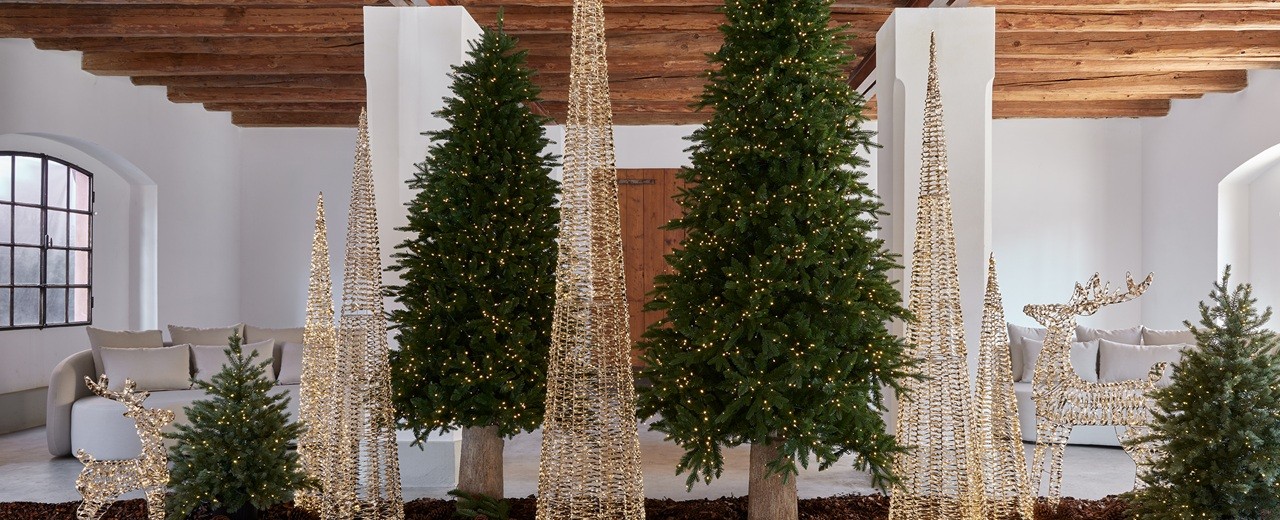
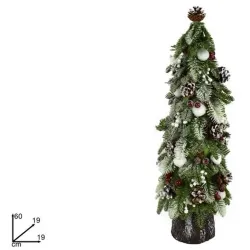
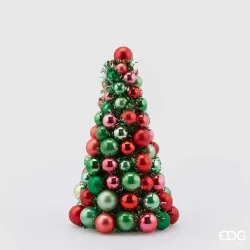
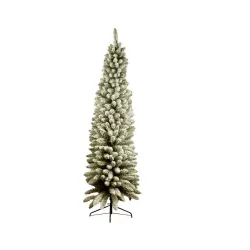
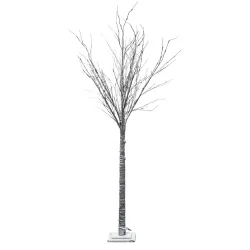
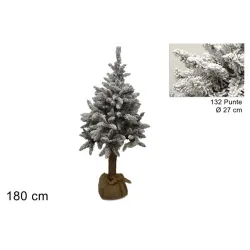
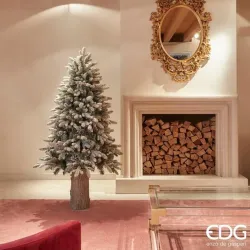
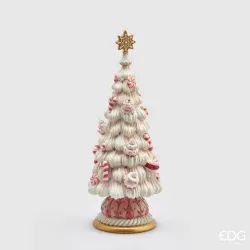
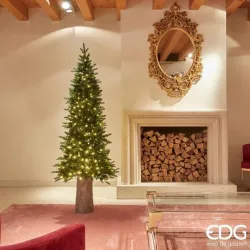
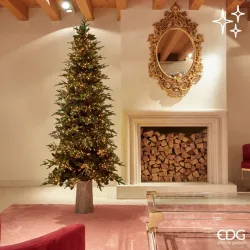
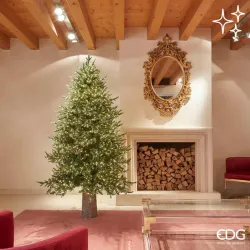
Every year, as the days get shorter and the cold begins to be felt, a scene is repeated almost everywhere: a tree, real or artificial, enters the house, is filled with lights and decorations, becomes the visual and emotional center of Christmas. We take it for granted, as if it had always existed, but in reality the Christmas Tree is the result of centuries of intertwined traditions, overlapping legends, cultural and religious choices that have transformed its meaning and appearance. Why does the Christmas Tree exist? Why has an evergreen, illuminated and decorated tree become the symbol par excellence of the holidays?
Behind those branches full of balls, ribbons and lights hides a complex history, which crosses the ancient celebrations of the winter solstice, the cults linked to sacred trees, the progressive Christianization of Europe and, later, the birth of the "domestic" Christmas as we know it today. The tree, even before becoming "Christmas", was a powerful universal symbol: of life that resists frost, of rebirth after darkness, of connection between earth and sky. It is on this fertile ground that, over time, the tradition of the Christmas Tree has taken root.
In the heart of homes, the Christmas tree is not just a decorative object: it is a collective ritual. Choosing the tree, assembling it, opening the boxes of decorations, deciding on a color palette and a style, hanging each element carefully, turning on the lights for the "first time" in front of family or friends are gestures that mark the symbolic beginning of the holidays. It is a miniature theater in which personal tastes, memories, affections are reflected, but also aesthetic trends, cultural influences and, increasingly, a certain attention to sustainability and quality of staging.
Yet, to really understand why the Christmas Tree is considered indispensable today, we need to take a step back and look at its historical evolution. From the forests of Northern Europe to aristocratic courts, from the first depictions in German cities to the explosion of tradition in the Victorian era, the decorated tree has crossed geographical and social boundaries, transforming itself from an elitist ritual to a popular symbol, capable of adapting to the most diverse contexts, from large city squares to shop windows, up to the most minimalist and contemporary interiors.
In this in-depth study, we reconstruct the journey of this "timeless" symbol: from pagan origins to Christian reinterpretations, from the symbolic language of lights and decorations to the most modern interpretations, attentive to design and environmental impact. Understanding why the Christmas Tree exists means, after all, understanding something deeper about our way of experiencing the holidays: the need to find each other, to give light to the darkness of winter, to transform a simple natural element – a tree – into a concrete sign of expectation, hope and sharing.
From the forests of the North to European living rooms: the ancient roots of the decorated tree
Before becoming the undisputed protagonist of the Christmas living room, the decorated tree was, for centuries, a symbol linked to nature, to the mystery of the forest, to the cycle of the seasons. To imagine its origins you have to move to the forests of Northern Europe, in a landscape made up of long winters, low skies and a cold capable of stopping everything. In this scenario, the evergreen trees, which do not lose their leaves even in the middle of winter, appeared as a sort of silent miracle: a sign of resistance, the promise of a life that does not surrender to the cold, a symbolic bridge between a dark present and a spring that, sooner or later, would return.
It is no coincidence that many Celtic and Germanic populations attributed a sacred role to trees. The cult of trees, and in particular of some species such as fir, holly, mistletoe, was widespread well before Christianity. Branches, garlands and fronds were brought into homes during the cold months to "call in" the force of nature, ward off negative energies, protect the family and the hearth. The tree, in this context, was not a decoration but a living symbol: it represented the axis that unites earth and sky, roots and alto, human and divine.
Even in the Roman world, albeit with different forms, green played a central role in winter celebrations. During Saturnalia, the celebrations dedicated to Saturn that preceded the solstice, houses and public spaces were adorned with branches of evergreen plants. It was a way to create a festive atmosphere at a time of year marked by darkness and cold, but at the same time it was a gesture full of meanings: those plant elements reminded everyone that nature was not dead, it was just resting.
With the advent of Christianity, these customs did not disappear at once. As often happens in the history of traditions, there is no clear break, but a slow process of transformation. The pre-existing symbols are reinterpreted, recoded, adapted to the new religious language. The evergreen tree, so strong and rooted in the imagination of the populations of the North, could not simply be erased. It therefore becomes a meeting ground between ancient beliefs and new meanings, passing from representing the forces of nature to symbolizing eternal life, hope, the light that conquers the dark.
Between the Middle Ages and the early modern age, a tradition appeared in some regions of Central Europe that surprisingly anticipated the contemporary Christmas tree: the "tree of Paradise". On December 24, a date that in some areas was associated with the feast of Adam and Eve, a tree with fruits, often apples, was decorated to evoke the tree of the Garden of Eden. This staging had a didactic and religious function, but it introduced a key element: a tree brought into an urban or interior space, intentionally decorated to tell a story, convey a message, create an atmosphere.
It is at this moment that the tree slowly begins to detach itself from the only ritual context linked to nature and to enter the dimension of representation. In German cities and neighboring regions, customs are spreading in which guilds, brotherhoods or communities decorate trees in public spaces or indoors to celebrate special occasions. Branches decorated with fruits, sweets, ribbons, small objects become a way to make the feast tangible: the tree is no longer just an abstract symbol, but a scenic element, almost a "vertical stage" on which to place signs of abundance, prosperity, blessing.
In the meantime, in the homes of the European elites, a new way of experiencing the holiday is emerging: more domestic, more intimate, more linked to the idea of a Christmas that is consumed within the walls of the house, in a controlled and well-kept environment. It is in this context that the decorated tree makes its decisive passage: from the forests and squares to the reception room, to the living room. There it takes on a double function, private and social. On the one hand it becomes the reference point for family celebrations, on the other it turns into a sort of aesthetic "business card", a way to show taste, refinement, attention to detail.
The presence of a decorated tree in the house, in the wealthier classes, is initially a sign of distinction. Not everyone can afford to devote space, time, precious objects to a decorative structure that will last only a few weeks. The decorations are not yet the ones we know today, but the idea is already emerging that the tree can be customized, enriched, made unique according to the economic possibilities and aesthetic sensitivity of those who exhibit it. In fact, the concept of the tree as a "decorative project" and not just as a symbol was born.
The ancient roots of the Christmas Tree, therefore, intertwine different levels: religious, symbolic, social and aesthetic. It is the intertwining of these levels that explains why this tradition has proved to be so resistant and, at the same time, so capable of changing. The decorated tree brings with it memories of ancestral rites, references to solstice celebrations, traces of the Roman world and medieval Christianity, but also the evolution of bourgeois taste and life between the eighteenth and nineteenth centuries. From a sign of nature's survival to an emblem of an increasingly domestic Christmas, the tree crosses the centuries, transforming itself without ever losing its symbolic core: being, in the middle of winter, a visual declaration of life, abundance and hope.
When we think of the Christmas tree today as a "natural" element of the domestic landscape of the holidays, we are unconsciously connected to this long and stratified history. The forests of the North, ancient rituals, the first city experiments and European living rooms coexist, in the form of an echo, in every tree we assemble and decorate. And it is precisely from this long genealogy that derive, even today, both the emotion we feel in turning on the lights, and the care with which we design and set up our tree, transforming it every year into a different story.
Between the winter solstice and Christianity: how the evergreen tree enters Christmas
To understand how the evergreen tree entered the heart of Christian Christmas, we need to start from a precise moment of the year: the winter solstice. It is the point where the night reaches its maximum extent and the light seems to succumb to the darkness, but at the same time it is the beginning of its return. Since ancient times, this passage has been perceived as a very powerful symbolic border, a threshold between apparent death and rebirth. It is not surprising that celebrations, rituals and festivities have been concentrated around this date in many different cultures, all united by a basic idea: to pay homage to the light that is reborn, to life that resists.
In this context, the evergreen tree is not a decorative detail, but a symbolic protagonist. In the height of winter, when most plants are bare, firs, pines and other evergreen species keep their canopy intact. They are presences that defy the cold, concrete images of a vitality that cannot be extinguished. For the populations of Northern Europe and the Germanic area, these trees represented a sort of guarantee: if the forest is not dead, humanity can also go through the dark period and reach the season of light.
With the expansion of Christianity in Europe, the Church is faced with a complex task: to replace or reorient pagan practices and symbols without completely breaking the cultural fabric of the converted populations. The strategy is not that of brutal erasure, but of integration and transformation. The winter solstice, with its symbolic power, lends itself to an operation of "translation": it enters the Christian calendar through the placement of Christmas, set on December 25 not only for theological reasons, but also to graft onto a period already full of meanings.
In the same way, the symbol of the evergreen tree is gradually reinterpreted. If for ancient cults it represented the force of nature and the cycle of the seasons, in Christian language it becomes a sign of eternal life and hope. The tree that does not lose its leaves during the winter is read as a metaphor for God's love that does not run out, for the promise of salvation that resists trials, for the light that, in the Child of Bethlehem, enters the world never to abandon it again. It is not an immediate or linear passage, but a slow process of overlapping meaning.
A fundamental passage takes place through the liturgy and medieval sacred representations. In some regions of Central Europe, especially in the Germanic area, the tradition of sacred representations linked to biblical stories developed, staged in churches or squares on major anniversaries. Among these, the feast of Adam and Eve, which in some areas is celebrated on December 24, takes on particular importance. To tell the story of original sin and the expulsion from Paradise, a tree is used – often an evergreen – decorated with fruits, especially apples, and sometimes with hosts or small religious symbols.
Thus was born the "tree of Paradise", a sort of direct ancestor of the Christmas Tree. This tree, placed in a Christian context and charged with a precise theological meaning, stages a double movement: it recalls sin and the fall, but it also prepares the ground for redemption, which finds its fulfillment precisely in the birth of Christ celebrated the following day. The presence of the tree on Christmas Eve thus becomes more than a simple scenographic element: it is a symbolic bridge between the Old and New Testaments, between the history of wounded humanity and the announcement of salvation.
At the same time, in homes and community spaces, the customs of bringing evergreen branches inside them in winter survive and transform. Garlands, festoons, small trees or decorated branches appear in domestic environments and public places as a sign of celebration and protection. In a now Christianized context, these elements are no longer perceived as tools to invoke divinities of nature, but as auspicious signs, often accompanied by symbolic references to the birth of Christ. The visible form remains similar, but the symbolic content has shifted.
It is important to note that, at this stage, there is not yet a unified model of the "Christmas Tree" as we understand it today. Rather, there is a constellation of practices: trees of Paradise in sacred representations, green branches in homes, plant symbols in winter liturgies. All these elements, over time, tend to converge around the celebration of Christmas, creating a common ground on which, between the late Middle Ages and the modern age, a more structured and recognizable tradition may be born.
Theology itself nourishes this convergence. In medieval Christian thought, the tree is often used as a symbolic image: the tree of life, the tree of the cross, the family tree of Christ. In this universe of metaphors, a tree that stands out, green and vital, easily finds a place in the heart of winter, becoming a sort of three-dimensional icon of ideas already circulating in sermons, sacred images, religious texts. It is not a decorative operation, but an extension into the domestic and community space of an already codified symbolic language.
The encounter between solstice, tree and Christmas also has a social dimension. In villages and towns, the winter period is a suspended time in which work in the fields slows down and the community gathers around the church and the hearth. The setting up of a "festive" space in the house or church, in which the evergreen plant element is present, helps to build a shared atmosphere. This creates a common imagery made up of lights, smells of resin and wax, intense colors that break the monotony of winter gray. The tree, or its branches, become a visual fulcrum, a gathering point for the gaze and emotions.
Little by little, this coexistence of planes – cosmic, religious, symbolic and social – consolidates the link between the evergreen tree and Christmas. The winter solstice remains in the background as an ancient root, but is reinterpreted as "the time of the birth of true light", which Christianity identifies with Christ. The tree, for its part, changes meaning without losing its visual strength: from an emblem of indomitable nature it becomes a sign of a spiritual promise, a physical support on which to hang symbols, stories, references to the birth of the Saviour.
When, centuries later, we see the emergence of the Christmas Tree in the form we recognize today, with lights, decorations and a stable location inside homes, this tradition will find fertile ground precisely because the relationship between evergreen and Christmas has already been internalized. It will not be a sudden invention, but the natural development of a long dialogue between solstice and liturgy, between popular use and Christian reinterpretation. In other words, the tree enters Christmas not as an unexpected guest, but as a protagonist who has earned his role over the centuries, transforming an ancient perception of the cycle of nature into a powerful sign of the Christian holiday.
Between the winter solstice and Christianity: how the evergreen tree enters Christmas
When we think of Christmas, we imagine lights, nativity scenes, gifts and, of course, a decorated tree taking center stage. But before it became the protagonist of our living rooms, the evergreen tree was above all a powerful sign linked to the sky, time and the transition between darkness and light. To really understand its role, we need to go back to the winter solstice, that is, to that time of the year when the night is longer than the day and it seems that darkness has definitively won. It is right there, at the point of maximum shadow, that the slow return of light begins. Ancient civilizations could not measure the minutes of sunshine as we do today, but they perceived this passage as a cosmic turning point: the sky, the earth and life itself seemed to be starting up again.
In this scenario, evergreen trees have played a privileged role right from the start. In the dead of winter, when the fields are bare and the branches of most trees are bare, firs, pines and other species retain their deep green. They are not simply plants that resist: in the eyes of ancient populations, they were visible proof that life never completely extinguishes, not even in the hardest months. For the Nordic, Germanic and Celtic peoples, accustomed to long and harsh winters, these trees become a symbolic reference: they embody the promise of a rebirth, the certainty that after the frost the warmth and the harvest will return.
Around the winter solstice, rites and celebrations are born that have at their center, in different forms, precisely the contrast between apparent death and life that resists. In the Roman world, the festivals of Saturnalia and the Dies Natalis Solis Invicti brought branches of evergreen plants, crowns, plant decorations into homes. They were not yet "Christmas trees", but the symbolic logic was the same: bringing greenery into inhabited spaces meant inviting the vitality of nature to enter everyday life, propitiating luck, protection, abundance. The house was transformed into a microcosm in which the rigor of winter was momentarily suspended in an atmosphere of joy, subversion of the rules, conviviality.
When Christianity spread in Europe, it did not encounter a symbolic desert, but a landscape rich in rituals, festivals and images linked to this time of year. The Church, in the course of the centuries, does not limit herself to forbidding pagan practices, but often rereads them, absorbs them, reorients them. Placing the celebration of Christ's birth around December 25 also means hooking onto a time already perceived as special: the moment in which light is "reborn". Christmas thus comes to superimpose, and then replace, the ancient feasts of the solstice, giving them a new theological center of gravity.
It is in this process of integration that the evergreen tree slowly begins to enter the Christian language. The idea that a form of life resists winter finds a natural affinity with the message of faith: Christ as a light that does not go out, as life that conquers death, as a promise of salvation that does not fail. What for ancient peoples was the "strength of the forest", in the Christian reinterpretation becomes an image of eternal life. The tree, from a cosmic symbol linked to the seasonal cycle, is progressively transformed into a theological icon, capable of speaking both to the simple hearts of the faithful and to the reflection of theologians.
A decisive step took place in the Middle Ages, when the Church increasingly used scenography and theatricality to tell the stories of the Bible to the faithful. In the German-speaking regions, in particular, the tradition of sacred representations linked to Adam and Eve, celebrated in some places on December 24, is spreading. To make the scene of the Garden of Eden tangible, a tree, often an evergreen, decorated with fruit, especially apples, is placed in the center of the presbytery or square. It is the "tree of Paradise": a scenic element that tells, in a single glance, original sin, the fall of humanity and the need for redemption.
This tree of Paradise is not yet a "Christmas" tree in the modern sense, but the temporal location is eloquent. The eve of Christ's birth, in which the sin of Adam and Eve is remembered, prepares the theological ground for the next day, on which the arrival of the Redeemer is celebrated. A tree full of fruit, accessible to everyone's gaze, becomes a sort of visual catechism: those who enter the church see with their own eyes the story of Genesis and, at the same time, find themselves on the threshold of the good news of Christmas. In this overlapping of times and symbols, the image of the tree set in the liturgy definitively enters the Christian imagination linked to December.
At the same time, outside the churches, domestic habits survive and are transformed. Bringing green branches into the house during the winter, hanging small decorations, creating garlands to be placed near the fireplace or front door remains a widespread practice. With the progress of Christianization, the meaning of these gestures slowly changed: the branches were no longer a tribute to divinities of nature, but became auspicious signs, often accompanied by crosses, sacred images, symbols that recall divine protection. The gesture remains similar, but the story that accompanies it is different. Symbolic language shifts, but it does not die out.
At the same time, medieval theological reflection makes extensive use of the image of the tree: there is the tree of life, the tree of the cross, the tree that represents the genealogy of Christ, the tree as a metaphor for the growth of faith. In paintings, stained glass windows, illuminated manuscripts, the tree motif often appears. In a context so full of references, it is not surprising that a physical, concrete tree is used as a support to tell sacred stories or to concentrate spiritual meanings in an easily recognizable object. The tree, from a simple natural presence, becomes a real symbolic "medium".
The link between solstice, tree and Christmas is therefore consolidated on several levels at the same time. On the cosmic level, the winter period continues to be perceived as a threshold between darkness and light. On the religious level, Christmas is presented as the birth of the "true light that illuminates every man", to use evangelical language. On a symbolic level, the evergreen tree immediately summarizes the idea of a life that does not give up. Finally, on a social level, the community needs rituals, places, images through which to recognize itself, especially in moments when the year seems to stop and everything slows down.
From the sum of these elements comes a profound familiarity between the evergreen tree and Christian Christmas. It is not a sudden adoption, but a long symbolic courtship. For centuries, the tree and the December festival have approached, brushed against each other, intertwined in liturgical rites, in popular traditions, in the images of sacred art. When, between the modern age and the nineteenth-century bourgeois world, the Christmas Tree will make its official entry into homes as a structured, decorated and recognizable element, it will find a ready-made ground: the connection between the evergreen and the birth of Christ has been internalized by both high and popular culture.
Today, when we decorate a tree in December, we are unconsciously talking to this whole story. In the apparently simple gesture of placing an evergreen in the center of the house, of illuminating it in the darkest period of the year, of transforming it into the fulcrum of the Christmas scene, the rites of the solstice, Christian reinterpretations, medieval representations, the theology of light and life are revived in an updated form. The tree is not there by chance: it is the result, stratified and very rich, of a centuries-old encounter between sky, calendar and faith.
From a privilege of the courts to a family ritual: the Christmas Tree conquers the world
When the Christmas Tree really starts to resemble what we know today, it doesn't do so in everyone's homes, but in the palaces of European elites. We are between the seventeenth and eighteenth centuries, especially in the German and Protestant regions, where the tradition of the decorated tree is consolidated in cultured and aristocratic circles. Here the tree is placed in large reception rooms, lit by real candles, decorated with fruits, biscuits, ribbons, sometimes small gifts. It is an event, more than a simple piece of furniture: the setting up of the tree involves servants, artisans, workers, and the final result becomes a reason for amazement and conversation in the living rooms.
In this context, the Christmas Tree is a social privilege. It takes up space, takes time, implies the availability of candles, sweets, decorative objects that are not within everyone's reach. It is not yet the "democratic" symbol of the holidays, but a declaration of status. Court inventories and chronicles of the time tell of sumptuous trees, where the abundance of decorations reflects the abundance of the house that houses them. The tree becomes almost a scenography of power, a way to show opulence and refinement within a ceremonial calendar that revolves around the great Christian holidays.
At the same time, in the cities of Central Europe, customs spread in which the decorated tree also appears in bourgeois contexts, albeit in more contained forms. Families of merchants, professionals, local notables began to imitate its structure, adapting it to their possibilities. The tree is resized, enters less monumental living rooms, but maintains a strong symbolic charge: it remains the visual fulcrum of the celebrations, the point of collection of gifts, the place where children and adults experience the most awaited moment of the holidays. A new model is slowly born: no longer just the tree of buildings, but the tree of the house, of the family, of the domestic story of Christmas.
The decisive passage took place in the nineteenth century, a century in which the Christmas Tree definitively left the perimeter of the courts and conquered the collective imagination. The most emblematic case is that of the English court. Queen Victoria, married to Prince Albert of Saxe-Coburg and Gotha, embraces the tradition of the tree of German origin. The images of the royal family gathered around the tree, published in the illustrated magazines of the time, went around the country and then the world. These illustrations, replicated, adapted, copied, have a disruptive effect: they make desirable a precise model of a "family" Christmas, centered on the decorated tree as a symbol of domestic unity and bourgeois intimacy.
At a time when the illustrated print is beginning to enter homes and guide tastes and aspirations, the tree scene becomes an aspirational icon. It is no longer just a "other" tradition, but a model to be imitated. The urban bourgeoisie, growing thanks to the industrial revolution, sees in that image something that resonates deeply: a Christmas lived at home, with children at the center, with gifts placed at the foot of the tree, with a careful setting that tells the respectability and order of the family unit. The tree is thus transformed from an aristocratic symbol to an emblem of bourgeois respectability.
While Europe elaborates this new Christmas style, emigration contributes to spreading the tradition overseas. German settlers and immigrants brought the Christmas Tree to the United States, where it was initially perceived as a curiosity linked to Germanic communities. Within a few decades, however, thanks to newspapers, illustrations and the American ability to transform symbols into shared rituals, the tree became an integral part of Christmas in the New World as well. Cities are filled with trees in the squares, families place one in the living room, department stores make it a spectacular element of their strategies of attraction.
At the same time, the language of decorations evolved. After the fruits and sweets linked to the domestic dimension, the nineteenth century saw the birth of a real decoration industry. In some regions specialized in glass processing, artisans and glassblowers gave life to the first blown glass balls, small decorative objects, shapes inspired by nature, animals, Christmas icons. What was previously improvised with what you had at home becomes an autonomous field of creativity and production. The tree ceases to be just "the place of the fruits of the earth" to be transformed into a stage of small, miniature design objects.
The spread of the tree as a family ritual is also intertwined with the birth of modern Christmas consumption. The gifts, once limited and mostly symbolic, gradually become more structured, also linked to the world of childhood and play. The tree takes on the role of visual guardian of this exchange: packages, boxes, packages accumulate under its branches, each with its own aesthetics and message. The scene of the opening of gifts around the tree, so familiar today, is a nineteenth-century cultural construction that asserts itself thanks to the growth of industrial production, specialized shops, shop windows and, later, department stores.
Public spaces are also transformed. If in the courtyards the tree was confined inside the buildings, in the nineteenth and early twentieth centuries the cities began to elect their own "official" tree, often placed in a central square. It is a crucial step: the domestic symbol comes out into the open again, but this time not as a residue of ancient agrarian rites, but as a sign of urban and community identity. The switching on of the lights on the city tree becomes a collective ritual that marks the beginning of the Christmas season, an eagerly awaited, photographed, told event. The same principle will then be replicated in shop windows, shopping malls, hotels, and corporate representative spaces.
During this journey, the Christmas Tree changes function without losing its centrality. From a ritual symbol linked to the cycles of nature, it becomes a narrative tool of the modern family, then a scenographic device for the city and for commerce. Yet, underneath the aesthetic and social transformations, the emotional heart remains unchanged: the tree is the point around which we gather, the physical "center" of the party, the place where expectations are concentrated and where, for a few weeks a year, the domestic space is transformed.
It is significant that, just as the world is industrializing and urbanizing, the Christmas tree is gaining in importance. In an existence increasingly marked by schedules, production, traffic and the city, that natural element – or its artificial, realistic and well-kept version – brings back to the center of the Christmas experience an image of warmth, roots, continuity. The ritual of decorating the tree as a family, deciding on style, colors and atmosphere every year, is not just a traditional gesture: it is a way to reaffirm a shared identity, build a memory, create a visual story that, over time, will become part of the emotional heritage of those who live it.
Thus, from the isolated privilege of the courts to the intimacy of the living rooms, and from there to the squares and shops of the big cities, the Christmas Tree has conquered the world not by imposition, but by attraction. It has been able to adapt to the aesthetic languages of every era, to the needs of families, to the logic of commerce and visual communication. Yet, every time the lights of a decorated tree are turned on in any house, the scene that is created is the same: a circle of people, a suspended moment, a feeling of warmth. It is in this intersection between high history and everyday life that the silent success of a symbol capable, truly, of crossing the centuries is measured.
The Christmas Tree in Italy: uses, dates and traditions that change from region to region
If there is one detail that tells how much the Christmas Tree has now entered Italian daily life, it is the feeling that "it has always been there". Yet, its history in our country is relatively recent compared to other areas of Europe. For a long time, the real protagonist of Italian festivals was the nativity scene, especially in the Center-South, while the tree took decades to gain space, visibility and meaning. The result of this process is a mosaic of customs and habits that change not only from region to region, but often from city to city, and even from family to family.
The first fertile ground for the Christmas tree in Italy was the North, especially the Alpine and pre-Alpine areas, more exposed to Central European culture. In Trentino-Alto Adige, in Friuli-Venezia Giulia, in some areas of Veneto and Lombardy, the decorated tree appears earlier than elsewhere, brought by Austro-Hungarian and German influences. Here the idea of a Christmas made of decorated fir trees, markets and lights spread in the squares is already familiar when in other parts of Italy the attention is still focused almost exclusively on the miniature nativity, carefully set up on tables, shelves and corners of the house.
With the twentieth century, and in particular after the Second World War, the spread of the Christmas tree accelerated. The growth of urban centers, the increase in consumption, the circulation of images, films, advertisements and television programs showing the "American Christmas" and the "European Christmas" contribute to making the tree a desirable and "modern" symbol. Even large Italian cities are starting to display monumental trees in the squares, often sponsored, which become reference points for shopping and Christmas walks. What is seen in the public space quickly enters the private space: the living room of the house is transformed into the privileged place of this new ritual.
One of the Italian peculiarities is the link between the Christmas Tree and some key dates in the religious calendar. In many regions, especially in the Centre-North, the "official" date for setting up the tree and decorations coincides with 8 December, the feast of the Immaculate Conception. This day is perceived as the ritual threshold that opens the holiday season: you take out the tree, assemble the branches, turn on the lights for the first time, and really begin to breathe the Christmas air. In some areas of the North, however, there is also the custom of starting earlier, as early as the end of November or from the first Advent, or on December 6, the feast of St. Nicholas, a saint linked to the figure of the giver of gifts to children.
The "closing" of the Christmas cycle, on the other hand, is almost everywhere associated with the Epiphany. On January 6th, with the Befana who "takes away all the holidays", the time comes to dismantle the tree, put away the decorations, fold the lights and give the house back its daily life. The period between the Immaculate Conception and the Epiphany thus becomes a sort of suspended parenthesis in which the domestic space is admittedly "special": a month in which the tree dominates the living room, redefines paths and perspectives, becomes the backdrop for photographs, gift exchanges, family dinners and lunches.
Regional differences emerge strongly especially in the relationship between tree and nativity scene. In Northern Italy, the Christmas tree tends to be the absolute protagonist, while the nativity scene, although present, often takes on a complementary or more intimate role. In many homes, it is the tree that manages the main visual impact, with well-defined color and style choices, sometimes coordinated with the rest of the furniture. In the regions of Central and Southern Italy, on the other hand, the nativity scene retains a very strong role, both for religious tradition and for artisan culture: just think of the shops of Naples, the richness of the Apulian nativity scenes, the detailed compositions in Lazio, Campania, Sicily. In these contexts, the tree has been inserted as a co-protagonist, often placed in a strategic point of the living room, while the nativity scene occupies a dedicated, sometimes almost scenographic portion.
This coexistence generates an all-Italian peculiarity: the house as a "double stage of the party", with the tree on one side and the nativity scene on the other. The Christmas Tree becomes the most immediate element, the one that speaks of lights, colors, gifts, style; the nativity scene preserves the most narrative and spiritual dimension, with the story of the Nativity told through characters, landscapes, small details of daily life. Families, over time, have created precise routines: there are those who prepare the nativity scene on December 8 but add the Bambino Gesù only on the night between the 24th and 25th, those who dedicate an entire afternoon to the tree, those who transform everything into a collective ritual with children, grandparents and relatives involved.
Even the places where the tree is placed tell a lot about Italy and its living spaces. In homes with large living rooms, the tree often finds a central position, near the windows or the conversation area. In smaller apartments, especially in large cities, creative solutions are multiplying: smaller trees, optimized corners, trees placed on consoles or sideboards, slim or wall-mounted versions. In many areas, especially in the South, the tree does not remain confined inside: balconies are filled with lights, sometimes with small illuminated trees, which become an integral part of the nocturnal urban landscape.
In the meantime, more subtle traditions have also settled, made up of family habits and emotional details. In many Italian families, the setting up of the tree is a ritual that belongs above all to children: they are the ones who decide where to place certain decorations, look for their favorite balls, remember the story of a particular decoration every year. In other families, on the contrary, a very precise adult direction prevails: a color palette is defined, ribbons, bows, lights are chosen in a coordinated way, an "image" tree is built that dialogues with the aesthetic taste of the house. In both cases, the tree becomes a self-portrait of the family: more playful and crowded with colors, or more essential and designed.
The commercial and urban dimension has, in turn, contributed to influencing Italian habits. The illuminated historic centers, the large trees set up in the main squares, the layouts of shops and shopping centers have familiarized the eye with ever new styles: minimalist trees, thematic trees, monochromatic trees, "couture" trees in large hotels or boutiques. This visual panorama inevitably enters domestic choices, prompting many to experiment with specific palettes, sophisticated plays of light, combinations consistent with home textiles or with the color of the walls.
Finally, in recent years, in Italy as elsewhere, a new sensitivity related to sustainability has made its way. On the one hand, the choice between real and artificial trees is discussed, considering the overall environmental impact, durability, and the possibility of reuse. On the other hand, there is a growing focus on materials and the quality of decorations: decorations that can be preserved for a long time, possibly renewed in the way they are combined, are preferred rather than disposable objects. Also in this context, the Christmas Tree becomes a mirror of a way of understanding the home, consumption and celebration: less improvisation, more project, more awareness.
The Christmas tree in Italy, therefore, is never just a tree. It is a geography of dates, rituals, balances between tradition and contemporary taste. It is the visible sign of how the country has been able to welcome a symbol born elsewhere, integrating it into a fabric already rich in rituals, images and stories. Whether it lights up on December 8 or a few days before, whether it coexists with an elaborate nativity scene or dominates the living room alone, each Italian tree tells, in its own way, a story of belonging, affection and identity. And, year after year, that story is enriched with new details, new choices, new memories that make it truly unique.
Branches, lights and decorations: the symbolic language of the Christmas Tree
A Christmas tree is never just a set of objects hanging from a green support. It is, to all intents and purposes, a visual language. Every choice – from the shape of the tree to the color of the decorations, from the type of lights to the tip – contributes to building a story. Looking at a tree decorated carefully means, in a certain sense, reading it: grasping its intentions, the echoes of tradition, the influences of contemporary taste, the personal or family stories it contains.
The shape of the tree is the first symbolic element we are confronted with. The fir tree, with its triangular structure and its vertical development, immediately suggests a movement from the basso to the alto. It is an axis that starts from the base, a concrete place of daily life, and rises towards the tip, a symbolic area that looks to the sky. This verticality tells of ascent, of desire, of crossing the limit. At the same time, the conical shape refers to the idea of refuge: a wide base, which welcomes, and a vertex that concentrates energy. In a domestic environment, the tree redefines space: it imposes itself as a central presence, reorganizes the gaze, becomes the "focal point" around which everything else is arranged.
The branches, with their density or their essentiality, communicate different atmospheres. A thick tree, rich in foliage, immediately conveys a feeling of abundance and warmth, as if to recreate, in the house, the depth of the forest. A more open tree, with evident branches and clearly visible spaces between one decoration and another, instead gives an impression of lightness, breath, graphic order. The way in which the decorations "inhabit" the branches is also significant: an overloaded tree, where every space is filled, speaks of conviviality, exuberant joy, the desire to amaze; A tree in which the elements are rigorously distributed, leaving conscious voids, refers to a more contemporary, measured, design aesthetic.
Color is perhaps the most immediate symbolic code. The green base, natural or imitated, recalls the life that resists, the continuity, the cyclical nature of the seasons. Against this background, the chosen palette gives a precise direction to the story. The combination of red and gold has its roots in the most consolidated tradition: red recalls the warmth of the hearth, blood, passion, but also winter berries; Gold evokes divine light, royalty, the precious gift. Together they build an intense, familiar, almost archetypal party imagery. White and silver shift the atmosphere towards the dimension of snow, muffled silence, purity. A tree in these shades tells of a more rarefied, almost suspended Christmas, in which the idea of light becomes cold, crystalline, sophisticated. The use of blue introduces a nocturnal and contemplative note: it is the color of the winter sky, of spirituality, of depth. The most contemporary palettes – from delicate pastels to dusty shades, up to unusual and "fashionable" combinations – translate the symbolic language of Christmas into the lexicon of design and personal style, making the tree a coherent extension of the taste of those who live in the house or design a shop window.
The decorations, then, act as real words. The spherical shape of the balls is an almost universal constant: the sphere, perfect geometry, recalls the world, completeness, harmony. A tree studded with spheres conveys an idea of order and totality, as if each element were a small planet suspended in its own orbit. Historically, the first decorations were fruits and sweets: apples, nuts, biscuits, symbols of abundance and nourishment. What remains of this legacy is the feeling that the tree "offers" something, that it is generous by nature. When decorations take on specific shapes – houses, animals, musical instruments, everyday objects – the tree is transformed into an inventory of signs, each with its own meaning. A tree can tell the story of a family's travels, through souvenirs transformed into decorations, or the presence of children, with playful characters and ironic details. It can also be the visual translation of a brand identity, in the case of a store: each decoration becomes a piece of storytelling, just like the well-kept packaging of a product.
No less important are the materials. Blown glass, with its luminous fragility, speaks of craftsmanship, care, tradition. Plastic, if well designed, adds lightness and practicality, allowing you to play with shapes and colors without fear. Wood refers to the natural, to the touch, to the warm simplicity; the shiny metal, on the other hand, suggests modernity, rigor, controlled reflections. The use of fabrics – ribbons, bows, tulle bows, velvet or linen elements – introduces an almost sartorial component: the tree becomes a tailor-made suit for the space that houses it, with draperies, soft volumes, studied falls.
Lights are the true emotional heart of the language of the tree. Their symbolic function is clear: they are the light that conquers the darkness, the visible sign of a warm presence that contrasts the winter night. But, beyond the meaning, the way they are used completely changes the visual impact. A warm, slightly amber light builds an intimate, welcoming, domestic atmosphere, close to the light of the fire. A cold light, whiter or tending to blue, creates an icy effect, more contemporary, almost scenic, which dialogues well with cold palettes and minimal environments. The density of the lights, their distribution between the internal and external part of the branches, the depth or surface effect that you choose to favor are all elements that "write" the tone of the scene. Rhythm also contributes to the narrative: fixed lights communicate stability and sobriety; On/off games, when used with moderation, add dynamics and surprise.
The tip, often perceived as a final detail, is actually the closing sign of the symbolic story. The star directly recalls the star of Bethlehem, guide of the Magi and symbol of the light that shows the way: placing it at the top of the tree means declaring an explicit reference to the Christian tradition. The angel, on the other hand, refers to the proclamation, to the communication of the good news, to the messenger dimension of the feast. Other tips, more abstract or decorative, transform the top into a purely aesthetic gesture, a graphic sign that completes the figure. In any case, the tip concentrates the energy of the entire structure on itself: it is the "final comma" of a visual sentence as long as the tree.
Finally, there is the base, often neglected from a symbolic point of view, but fundamental in the overall perception. The base hidden by a foot cover, a knitted blanket, a scenographic box or a composition of packages is the place where the tree "takes root" in space. Here the gifts, real or simulated, are accumulated, often carefully packaged: papers, ribbons, boxes, bags dialogue with the colors and materials of the tree, extending its symbolic language to the floor. It is precisely in this area, between roots and gifts, that the theme of sharing is concentrated: the exchange, the surprise, the wait for what will be opened, the concrete physicality of the party.
Thinking of the Christmas Tree in terms of symbolic language does not mean taking away spontaneity from its preparation, but adding awareness. Every choice, even the most apparently instinctive, helps to define a message: whether it is a domestic living room or a shop window, the tree is the first visual story of Christmas. Reading it, and knowing how to "write" it with branches, lights and decorations, means using an ancient and very powerful tool to communicate who we are, what atmosphere we want to create, what kind of experience we want to offer to those who enter our home or store.
From candles to LED lights: evolution of tree decorations and style
If we look at a contemporary Christmas tree, with its programmable LED lights, the color palettes studied in detail and the decorations that look like small design objects, it is almost difficult to imagine how simple, and at the same time fragile, its original version was. Yet, the history of Christmas decorations is a long evolution made up of inventions, risks, aesthetic achievements and technological transformations, which tell a lot not only about the taste of the ages, but also about the way we experience the home, security, light and even consumption.
The first decorated trees, in the noble and bourgeois houses of Central Europe, were lit by real candles fixed to the branches with metal supports or inserted directly into small cavities. The effect had to be extraordinary: the warm light of the flames that trembled between the needles of the fir tree, the play of shadows on the walls, the almost theatrical atmosphere of a room illuminated by a single large luminous fulcrum. At the same time, it was an inherently dangerous staging. The chronicles tell of fires that are not rare, so much so that they require constant vigilance during use and a very limited duration of ignition. The tree was beautiful, but demanding: it required attention, control, presence.
Alongside the light of candles, the first decorations were often spontaneous and linked to what the house could offer: fresh or dried fruit, nuts, apples, sometimes sweets hung with ribbons or threads, biscuits prepared for the occasion. The tree was not only a spectacle for the eyes, but also a sort of symbolic pantry, a small storehouse of goodness that children could discover and taste. The boundary between decoration and nourishment was thin: what decorated the tree could be detached, shared, eaten. The aesthetic dimension was intertwined with the sensory and convivial one.
With the nineteenth century, and with the birth of specialized craftsmanship, a decisive evolution began. In some regions of Germany, particularly in the glass district of Thuringia, master glassblowers begin to produce spheres and small glass decorations designed specifically for the tree. These objects, initially inspired by the fruits and shapes of nature, represent a real turning point: for the first time the decoration stops being the result of domestic improvisation and becomes a product, a purchased object, a collectible one. Blown glass introduces a new dimension of light: the reflective surfaces, the silver interiors, the transparencies work in dialogue with the candles, amplifying their luminous effect.
The gradual spread of the urban bourgeoisie and the attraction to the "English Christmas" and German-inspired bring these decorative elements into more and more homes. The tree becomes the privileged place in which to exhibit a certain taste for detail and elegance. The first coordinated series of decorations were also born, albeit far from the current sophistication: a group of similar spheres, some particular figures, ribbons and festoons that create visual continuity. The tree stops being only symbolic and begins to be stylistically coherent, with increasing attention to the overall composition.
The advent of electric lighting marks another fundamental step. At the end of the nineteenth century, the first light bulbs applied to the tree were experimented, but it was during the twentieth century that light chains became a stable element of the Christmas imagination. With electric light, the fire risk is drastically reduced, the ignition duration increases, the scene becomes more controllable. We move from the tension of the open flame to the safety of continuous light. The tree can shine for hours, accompany entire evenings, become the constant background of domestic life during the holidays. And light, from an event, becomes presence.
After the Second World War, the industrial production of decorations experienced a real explosion. Plastic enters the scene with force, making the decorations more accessible, resistant, light. The shapes multiply: no longer just spheres and fruits, but a galaxy of subjects inspired by the world of children, nature, Christmas icons. It is the era of glittering garlands, festoons, silver threads, "abundant" solutions that transform the tree into a sort of cheerful three-dimensional collage. The palettes widen, brighter colors appear, sometimes even saturated, often in contrast with the more traditional codes.
At the same time, the evolution of artificial trees allows us to experiment with ever-changing shapes and styles. Trees that imitate the natural are flanked by snow-covered trees, white, silver, gold, up to the most daring solutions in unexpected colors. The tree is no longer just "the forest in the home", but a design object that can accentuate the identity of a space, a brand, a family. In the commercial sphere, this creative freedom finds a privileged ground: shop windows, department stores, hotels become laboratories in which the very concept of the tree is reinterpreted every year through new themes, palettes and scenographies.
The advent of LED lights has opened a further chapter. Compared to traditional bulbs, LEDs offer reduced consumption, a much longer lifespan, and advanced customization possibilities. It is thanks to this technology that complex dynamic effects, lights with adjustable color temperature, remotely controllable chains, up to systems that allow you to create light sequences synchronized with music or digital content, have spread. The tree becomes, in fact, a programmable scenographic device, in which light is no longer just static, but can tell micro-stories, follow rhythms, change identity during the holidays.
At the same time, contemporary taste has led to the definition of real tree "styles". On the one hand, the traditional model resists, rich, warm, with decorations accumulated over time and a strong emotional component. On the other hand, trees designed with almost interior criteria are emerging, in which each element is designed to dialogue with the colors of the walls, textiles, floors. The monochromatic palette, the tone-on-tone combinations, the calibrated use of a few selected materials reflect an approach in which the tree is considered an integral part of the furnishing project. The spread of social networks and visual platforms has amplified this trend: the tree is no longer just the private heart of the home, but also a subject to be photographed, shared, transformed into an image.
In recent years, a further transformation concerns the sensitivity towards quality and durability. We are witnessing a return of interest in handcrafted decorations, made of noble or natural materials, or in decorations that can cross several seasons without losing their charm. This choice coexists with the desire to renew the visual story of the tree every year, often not changing everything, but reinterpreting what you already have with new combinations, new ribbons, new lights. The idea of a "collection" of decorations, to be enriched over time, rather than hasty consumption, becomes central.
From a marketing and retail perspective, the evolution of decorations has opened up a huge space for creativity. The tree has become a sort of vertical showcase for materials, finishes, color combinations. Every lighting choice, every texture of tape or ball surface is a way to evoke a positioning, a target, a shopping experience. At the same time, in homes, the ritual of decoration has turned into a small identity mise-en-scène: there are those who change the theme every year, those who jealously preserve the same style, those who alternate a "children's" tree and an "adult" tree, those who use the tree as a testing ground to experiment with trends that will then enter other corners of the house.
From candles dangerously close to dry needles to apps to control lights from smartphones, the path of the Christmas Tree decorations tells the transition from a Christmas lived in the name of exception to a Christmas integrated into everyday life, but no less full of magic. If technology has made everything safer, more efficient and more flexible, it is our gaze that decides, every year, how to use this freedom: to reproduce the enchantment of the origins, to build sophisticated sets or to find a personal balance between tradition, innovation and aesthetic identity. In any case, the light that shines on the branches remains the symbolic gesture that marks, unequivocally, the beginning of the festive season.
A symbol that is renewed: between sustainability, contemporary design and new trends
Arrived at the present, the Christmas Tree carries centuries of history on its shoulders, but it is by no means a static symbol. On the contrary, it is one of the visual devices that most quickly adapt to changes in taste, technology, environmental sensitivity and even digital languages. Observing how a tree is designed, told and experienced today means reading our way of understanding the home, consumption, celebration and identity – personal and brand – in filigree.
The first major terrain on which the symbol is being renegotiated is that of sustainability. The debate between real and artificial trees is no longer just a matter of aesthetic preferences, but an issue that questions the overall environmental impact of our choices. The real tree brings with it the undeniable charm of the scent of resin, of direct contact with nature, of the feeling of "forest at home". At the same time, it asks questions about the origin, the methods of cultivation, the disposal times. The artificial tree, for its part, has gone from a somewhat rigid and unbelievable object to a highly evolved product: more realistic materials, foliage designed to restore depth, quick assembly systems, integration with lights. The knot is no longer simply "real or fake", but how, how much and for how long we use it.
From a contemporary perspective, the artificial tree makes sense if it is chosen as a durable object, to be preserved and enhanced for many years, perhaps updating its visual story through different decorations, lights and palettes. Sustainability moves to the level of design: fewer compulsive substitutions, more care in selecting a qualitatively valid model, capable of going through different seasons and changing styles. Real trees, on the other hand, enter into a responsible logic when they come from controlled supply chains, from dedicated crops, and when their "after" is carefully considered, avoiding that they become simply a bulky waste a few days after the Epiphany.
Alongside the tree itself, the theme of sustainability inevitably touches on decorations, lights, accessories. We are witnessing a resurgence of interest in natural or recycled materials, in decorations that can be reused, repaired, reinterpreted. Wood, paper, fabrics, glass, metals destined to last, but also handmade, personalizzati elements, linked to a specific history. In this scenario, the design of the tree takes on traits close to those of conscious design: one thinks in terms of life cycle, aesthetic coherence and respect for resources. Even in retail, where the temptation of "new in every season" is strong, the possibility of working on reusable basic structures is making its way, integrating updated elements or targeted themes every year, instead of starting from scratch.
Contemporary design has, in turn, redefined the formal vocabulary of the Christmas Tree. Alongside the classic, realistic and thick model, minimalist trees, essential metal structures, wooden or cardboard silhouettes, light installations that suggest the shape of the tree without literally reproducing it coexist. In the home, these solutions find their place above all in very modern environments, lofts, interiors with an essential taste, where the traditional tree could be too "full". In shops and shop windows, reinterpretation becomes a narrative tool: the tree can be transformed into a composition of stacked boxes, into a structure of suspended ribbons, into a play of mirrored surfaces, into a tower of products arranged as if they were branches.
These "abstract" versions do not erase the symbolic value of the tree, but decode it in a contemporary key. The form is reduced to the essentials, often using only the triangular profile or simple verticality, while the message remains intact: there is a center, there is a light, there is a place where the gaze is focused and the party takes shape. It is a bit like the process we see in logo design or packaging: simplification, graphic cleanliness, immediate recognition, without sacrificing the ability to evoke an entire imagery.
Another factor that has radically changed the relationship with the Christmas Tree is the explosion of social networks and visual content. The tree is no longer just an experience lived in presence, but also a subject to be photographed, shared, told. Every year, feeds and bulletin boards are filled with trees of all kinds, from the sophisticated compositions of interior design magazines to the spontaneous solutions of real homes, passing through the spectacular installations of high-end stores. This continuous exhibition has produced a double effect: on the one hand it has raised the bar of aesthetic expectations, on the other it has democratized access to ideas, making inspirations and styles easily imitated or reinterpreted.
For those who design professional installations – whether it is a store, a concept store, a hotel or a boutique – the tree has become an integral part of the branding strategy. It is no longer enough to "have a tree": you need a tree that speaks the same language as the brand, that expresses values, positioning, tone of voice. The colors are chosen not only according to Christmas, but also in line with the logo, with the product range, with the type of customers. The materials of the decorations dialogue with those of the packaging, shopping bags, displays. The tree, in this context, becomes a sort of three-dimensional business card, capable of welcoming the customer and introducing him to the brand's universe even before he looks at the references on display.
At the same time, in homes, the trend towards personalization is increasingly strong. Far from the idea of a "standard" tree, the choices that transform it into a portrait of the family that lives there are multiplying. Decorations collected during travels, souvenirs transformed into decorations, handcrafted or handmade elements, small references to hobbies, pets, children's passions. The tree becomes a sort of vertical diary, an emotional archive that, year after year, is enriched with new chapters. Each decoration added is not just an extra object, but a fragment of memory that becomes part of the shared Christmas story.
However, new trends do not mean abandoning tradition. Rather, we are witnessing a back-and-forth movement between established codes and the desire for innovation. Many contemporary trees experience a double dimension: from a distance, they respect the classic imagery of Christmas; up close, they reveal unexpected details, unusual color choices, micro-narratives inserted with discretion. Reds and golds coexist with dusty tones, natural materials are flanked by mirrored or glitter surfaces, handcrafted blown glass dialogues with contemporary elements in metal or resin. The result is a dynamic balance between familiarity and surprise.
In this evolving context, the role of the Christmas tree as a "timeless symbol" is not diminished, but is enriched with new levels of interpretation. It is still the sign of light in the darkest period of the year, the place around which people gather, the setting for family celebrations and moments of conviviality. But it is also a style laboratory, a testing ground for experimenting with colors, materials, atmospheres. For brands, a powerful storytelling tool; for families, a creative ritual that is renewed; for designers, visual merchandisers and exhibition professionals, a vertical canvas on which to paint a different interpretation of Christmas every year.
After all, the ability of the Christmas Tree to cross such different eras, contexts and tastes depends precisely on its dual nature: it is stable in its deep meaning, but extremely flexible in form. We can change the materials, the lights, the decorations, the styles, but the function we attribute to them remains the same: to create a center, turn on a light, build a space-time "other" than the routine. Whether it's a real fir tree in a mountain living room, a designer artificial tree in an urban apartment, a luminous structure in a square or a composition of boxes in a shop window, what we recognize is always the same symbolic gesture: an invitation to stop, to look, to share.
In a world where everything moves quickly, the Christmas Tree continues to offer us a ritual pause, a moment of slow planning, conscious choice, care for space and relationships. This is, perhaps, the deepest reason why it still exists, and will continue to exist, far beyond fashions and trends: because it allows us to give visible form to an ancient need – to feel part of something, around a common light – using, year after year, the language of our time.
One tree, many stories: why it keeps making sense
If we retrace the path of the Christmas Tree from its most remote roots to the hyper-contemporary shapes that populate homes, squares and shop windows, the picture that emerges is clear: this symbol was not born by chance, nor by simple decorative convention. It is the result of a centuries-long interweaving, in which rites related to the winter solstice, Christian readings of light and life, habits of European courts and bourgeoisie, Italian popular traditions, up to the logic of design, visual communication, branding and sustainability that we know today have been superimposed. Each historical phase has added a level, a meaning, a concrete practice, without completely erasing what came before.
In the beginning, there were forests and the almost instinctive perception of the strength of evergreen trees, capable of staying alive in the dead of winter. There was a need to reassure ourselves in the face of the longest darkness of the year, to celebrate the return of light, to bring a fragment of resistant nature into the house. Then came the Christian reinterpretation, which transformed that vegetal force into a symbol of eternal life and hope, placed the tree close to Christmas, intertwined the wood of the branches with the wood of the cross, the tree of Paradise at the birth of the Saviour. In that passage, the evergreen has become much more than a plant: it has become a theological metaphor within everyone's reach.
The subsequent "adoption" by the courts and elites changed the scenario, shifting the center of gravity from the outside to the inside, from the square to the reception room, from the community rite to the domestic celebration. The tree entered the buildings, lit up with candles, was loaded with fruits, sweets, precious objects. From a cosmic symbol it has also become a status symbol, from a sign of religious belonging it has also become a declaration of taste and style. When, with the bourgeois nineteenth century and the illustrated press, this image began to circulate everywhere, the Christmas Tree made the definitive leap: from a practice limited to a few to a shared, replicable ritual, desired in millions of homes.
In Italy, this process has been intertwined with a very strong tradition such as that of the nativity scene, generating a unique balance: on the one hand, the tree, with its immediate strength, its visual impact, its ability to reinvent itself; on the other hand, the nativity scene, with the detailed story of the Nativity and daily life, with a slow ritual that accompanies the wait. The dates, the ways, the spaces change from region to region, but everywhere the tree participates in the same task: to transform the domestic space into an "other" place, to declare that we have entered the Christmas season.
The symbolic language of the Christmas Tree – branches, colors, shapes, materials, lights, tip, base – works like a real visual alphabet. Every choice, conscious or instinctive, contributes to building a message: from the idea of warm abundance of red-gold combinations to the rarefied purity of whites and silvers, from blown glass that speaks of craftsmanship to metal surfaces that tell of modernity, from warm lights that envelop to cold lights that sculpt. In the domestic sphere, this language returns a self-portrait of the family; in retail, it becomes a precise tool for brand storytelling.
Technological evolution has done the rest. Flickering and risky candles have given way to the first light bulbs, then to light chains, today to intelligent LEDs that allow sequences, customizations, remote control. The decorations have been transformed from fruits and biscuits hanging from branches into a universe of designed, collectible objects, capable of lasting over time and changing meaning based on how they are combined. The tree, from a fragile and temporary scenography, has become a stable, safe, flexible device, capable of accompanying daily life for weeks without losing its charm.
Today, against this backdrop, sustainability and contemporary design add new questions and new opportunities. We no longer ask ourselves only if the tree is "beautiful", but also how long it will last, where the materials come from, how what is no longer needed will be disposed of, to what extent our choices are consistent with the values we declare. At the same time, aesthetic design is not limited to imitating a single model: it experiments with abstract shapes, light structures, new palettes, integrations with the architecture and with the visual identity of those who exhibit it. The Christmas Tree thus becomes a laboratory in which tradition, technology and environmental responsibility try to find a balance.
If we then try to answer the initial question – why does the Christmas Tree exist? – the answer cannot be just one. It exists because we need symbols that help us give meaning to time and its thresholds, to the passages between darkness and light, between routine and celebration. It exists because it concentrates many dimensions in a single gesture: religious, family, aesthetic, social, commercial, emotional. It exists because it knows how to speak at all levels: to those who see in it an explicit reference to the Christian tradition, to those who experience it as a pure family ritual, to those who use it as a visual storytelling tool for a public space or a brand.
Above all, it exists because it continues to prove to be surprisingly flexible. Every year we can change something, reinterpret it, bend it to the language of our time without breaking its symbolic core. We can make it a rich and colorful domestic forest or a minimalist installation, a tree of accumulated memories or a project of rigorous style, a private ritual or a scenography intended to be photographed and shared. In all cases, one fixed point remains: the moment we turn on the lights, we declare to ourselves and to others that ordinary time is suspended, that the house – or the place we live in – is ready to become the scene of different, more intense, more conscious experiences.
Here, perhaps the most current meaning of the Christmas Tree is precisely this: to offer us, every year, the opportunity to design a symbol that represents us. Knowing that, behind those branches, there is a long and stratified history allows us to use its language with greater awareness, whether it is a living room, a shop window or a reception space. After all, the tree is a silent question that we ask ourselves: what do we want to tell, this year, when someone enters and sees it? The answer, as always, will come from a choice of lights, colors, shapes and details. And it is precisely in this freedom, framed by an ancient tradition, that the Christmas Tree continues to find the deepest reason for its existence.