This guide is designed for our customers who are looking for an artificial tree that is meant to last, with professional aesthetics and easy maintenance. We write in an operational way, without lists, so that each chapter can be read as an autonomous micro-manual.
When it makes sense to choose a lure
Choosing an artificial tree makes sense when we want a constant result over time, a recognizable silhouette from season to season and extremely simple logistical management. Sustainability, in this case, should not be read on the individual purchase but on the cycle of use: the more years we manage to use the same model, the more the impact is diluted. A medio-high range tree maintains structure, color and scenic performance for seven, eight, up to ten seasons; if we consider the cost per season and add it to the essential accessories (light chains, storage bags, small spare parts), we obtain a TCO that is often lower than the repeated purchase of real trees of equivalent size. In commercial contexts, the artificial choice guarantees standardization, hygiene and reduced assembly times, with the advantage of not losing needles and resisting movement and cleaning. The limits remain: there is no scent of resin and there is no symbolic gesture of replanting; we can compensate with well-chosen environmental fragrances and green projects consistent with our identity.
Materials and structure: PE, PVC and a combination of them
Realism comes from the tips. Injection-molded polyethylene (PE) replicates the profile of the natural needle and makes visible areas of the tree believable; polyvinyl chloride (PVC) provides volume within the canopy, concealing cables and supporting decorations. The combination of PE on the outside and PVC on the inside is the most effective solution for value for money. The quality can also be perceived from the metal core of the branches: a steel wire with shape memory allows the foliage to be shaped and kept stable over time, especially when we use glass, ceramic or clusters of balls. We prefer the hinged structure, which opens the sections like a book and reduces installation time, compared to hook branches that require more repetitive operations. Colour uniformity is another reliable indicator: slight variations in tone, with slightly lighter tips and a darker interior, return depth; a flat and monotonous green betrays the entry of the range. In pre-illuminated models we always check electrical compliance, transformer quality and clarity of instructions.
Correct height and proportions with the environment
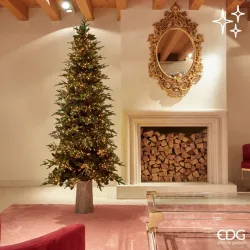
The choice of height is not only a matter of aesthetics, but of the ergonomics of the environment. A simple rule works: the tree should be twenty or thirty centimeters basso the ceiling, so as to leave room for the tip and visual "breathing". In Italian houses with ceilings between two meters and forty and two meters and fifty, the best stage presence is obtained with models between two meters and ten and two meters and thirty; with ceilings at two meters and seventy the sensible jump is between two meters and forty and two meters sixty; Beyond three meters we can think about three full meters or modular projects, providing the correct equipment for assembly. If the tree is placed in the center of the room or in a deep window, it is advisable to go up in size to take advantage of the verticality; in niches and passages, on the other hand, the measure must be kept under control to avoid crushing the scene. When we use important toppers, we mentally add five or ten centimeters to the overall height.
Diameter and silhouette: full, slim, pencil
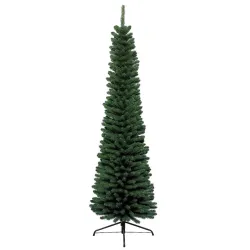
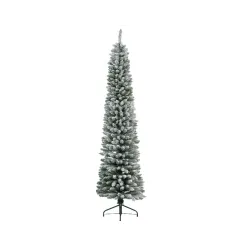
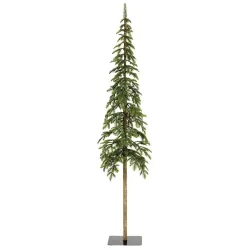
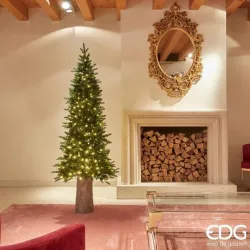
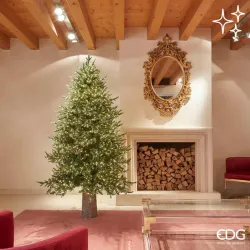
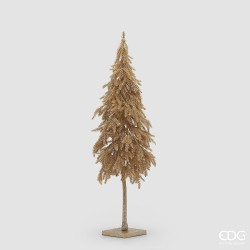
The diameter at the base is the measurement that really affects the overall dimensions. A full silhouette offers a wide and scenic hair, suitable for generous living rooms and halls; however, it requires air around it to be read, otherwise it appears compressed. The slim version retains its vertical presence by reducing the diameter, integrates well into wide corners and corridors and into many shop windows. The pencil silhouette pushes on extreme verticality and solves tight spaces without sacrificing the "whole tree" effect. In homes and boutiques, we recommend reserving at least sixty centimeters of free radius on each side, so as to ensure comfortable passages and a clean perception of the shape.
Finishes: classic green, snowy and contemporary variants
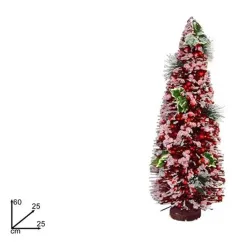
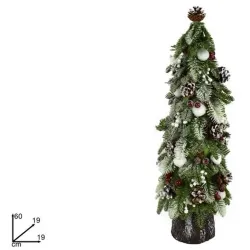
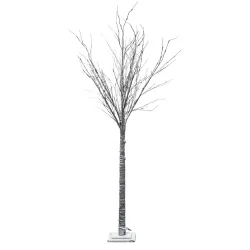
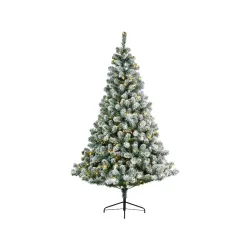
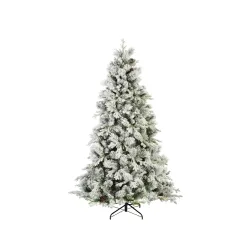
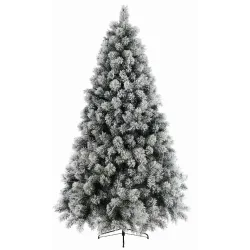
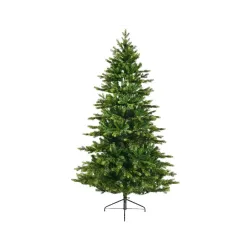
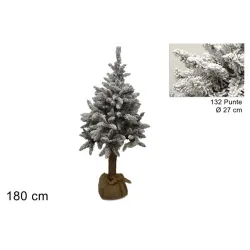
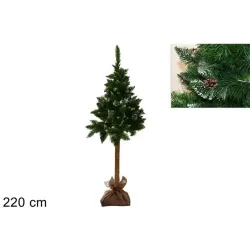
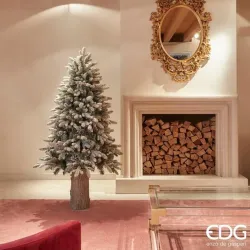
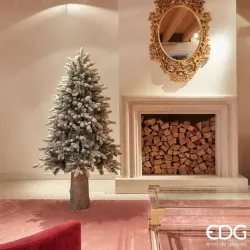
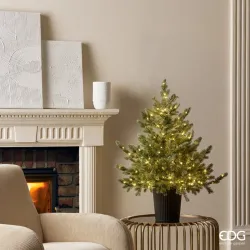
The finish is not a decorative detail, but the first language with which the tree dialogues with the environment. Classic green is transversal and naturally welcomes warm decorations and organic materials; It is the most flexible choice when we plan to renew the styling over the years. The snowy flock builds a luminous scenography even when the lights are off; however, it demands delicate manipulations, because in the first seasons it can release residues. The two-tone finishes, with lighter tips and a darker interior, avoid the flat effect in photography and bleed. The trees with pine cones, berries and micro-branches with an ice effect already integrate part of the visual story and allow quick set-ups without compromising elegance. In minimal and contemporary spaces, a snowy slim with neutral light and transparent glass works; in classic and warm environments, a full green with warm light enhances woods, reds and gilding; In high-end retail, the combination of ice green with satin metals and technical ribbons restores rigor and controlled brilliance.
Illumination: pre-illuminated or free, density and color temperature
Deciding whether to buy a pre-lit model means choosing between speed and creative freedom. Pre-lits offer uniform distribution of light points, invisible wiring and quick connectors between sections; quality is measured by the number of LEDs, the color temperature expressed in Kelvin, the presence of dimmers and controllers with memory, as well as the robustness of the transformer. Trees without lights allow infinite upgrades: we can use cluster chains for brilliance, micro-wire for depth and combine an internal line, close to the trunk, with a more superficial one on the tips to obtain a three-dimensional effect. As an order of magnitude, a rich but elegant result is obtained with three hundred to five hundred LEDs on one hundred and eighty centimeters in height, five hundred to eight hundred on two meters and ten, seven hundred to one thousand on two meters and forty, and up to one thousand two hundred to one thousand and eight hundred on three meters. The warm temperature between two thousand two hundred and two thousand seven hundred Kelvin builds a cozy atmosphere; a neutral between three thousand and four thousand Kelvin supports cold vanes and mirrored materials; Multicolor makes sense in Family Rooms and Kids departments, as long as the controller programs prioritize smooth transitions. In every scenario, we prefer low-voltage power supplies and clear indications of the maximum power that can be connected in series.
Canopy density: number of tips and branch architecture
Fullness is not an impression, but a sum of parameters. The number of tips is the most intuitive metric: for the same height, more tips mean greater density and better distribution of ornaments without visual holes. On a tree of one hundred and eighty centimeters a realistic scissors starts from seven hundred and reaches twelve hundred points; on two meters and ten meters you work well between twelve hundred and one thousand seven hundred-eighteenhundred; on two meters and forty you need at least eighteen hundred and up to two thousand eight hundred; On three meters, the best architecture easily exceeds two thousand eight hundred and can go beyond four thousand five hundred. The combination of PE on the ends and PVC on the inside helps both the glance and the practical handling of cables and decors. Finally, the architecture of the branches makes the difference: better branches with adjustable secondary branches, capable of fanning out and filling the volume, rather than a few rigid arms that create unnatural visual corridors.
Basics, stability and security
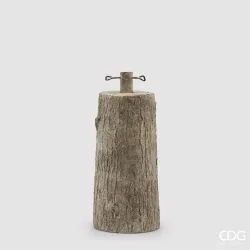
A foldable metal base with non-slip feet is the most stable solution in heights over two meters and ten. Plastic elements are lighter and can work on small sizes or in temporary installations, but in the presence of many decorations in alto the center of gravity must be managed carefully. In shop windows or passage areas, we suggest discreet ballast or punctual fixings, always in compliance with safety policies. Cable management must be planned before assembly, choosing the exit point near the socket to avoid penetrations to the floor; When there is no alternative, a low channel solves the aesthetic and regulatory issue. The materials of the needles, in quality products, are added with flame retardants; We always ask for the manufacturer's documentation and observe the minimum distances to heat sources indicated in the instructions.
Brand, warranty and service
The brand is not a label, but a set of processes: design, quality control, availability of spare parts and clarity of technical information. We always evaluate transparency on the board: percentage of PE and PVC, diameter at the base, number of tips, type of hinges, accessories included and duration of the warranty. In the pre-illuminated models, the cover on the electrical components and the possibility of replacing individual sections make the difference in the real life cycle. Premium references, such as EDG – Enzo De Gasperi, stand out for the realism of the tips, well-kept silhouettes and consistency of the collection: aspects that allow you to renew the styling over the years without changing the "backbone" of the set-up. Even seemingly minor details, such as the absence of strong odors at the first assembly, the quality of the seals and the robustness of the packaging, are useful signs to distinguish a well-made project from a hasty product.
Assembly, fluffing, maintenance and storage
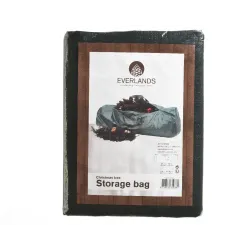
The mounting method is only as good as the quality of the shaft. We put on gloves, assemble the base and insert the first section: we open the branches starting from the inside, separating the subdivisions and shaping them in several directions to eliminate optical corridors. We proceed in sections, climbing calmly and checking the balance of the profile at each step. If we use external lights, we first place a deep line near the trunk and then a more superficial one on the tips; The luminous depth enhances the texture of the needles and gives a showcase effect. On a tree between two and ten meters and two meters and forty, half an hour or an hour of work dedicated to fluffing transforms the final result. Maintenance is routine: an antistatic dust cloth and, on flocked models, a soft brush or light air, avoiding humidity. For storage, we choose a dry and dark place; A reinforced bag protects better than cardboard boxes, especially if we plan frequent transport. In the retail sector, it is advisable to archive a set-up sheet with photos and notes on the light density and distribution of decorations; the following year's editing becomes almost automatic.
Standards, Markings and Electrical Safety
For pre-lit trees and the light chains we use on non-pre-lit trees, compliance is not an option but a working condition. Light chains fall within the scope of the European low voltage framework and the reference technical standard for decorative chains is EN/IEC 60598-2-20. In practice, this means that products are designed and tested for their intended use, with clear instructions and legible markings, including distinguishing between indoor and outdoor use only. When the set-up continues outdoors, we look for an adequate degree of protection against atmospheric agents: IP44 is the minimum reasonable level for typical exposure to rainwater and splashes; In exposed or permanent installations, we aim for professional solutions with superior protection. Perceived safety increases when the power supply is at very low safety voltage: SELV transformers with 31, 24 or 12 volt outputs, watertight connectors and wiring suitable for installation. In Italy, in addition to the CE marking, we can consider the voluntary third-party marks (IMQ, ENEC) as independent control indicators.
Energy, light and objective data
The difference between LED and incandescent is not a cliché but a measurable order of magnitude. An incandescent chain of one hundred bulbs can absorb around forty watts, while a compact LED chain of seventy light points is around five watts in total. We can translate these numbers into operational choices. If for a two-and-forty-meter tree we choose about eight hundred LEDs distributed between the inside and outside of the canopy, the overall consumption remains in the order of a few tens of watts. In a typical season with six hours of ignition a day for thirty days, we are talking about a few units of kilowatt hours. Colour temperature is a design variable: around 2200–2700 kelvin we obtain a warm domestic light; Going up towards 3000–4000 Kelvin the yield becomes more neutral and graphic, useful with cold palettes and reflective materials.
Environment: reuse thresholds and substances
On the environmental level, the synthesis studies converge on a reuse threshold. An artificial tree uses energy and materials in production; The climatic convenience compared to a real reused or composted sapling is achieved in the medio period. The useful window varies according to weight and materials: we are talking realistically about different seasons, up to counts that reach a dozen years; beyond that threshold, the artificial becomes a consistent choice as long as it continues to be reused. On substances, the European framework allows consumers to ask suppliers if the article contains substances of very high concern by more than 0.1% by weight. For the flocking of snow-covered trees, modern chemistry often uses cellulosic fibers with flame-retardant adhesives and additives; This does not eliminate the need for prudent handling and case-by-case assessment of safety data sheets.
End of Life, WEEE and Good Practices
When the lights are integrated into the product, the tree at the end of its life falls within the perimeter of electrical and electronic waste. Appropriate management involves disposal in suitable centres, avoiding dry disposal. The external light chains follow the same logic: they are electrical appliances in their own right, also recognizable by the symbol of the crossed-out bin. In a circular logic, the choice of shafts that are not pre-lit or with modular and replaceable electrical segments reduces the risk of having to scrap the entire body at the first electrical failure.
Guarantees and assistance in the EU
In the European market, the legal guarantee of conformity for consumers is two years and is exercised against the seller; Many brands extend coverage in commercial form. Our selection method favours manufacturers with comprehensive technical documentation, availability of spare parts for light segments and clear language instructions, in line with the new general product safety framework in force in the EU.
Choosing the right tree means starting from space and use, reading the specifications carefully and investing in materials and structure that stand the test of time. With consistent lighting design and methodically executed fluffing, even a medio budget returns a professional and repeatable result. For those who want a safe reference in terms of realism and durability, EDG collections represent a reliable base on which to build Christmas seasons consistent with the identity of their environment.