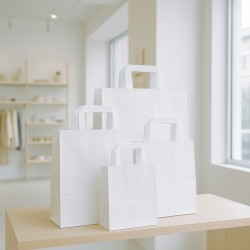
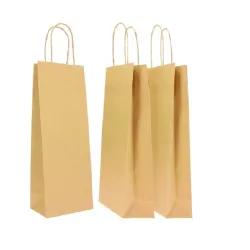
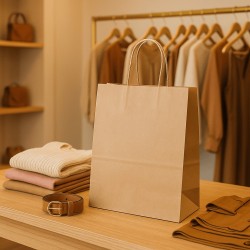
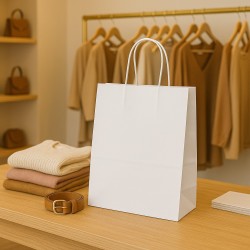
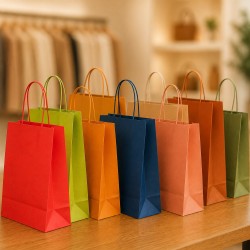
If you say "shoppers", "envelopes" or "bags" in your store, you are actually talking about the same thing: the first packaging that the customer takes away and that, outside the door, continues to tell who you are. It's not just the graphics or color that make the difference. Above all, the handle does it, because it is the point where the customer really feels quality: in the grip, in the comfort, in the stability while walking, in the safety with which he carries the purchase. This is where the most common, and also the most strategic, question arises: is it better to have a shopper with a flat handle or a shopper with a drawstring handle?
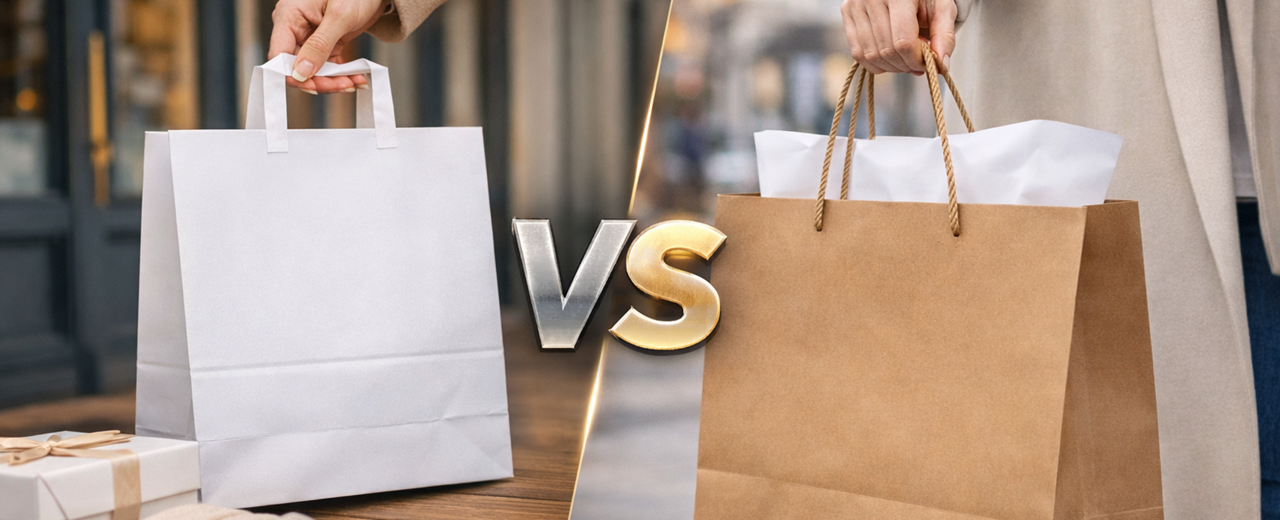
Choosing between a flat handle and a lanyard handle is not a technical detail: it is a decision that affects the customer experience, the perception of your brand and efficiency at the counter. A flat handle communicates essentiality, speed, practicality; It's often perfect when you have a quick checkout flow and want neat, replicable packaging. A drawstring handle, on the other hand, increases comfort, immediately raises the "premium" tone and makes the shopper more pleasant to carry and more likely to reuse, especially when it comes to gifts, boutiques or purchases that need to "make experience". But the truth is, there is no absolute right choice: there is the right choice for you, for your positioning, for the type of products you sell, and for the way customers experience leaving your store.
In this guide, focus on a practical method for deciding without going by feeling. You will understand how to evaluate weight and format, why a paper bag or paper bag that is too large or too small can ruin the final effect, and how to choose the handle based on what you really deliver every day, not on the basis of exceptional cases. You will also see how needs change if you work in retail, if you manage a store with a high turnover, if you have a more "boutique" identity, or if you prepare orders and packaging for e-commerce and want delivery to be consistent with the idea of quality you promise online. Because the shopper is not just a container: it is an extension of your brand, a communication tool, and often the first element that determines the perceived value of the purchase.
There is another point that matters, especially today: the shopper is also an object that can be kept around. Personalized shopping bags, when they are well designed, become a recurring presence in the customer's life. An envelope that is reused is a silent and continuous advertisement; An uncomfortable or fragile bag, on the other hand, soon ends up in oblivion and leaves a feeling of approximation. For this reason, talking about flat handle vs lanyard handle means talking about image, care, tightness, comfort, sustainability understood as durability and reuse, and also practical management: time at the counter, standardization, stocks, visual consistency over time.
If you really want to choose "the right one", you have to get out of the logic of personal taste and adopt clear criteria: how and how much the shopper is carried, what it contains, how essential or premium it should seem, and what kind of experience you want the customer to have, from the moment of delivery to the home. Here you will find a complete path to do this, with a simple but decision-making language, so you can transform shoppers, bags or bags into a concrete packaging and positioning lever, not into an inevitable cost.
Why the shopper is not a detail: what it communicates even before the product
When you deliver a purchase, you're not simply "putting away" a product – you're closing the experience. The shopper is the last thing the customer touches inside the store and the first thing they show outside. In a few seconds it tells if you pay attention to details, if your style is consistent, if what you sell is designed to last or just to change hands.
The shopper works on two floors at the same time. On the one hand, it is functional: it must hold, protect, accompany. On the other hand, it is pure communication: it is a visual signal that travels on the street, in the car, in the office, at home. If it is orderly, proportionate and well chosen, it immediately raises the perceived quality. If it is wrong, it clashes, deforms, bends or "screams" incoherence, it weakens everything else, even when the product is excellent.
There is a point that is often underestimated: the shopper is not judged only by how she looks, but by how she behaves. If it is uncomfortable to carry, if the weight "cuts" the hand, if the handle gives way or if the contents dance inside, the negative feeling remains longer than you imagine. The customer may not tell you, but he will remember it. And when it comes to loyalty, what remains in the memory weighs as much as what is seen.
In this sense, the handle is not a technical detail: it is an element of experience. It determines comfort, conditions the perception of solidity, communicates a choice of style. A flat handle can say essentiality, pragmatism, speed. A lanyard can say attention, gift, premium. Neither is "better" at all: it is the right choice for your context that makes the difference, because it allows you to be consistent with what you sell and how you want to be remembered.
If you work with a counter that needs to be fast, the shopper must help you and not slow you down. If you work on a more alto positioning, the shopper must support that expectation and not contradict it. And if you want the customer to reuse the bag and keep it around, then you're not just choosing one container – you're building repeat contact with your brand. This is where a seemingly simple decision becomes strategic.
In the world of ChartaRè packaging, the shopper is part of the system: she does not live alone. Dialogue with the colors of your store, with the quality of the materials, with the care of the interior, with the time you have available at the checkout. And precisely because it crosses so many factors, choosing between a flat handle and a lanyard handle should never be an automatic gesture. It is a choice that you can govern with clear criteria, and in the next chapters you will focus on them one by one, leaving nothing to chance.
Flat Handle vs Lanyard Handle: Real Differences (Not Just Aesthetics)
When you compare flat handle and lanyard handle, the temptation is to stop at aesthetics: one appears more essential, the other more polished. In reality, the difference is more concrete and concerns three aspects that directly affect how the customer experiences the purchase: the sensation to the touch, the convenience of transport and the positioning message that the shopper conveys.
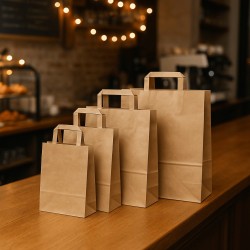
The flat handle is the most linear and functional choice. At a glance it communicates immediacy, practicality, an idea of "clean" packaging. It is a solution that lends itself well to everyday use and, above all, integrates naturally into a fast cash flow. It does not require any special direction: if the paper is well structured and the format is the right one, it does its job consistently and without attracting attention to itself. And this, in many cases, is an advantage: the packaging accompanies, not overpowers.
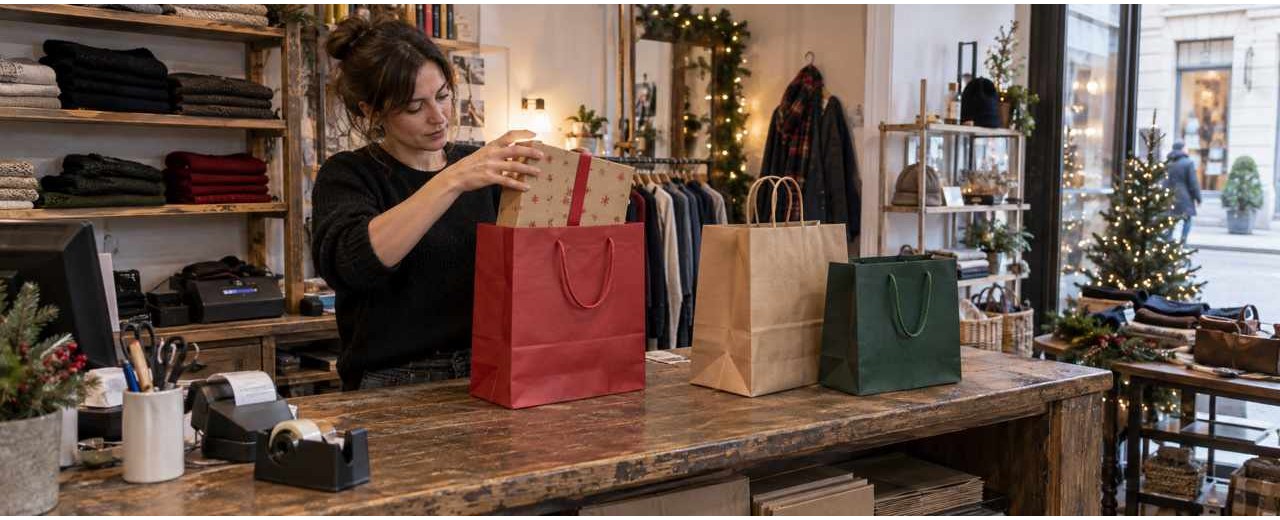
The lanyard, on the other hand, carries with it a different language. The shopper with a drawstring handle tends to be perceived as more "important" from the first contact, because it introduces a detail that the customer associates with care, gift, boutique. It's not just a visual effect: it's also a matter of ergonomics. As the load grows or when the shopper is in the hand longer, the lanyard changes the carrying feel, making it generally more comfortable. This affects the memory of the experience: a delivery that does not "weigh" on the hand is experienced as more pleasant and, often, more premium.
The most interesting difference, however, lies in the implicit message. The flat handle conveys a sober, essential, contemporary elegance, especially when it is inserted into a coherent system of paper, printing and colours. The lanyard, on the other hand, signals that you are investing in a more complete experience, where the container also plays a role. This is why, in many cases, the lanyard becomes the natural choice when you want the shopper to be reused: the customer is more likely to keep it, carry it with them and consider it a "good" item, not just a bag.
That said, there is a typical mistake that is worth avoiding: thinking that the lanyard automatically makes the shopper premium or that the flat handle is necessarily "basic". It doesn't work like that. A shopper with a cord but with weak paper or the wrong size loses credibility. Similarly, a shopper with a flat handle, if well designed in structure and with attention to graphics, can be extremely elegant and consistent with a high-end brand. The handle isn't a trick that raises the bar on its own: it's an element that amplifies what the rest of the packaging is already saying.
In summary, the choice is played on how you want the customer to perceive your store and how you want them to feel while taking away the purchase. If you're looking for cleanliness, speed, and an essential footprint, the flat handle is often the smartest answer. If you want to increase comfort, perception of value and likelihood of reuse, the lanyard becomes a powerful ally. In the next chapters you will get into the concrete, because to make a good decision it is not enough to know the differences: you need to understand how weight, format and content completely change the choice.
Durability and portability: how to choose based on weight, format and content
To really choose between a flat handle and a lanyard, you need to shift your focus from "what I like" to "what happens when the customer leaves the store". The shopper can be beautiful, but if it doesn't hold up or if it makes transport uncomfortable, everything else loses value. This is where three decisive variables come into play: weight, format, and type of content.
The first step is to think realistically about your weight. There is no need to take the heaviest receipt of the year as a reference, and not even the receipt medio "perceived". You have to think about what really happens in most cases: how much a purchase weighs on average, and how much a "frequent but challenging" purchase weighs, i.e. that range of orders that is not rare, but puts the shopper to the test. When you are clear about this, the handle stops being a detail and becomes a comfort component. In general, the more weight increases, the more likely it is that the lanyard will be the most comfortable choice, especially if the customer has to walk or carry the bag for a long time.
Then there is the format, which is often the real sticking point. A shopper that is too large for the contents gives an impression of lack of care: the product moves, tilts, "dances", and the customer perceives instability. A shopper that is too small, on the other hand, creates tension: you force insertion, increase creases and stress on the paper and handle, and make the operation slow at the counter. The right format is the one that contains the product in a natural way, without constricting and without leaving unnecessary voids. When the format is correct, the handle also works better, because the effort is distributed in a more balanced way.
The third variable is the nature of the content. A soft product, such as a folded garment or a textile accessory, is more "forgiving": it adapts to the container and often does not require a particularly rigid structure. A rigid product, such as a box, changes everything: the shopper must maintain shape and stability, otherwise the contents push, deform, create edges and increase the risk of sagging. If the contents are fragile, then, it is not enough for the shopper to hold up: it must also protect. In this case, the choice of handle is intertwined with the choice of structure and interior, because a comfortable handle does not compensate for an unstable packaging.
When you put these three elements together, a simple rule emerges: the handle should not be chosen alone, it should be chosen together with the "design" of the shopping bag. If you know the contents are heavy or stiff, the lanyard handle tends to give a noticeable advantage in portability, but it only really works if the shopper is adequate in paper and construction. If you know that the content is light and the path is short, the flat handle can be perfect, as long as the size is correct and the paper does not appear poor or sagging. In other words, comfort is not just in the handle: it is in the balance of the system.
There is also an operational aspect that is worth as much as resistance: management over the counter. If you work with many variations, you waste time, get the format wrong, create clutter and waste. On the other hand, if you narrow down the choice to a few smart formats, you cover most of the sales and maintain visual consistency. An essential but well-calibrated range allows you to be fast, to deliver well and to avoid those situations in which, to "make do", you end up using an unsuitable shopper and ruining the experience right at the last moment.
In this chapter the key question is not "flat or lanyard?", but "what should it carry and how should it be carried?". When you answer precisely, the right handle becomes almost a natural consequence. In the next chapter you will enter the aspect most perceived by the customer: comfort, reuse and that subtle but very powerful idea of quality that a shopper can build, or destroy, in a few meters outside the door.
Customer experience: comfort, reuse and perception of quality
When a customer leaves the store, the shopper becomes his "travel companion". If it is comfortable, stable and pleasant to the touch, the experience continues in a positive way. If, on the other hand, it is uncomfortable, cuts the hand, deforms or forces you to hold the contents carefully, the memory of the purchase becomes dirty. And often it doesn't take an obvious problem for this to happen: a small feeling of annoyance is enough for the customer to associate, even unconsciously, with an idea of less care.
Comfort is the first lever. It's not just a question of weight, but of how that weight is perceived. A lanyard handle, in most cases, is experienced as more comfortable when the shopper remains in the hand for a long time or when the contents are challenging. The cord also communicates a certain "softness" of the experience: the grip is more pleasant and, in many situations, gives the idea of a well-accompanied product. The flat handle can be absolutely adequate and functional, but it requires even more attention to the overall balance, because if the shopper is even slightly undersized or the paper is poorly structured, the customer immediately feels it.
The second lever is reuse, which is a commercial issue even before it is an aesthetic one. A shopper that the customer reuses becomes a channel of continuous visibility. It is an object that returns to the street, enters other stores, is seen in the office or in the gym. And reuse doesn't just depend on robustness: it depends on whether the shopper is perceived as "good". The lanyard handle helps, because it increases the likelihood that the customer will consider it an object to keep. But the rule of the system also applies here: if the shopper is well proportioned, has a pleasant paper and a consistent appearance, it can also be reused with a flat handle. The point is not to imitate premium: it is to build credible, recognizable, repeatable quality.
The third lever is the perception of quality, which arises from the way in which all the elements add up. The customer does not analyze the shopper piece by piece, he "feels" it as a whole. If the structure is stable, the print is clean, the color is consistent and the content stands still, then the shopper reinforces your image. If, on the other hand, there is inconsistency, if the paper appears fragile or the format is random, even the most accurate detail loses effectiveness. This is why a shopper with a drawstring but with weak paper can be less premium than a well-designed flat handle shopper shopper. The lanyard, alone, does not save the experience. The flat handle, on its own, does not impoverish it. It is the whole that speaks.
Then there is an often underestimated, but very powerful aspect: the moment when the customer opens the shopper at home. If he finds a tidy interior, if the product is protected and presented with care, the experience is prolonged and consolidated. Here there is no need to exaggerate, we need consistency. Even a simple well-kept interior, with a paper that protects and gives order, can transform the perception of quality without increasing too much time and costs. When the shopper is thought of as part of a system, the customer feels that everything has been designed, not improvised.
In practice, the customer experience is the sum of micro-sensations: grip, stability, touch, order, visual coherence. These are details that are not noticeable when they work, but are immediately noticeable when they are missing. And this is precisely why the choice of the handle should always be made looking at your positioning: what you deliver must live up to what you promise. In the next chapter, in fact, you enter the most strategic point: how to align the choice between essential and premium, without confusing the customer and without complicating the work at the counter.
Store positioning: when "essential" and when "premium" is convenient
The handle you choose isn't just about practicality: it's about you. Tell your position immediately, without the need for words. For this reason, the question is not only which solution is more comfortable or more resistant, but which solution is consistent with the experience you want to offer and with the type of store you want to be in the customer's mind.
If you work on an essential approach, the priority is clarity. You want clean, functional, quick-to-manage packaging, always the same. In this scenario, the flat handle is often the most logical choice, because it accompanies the purchase without turning it into a ritual. The point, however, is not to slip into the "anonymous" effect. Essential does not mean poor. It means designed. If the paper is well structured, if the format is correct and if the visual identity is consistent, the flat handle becomes a sign of modernity and control. It conveys that you know exactly what you're doing and that you don't need to "decorate" to look level.
If, on the other hand, your positioning is more premium, the shopper must support a different expectation. Those who buy from you expect a more refined experience, a slower and more intentional gesture, a detail that makes them perceive value. In this case, the lanyard handle is often the natural choice, because it immediately raises the tone of the delivery. It's not just aesthetics: it's an implicit promise of comfort and attention. But premium, even here, cannot be improvised. If you choose the lanyard and then let the shopper feel flimsy or disproportionate, you create a dissonance. The customer feels that you are trying to "dress" a container that does not hold up to the promise. Premium works when every element is consistent: paper, structure, handle, graphics, and possibly even the interior.
Then there is a third, very frequent scenario, which concerns peak periods and special occasions. During parties, ceremonies, product launches or moments with alto symbolic value, the customer does not just buy an object: he buys a gesture. In these cases, the shopper becomes part of the gift. Here the lanyard is often an advantage, because it helps to communicate "opportunity", but the smartest choice is not to change everything: it is to have a system that adapts. If you have to reinvent delivery every year, you waste time, create inconsistency, and risk ending up with random solutions just when you should be most solid.
To govern these three scenarios without complicating your life, the most effective strategy is a double line. You need a daily line, designed for efficiency and repeatability, and a gift line, designed to raise the bar when needed. With this approach, you don't have to choose once and for all. You give yourself the opportunity to be essential when the sale requires it and premium when the occasion deserves it. And above all, you avoid the most common mistake: always using the same shopper for everything, transforming an important purchase into a "standard" delivery or, on the contrary, making the work at the checkout cumbersome for sales that require speed.
In this chapter, the point is not to decide which handle is better, but to understand what language you want to speak. If your store is geared towards speed and cleanliness, the flat handle can become a style choice, not a compromise. If your store thrives on experience, gift, and perceived value, lanyard can be an investment that pays off in memory and reuse. In the next chapter, you put it all together and take action: you turn these criteria into a practical method, so every choice becomes quick, consistent and easy to replicate at the counter.
In practice: how to choose the right handle (flat or lanyard)
At this point, you are clear about the benefits and implications of both solutions. Now you need a simple method, which allows you to decide in a few seconds without going "by feeling" and without finding yourself, every time, improvising at the counter. The choice of the handle becomes immediate when you cross three elements: what type of purchase you are delivering, how much it will have to be carried and what image you want to convey.
Always start with use, because it is the most stable indicator. If you're delivering an everyday, quick purchase that needs to go out efficiently, the flat handle is often the smartest choice. It helps you maintain speed, control, and consistency, especially when managing volumes. In this context you are not "taking away value", you are choosing essential language. Value, if anything, is built with the overall quality of the shopper: a pleasant menu, a structure that does not yield, a format that fits well and clean graphics.
If, on the other hand, the purchase has a gift or occasion component, the cord handle becomes a natural ally. Not because it is mandatory, but because it immediately raises the tone of the experience and makes the delivery more "important". It is the difference between a container that accompanies and a container that participates. In these cases, even a minimal detail inside plays its part: a visual order, a protection, a presentation that avoids the "thrown in" effect. You don't have to do more, you have to do it better and consistently.
The second step concerns the weight and, above all, the time in hand. This is where the theory becomes reality: what weighs little for you can become uncomfortable for the customer, because weight is not the only factor; it matters how it is perceived while walking, running other errands, getting into the car, entering an office. When the contents are medio or heavy and you plan to carry longer, the lanyard tends to be more comfortable and therefore more "premium" even if only for a physical reason. If, on the other hand, the path is short and the load is light, the flat handle works very well, as long as the shopper is proportionate and stable. In other words, it is not just "how much it weighs", but "how and for how long it will be carried".
The third step is positioning, i.e. consistency with the image you want to leave. If your language is essential, the flat handle should feel like a deliberate choice, not a fallback. To do this, you need to avoid two mistakes: using random formats and choosing a structure that immediately gives the idea of fragility. If your language is premium, the lanyard must be supported by a shopper that is solid, tidy, coherent. In this case, the most common mistake is to think that the lanyard "does everything": if the paper is weak or the print is confused, the final effect is inconsistent and the customer perceives it immediately.
When you have these three criteria in mind, you can also take an organizational leap without complicating your life: build a set that covers most situations. It almost always works like this: a daily line designed for speed and repeatability, and a line for gifts and occasions that raises the bar when needed. With this approach you are not forced to fit everything into a single choice, you avoid "wasting" premiums where you don't need them and, above all, you don't lower the experience when it should be more curated.
The most important part of this chapter is that you're not choosing a handle, you're choosing a consistency. When the handle is right, the customer does not notice it as a detail: he experiences it as natural. And when it is natural, the experience flows, the perceived quality rises and your delivery stops being a technical step to become a gesture that reinforces the value of your store. In the next chapter, close the circle with a concrete checklist, so you can make this choice repeatable, standardize the counter and always maintain the same level, even in the busiest periods.
Final checklist: 10 questions to choose the right shopper and standardize the counter
When you get to the end of a purchase, the packaging must always work, not "almost always". On quiet days it is easy to be impeccable. You make the difference when there is flow, when you have little time, when the priority is to deliver well without slowing down the sale. This is why a checklist is useful: not because it complicates, but because it allows you to standardize and minimize impulsive choices, those that then generate inconsistency and waste.
The first question you need to ask yourself is about the real weight of what you sell. Don't think about the single exceptional case, but about what happens every week. Ask yourself how much a receipt weighs on average and what weight, however frequent, really puts the shopper to the test. From here you immediately understand if you just need an essential solution or if you need a more comfortable portability.
Then look at the nature of the content. A soft product fits, a rigid product pushes and deforms, a fragile product requires stability and protection. If you don't consider this point, you risk choosing a shopper that is perfect "in theory" but unsuitable "in practice", because the content is precisely what determines the stress and behavior of the material.
Immediately after comes a question that many underestimate: how long the shopper will stay in the hand. If the customer makes a short commute, the experience is different than a day of errands, a walk, or a long commute. Comfort is measured by durability, not just weight. This is often where a lanyard handle proves to be more consistent, while in other cases a flat handle does its job just fine without adding complexity.
At this point, you need to clarify whether you are delivering an everyday purchase or a purchase with a gift component. It is a simple but decisive distinction. In the gift, the shopper becomes part of the gift, so every detail weighs more, even emotionally. In everyday life, however, the cleanliness of the gesture counts: order, speed, consistency and no friction.
Now positioning comes into play: what image do you want to leave in the customer's hands? If your language is essential, you need to make sure that the choice seems deliberate and not cheap. If your language is premium, you need to make sure that every element holds up to the promise. In both cases, consistency is more powerful than the amount of detail: better a few right elements than too many different solutions.
The next question is the one that makes everything sustainable: how many formats do you really need? If you want to cover 80% of situations, a few well-chosen measures are often enough. When you multiply formats without criteria, you increase errors, slow down delivery and find yourself using the wrong shopper because "it's the one I have at hand". Standardizing doesn't mean limiting yourself: it's controlling the experience.
At this point, evaluate the inside, because the experience does not end outside the store: it continues when the customer opens the shopper. If the interior is neat and protective, order increases and the perception of quality rises without the need for excess. If, on the other hand, the content is "left free", even a beautiful shopper can lose effectiveness. There is no need to make scenography: you need a presentation logic that is replicable and fast.
Then ask yourself how much time you can afford at the counter. It's an operational question, but it determines everything. If the packaging is complex, it will perform poorly at peak times. If it's too simple but inconsistent, pull down the image. The right solution is the one that maintains quality even when you are in a hurry: few choices, clear gestures, ready-made materials.
Another decisive question concerns continuity. Can you keep the same shopper over time or do you have to change often? Constant changes confuse the customer and weaken the identity. A well-set choice involves stocking, reordering, and a stable line of sight. If you want to build recognizability, the rule is simple: solid continuity is better than random alternation.
Finally, do the last check: shopper, interior and final detail speak the same language. Colors, style, finish, overall tone. If each element is consistent, the customer perceives quality even without being able to explain why. If something is out of tune, he immediately notices it, and the experience loses compactness.
When you answer these questions clearly, the right handle is no longer a doubt. It becomes a consequence. And above all, it becomes a replicable choice: you and your team know what to do, in every situation, without improvising. If you want to simplify even more, the most effective solution remains to build two lines: a daily one, fast and consistent, and one dedicated to gifts and occasions, capable of raising the level without slowing down the counter. In this way, you control costs, image and operations, and turn delivery into a gesture that reinforces the value of your store.
Ultimately, choosing between shopping bags, pouches or pouches with a flat handle and shopping bags with a drawstring handle means making a choice of consistency, not just style. The handle is the point at which the customer measures quality immediately: in the grip, in the stability, in the ease with which he takes away the purchase. If the delivery is convenient and orderly, the perceived value goes up; If it is uncomfortable, unstable or improvised, even an excellent product risks losing strength right at the final moment, when the experience should be consolidated.
The flat handle is often the most effective solution when you want speed at the counter, standardization and a pared-back, contemporary image. It works great if the shopper is designed wisely, with structured paper, correct size and clean graphics. The drawstring handle, on the other hand, is ideal when you want to increase comfort and premium perception, especially on gift purchases, special occasions or situations where the shopper remains in the hand for a long time. In many cases, it is also the choice that most favors reuse, transforming the bag into an object that remains in the customer's daily life and continues to talk about your brand.
The key point, however, is to remember that there is no one-size-fits-all rule. The right choice depends on what you really sell every day, the weight and size of the content, the path the customer takes after the purchase and the positioning you want to communicate. When you apply these criteria, you stop reasoning by "preferences" and start reasoning by method. And when you have a method, you can standardize, reduce errors, improve checkout speed, and achieve visual consistency that reinforces your identity over time, both in-store and e-commerce.
If you want to simplify further, the most solid strategy remains to build a system in two levels: a daily line, practical and replicable, and a line dedicated to gifts or premiums, capable of raising the perceived quality when needed. This approach helps you control your budget and stock, but more importantly, it allows you to respond to different scenarios without improvising. It is the difference between "any shopper" and a shopper chosen to support sales, image and loyalty.
In today's packaging, shoppers, pouches and bags are not accessories: they are an extension of your service. When the handle is the right one, the customer does not notice it as a technical detail: he experiences it as natural. And what is natural, convenient and consistent is what is remembered, reused and associated with quality. If you want to make this choice even easier, build your counter set starting from a few smart formats and a consistent visual line, so that each delivery becomes a clear, recognizable gesture that lives up to your positioning.