The guide in 10 minutes
When you start thinking about outdoor furniture, the most common temptation is to start with aesthetics: a matching set, a color you like, a sofa that "sets the mood." But the outdoors is not a storefront and does not live in protected conditions like the indoors. To buy well, you have to think as if you were designing an extra room, with real constraints and precise goals: usability, durability, sustainable maintenance, comfort over time. If you set the process this way, every choice returns value to you, and the end result is not only beautiful, but above all livable.
The starting point is the space, the real one, not the "imagined" one. Before you buy, you need to understand real dimensions, passageways, French-door openings, slopes and critical points. You need to look at how the sun travels through the area, how much wind it gets, how humid it is in the evening, whether you are exposed to side rain or salt spray. Here comes the decisive step: define the dominant use. If your outdoor is social, then table and seating should be the heart of the design. If it is relaxation, reading and conversation, then the lounge area is prioritized. If you're looking for both, the key word becomes flexibility: modular furniture, correct proportions, and layouts that don't block flows. An outdoor space works when you move naturally, without having to move chairs every time you open a door or take out a tray.
Having clarified the space, you need to address what really determines durability and perceived quality: materials and structures. Outdoors, the difference between "good as new" and "good over time" is huge. Structure is the basis of comfort and safety: if it is weak, vibrates, warps, or oxidizes, everything else loses value even if the upholstery is elegant. Materials such as powder-coated aluminum are often a rational choice because they combine lightness and strength, but you must always evaluate frame rigidity and finish quality. Ferrous metals and painted steels can be solid and convincing, but they require attention to paintwork and vulnerabilities because scratches and stagnation can accelerate aging. Wood is a warm and prestigious choice, but it demands proper maintenance and expectations: it changes, matures, and needs care to remain beautiful. Synthetic weaves and outdoor ropes can be excellent if they are designed well, while resins and plastics make sense if you accept more limited aesthetic durability and favor practicality and budget. Table tops should also be chosen with everyday life in mind: cleanliness, stains, bumps, weight, and base stability should be consistent.
Once you have chosen the "body" of the furniture, comes the "skin": fabrics and cushions. This is where you decide whether your outdoors will be truly comfortable or whether it will become a place you avoid because it is always damp, uncomfortable or difficult to manage. Outdoors means designed for sun, rain, and moisture: fabrics that are UV-resistant and easy to clean, padding that won't retain water like a sponge, linings that are easy to remove, and seams that won't sag. Comfort is not the same as immediate softness: quality lies in support and the ability to remain stable over time. You need to choose pillows that dry reasonably well and do not force you to move constantly. If daily management becomes a chore, you will stop doing it, and at that point, even a good product will seem like a bad purchase.
The most underrated chapter, and often the one that decides the success of the purchase, concerns mechanisms, hardware and stability. Extending tables, reclining chairs, adjustable loungers and moving components are sensitive points because what moves is most exposed to wear, dust and moisture. Quality is seen in the smoothness of movement, the solidity of the block, and the absence of vibration and play. An extension table must become stable when open, not just open. A crib must hold different positions without creaking or sagging. The hardware must be protected and well designed, because outside, it's not just the weight that counts: it's the weather that counts. Safety is also part of quality, especially if you have children or guests, because crush points and unreliable locks are not acceptable in a serious product.
Having clarified how to recognize quality, you need to address the more practical issue: what to buy first. The winning strategy is not to "fill," but to build by priority. The first purchase must make the space usable right away. If you live the outdoors for eating, table and seating are the main investment. If you live it to relax, lounge seating is what turns the area into a desirable place. Sunbeds and sunroom solutions make sense if you really will use them and can manage movement and protection. The square footage changes the logic: on small balconies you need multifunction and lightness, on medium terraces you need to avoid crowding and keep free flows, in the garden you need to avoid dispersion and create a "heart" close to the house. The smart choice is to buy a few elements well and complete them later, when you know for sure what is really missing.
This is where shade and protection come in, which are not accessories but infrastructure. Shade determines livability during decisive hours and also protects furnishings, slowing their aging. Umbrellas, pergolas, tents and sails work if they are chosen according to exposure and wind and if they have proper structure and fixings. A parasol is a mechanical element under stress: base and joints are crucial. A pergola can transform the outdoors into a room, but it should be considered as a structural investment, with attention to stability and water management. Protection, however, is also about what happens when you are not outside: where you put cushions, how you cover furniture, how sustainable the routine is. If protecting becomes tiring, you'll stop doing it, and that's when the problems start. The right solution is one that you can maintain consistently without stress.
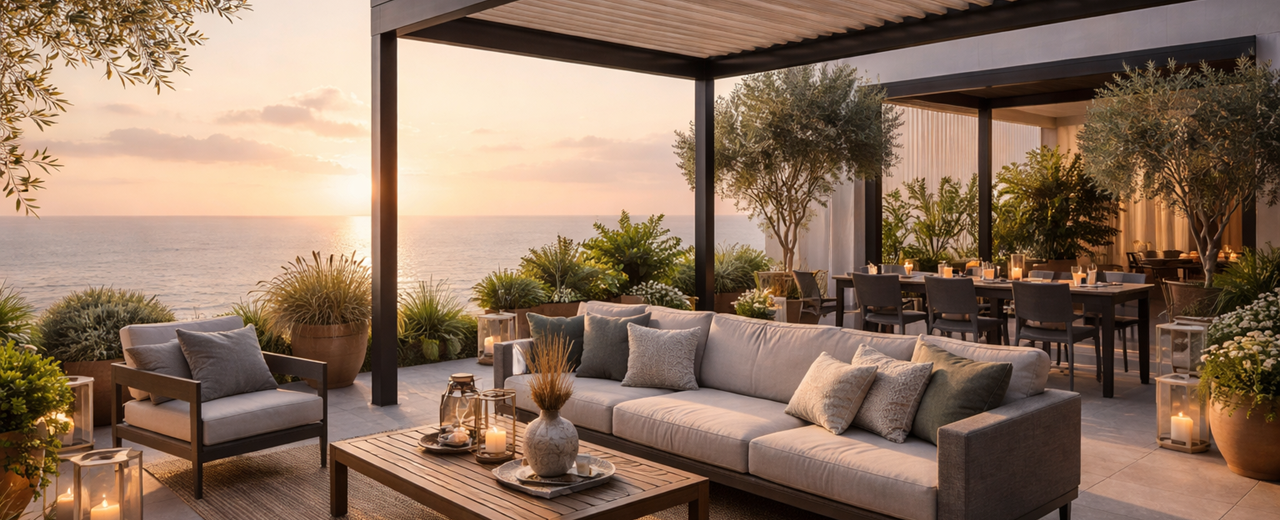
Finally, style and colors serve to give identity and consistency, but they must be managed with a logic of durability. The successful exterior looks designed because it has a clear visual language, not because it is full. Neutrals are not a "characterless" choice: they are a strategic foundation that allows you to renew the atmosphere with accessories and textiles, without replacing big pieces. Treat the exterior as a room: balance volumes, let the space breathe, repeat certain materials and tones to create continuity. Lighting, especially in the evening, is an integral part of the style because it changes the perception of colors and makes the room more welcoming and lived-in. Character is built with a few well-chosen elements, not with accumulations.
The result, if you put these principles together, is easy to recognize: an outdoor space you actually use. A quality outdoor space does not impose constant attention on you or force you to "maintain" your desire to go outside. It welcomes you, holds up to the weather, cleans easily, and remains stable and consistent. Above all, it enhances your daily life because it becomes a place where you naturally sit, receive, read, breathe. If you buy with function, materials, comfort and protection in mind, style comes as a result and lasts over the years. And at that point you are no longer buying furniture: you are buying quality time outdoors.
The complete guide (recommended)
You have an outdoor space and you know it: it is not "just" a garden, terrace or balcony. It's an extension of the house, a room without walls that can become the most lived-in place throughout the warm season, and often beyond, if you design it cleverly. The point is that decorating outside is not the same as decorating inside. Outdoors, materials work harder, the sun discolors, moisture penetrates, wind puts everything under stress, rain doesn't ask permission, and dust settles every day. And that's where you see the difference between a "gut" purchase and a conscious choice: you're not just buying a table or a sofa, you're deciding how comfortable and stable your leisure time will be, how much maintenance you'll have to accept, how long the aesthetic that convinces you today and might tire you tomorrow will last, and above all, how much freedom you'll have in living that space without the anxiety of ruining everything.
If you have ever looked at an outdoor set before and thought that "they all look the same," know that this is a very common illusion. From a distance, in photos, the furniture always looks perfect: clean lines, soft cushions, trendy colors, promises of instant relaxation. Then comes reality and, with it, the questions that really matter. How does that structure react to the July sun? Do the cushions dry out in a few hours or do they stay damp for days? Is the metal treated seriously, or will oxidation and scratches appear in two seasons? Does the tabletop clean up in a jiffy or does every stain become a battle? Is the mechanism of the extendable table stable or does it wobble like a compromise? This is where a well-thought-out purchase saves you money, time, and frustration. And it saves you that nagging feeling of having spent "just enough" for a product that, however, performs as if it were worth half as much.
The first important choice is not about color or style. It's about you, the way you live, and how much you want the outdoors to work for you instead of demanding constant attention. If you love the idea of wood, for example, you must also want its maintenance or, at least, accept it: because real wood, outdoors, is living matter that changes, ages, transforms. If, on the other hand, you want practicality, then the structure becomes the heart of the project: aluminum, steel, synthetic weaves, technical tops, outdoor fabrics. Materials that are not "cold" or "warm" in an aesthetic sense, but in the most concrete sense of the word: warm because they make you live well, because they don't force you to chase repairs and touch-ups, because they leave you time for what really matters.
And then there is an issue that is often underestimated, but which makes the difference between a scenic exterior and a truly lived-in one: ergonomics. A chair can be both beautiful and uncomfortable, a sofa can look inviting and become a problem if the cushions are spongy and act like a sponge even in nighttime humidity. A table can look solid and turn out to be unstable as soon as you put your elbow down. Quality, outside the home, is a balance between sturdiness and lightness, between comfort and durability, between ease of cleaning and the ability to remain beautiful over time. It is not a detail: it is the condition that allows you to really use your space, not just look at it.
If you are wondering where to start, the answer is simpler than it sounds: start with functions and priorities. The outdoor space doesn't have to have everything; it has to have what you need. If your idea of the outdoors is dining with friends and family, then the table and chairs are not accessories, they are the main investment. If your goal is to relax, read, disconnect, then the lounge area is the core and everything else has to revolve around that comfort. If you want both, and you often do, then it becomes critical to choose modular furniture, correct sizes, solutions that fit the moments, not just the pictures. Shade, for example, is also real furniture: pergolas, umbrellas, curtains. They are not "add-ons," they are what allows you to use the space during the hours when it is warmer, and to extend your time outdoors without compromise.
In this guide you will find a reasoned path to choosing garden furniture and furnishings wisely, avoiding the most common mistakes and focusing on what is really valuable: the right materials for the environment you live in, structures that will endure, fabrics that won't betray you, reliable mechanisms, correct proportions, and style meant to last and not to tire. The goal is not to fill the space, but to make it livable and consistent, because a well-designed exterior is not a seasonal whim: it is a quality-of-life choice. And when you choose well, you can tell right away. Not because it "looks nice," but because you use it every day naturally, without thinking about it, as if it had always been that way.
Evaluate the outdoor space and actual use
Before you even choose materials, colors, or design lines, you have to make a decision that matters most of all: figuring out what kind of space you really have and how you will actually use it, not how you imagine you will use it. It's a subtle but crucial difference. A balcony can become an intimate dining room or a reading nook that puts you back in the world; a terrace can turn into an outdoor living space capable of stress-free hosting; a garden can be an oasis of relaxation or the center of home sociality. But every furniture choice makes sense only if it stems from a realistic photograph of the space and your habits. When this picture is clear, you buy better, spend wisely, and get a result that works every day, not just in the first few weeks.
Start with the architecture, that is, what you cannot change. How large is the actual walking surface, what is left once you consider walls, railings, steps, planters, drains, columns, French doors, and walkway areas? Many exteriors "on paper" look generous, but in daily life they are traversed all the time: you open a French window, take out a tray, come back in to get a glass, pass by with the watering can, move a pot. If the furniture gets in the way of these gestures, even the most beautiful set in the world becomes an obstacle and you begin to experience it badly. Functionality, in the outdoors, is not a renunciation of style: it is what allows you to enjoy it effortlessly.
Then you look at the exposure, which is the true "climate" of your space. A south-facing terrace does not live the same life as a garden in half-shade, and a balcony in the city with drafts between buildings does not behave like a sheltered patio. Direct sun affects everything: perceived temperature, comfort in the middle hours, discoloration of materials, speed of drying after rain, strength of fabrics. Wind, in turn, is not just a nuisance: it is a force that puts stress on umbrellas, light structures, mechanisms, high backs, covers, and even cushions. If you already know your area is windy, you cannot treat the choice of shade as an aesthetic detail: you must design it as a structural element. The same goes for humidity, saltiness or temperature fluctuations, which in many parts of Italy completely change priorities on materials and finishes.
At this point you do a step that many people skip, but which saves you from impulse purchases: define the dominant use. Not the "ideal," picture-perfect use, but what is most likely to happen in your routine. If you love to invite, the dining area should be comfortable and fluid, with seating that doesn't tire and a table that doesn't force you to do complicated maneuvers every time. If, on the other hand, the space is mostly for you to read, work on your laptop, sunbathe, make a long phone call, or simply disconnect, then the priority becomes seating comfort, shade at the right hours, and a perception of privacy. If you have children or pets, safety, stain resistance, ease of cleaning and no sharp edges or delicate surfaces also come into play. Each scenario brings with it different needs, and when you recognize this at the outset, you avoid filling the exterior with elements you won't use later.
Size is not just a matter of square footage, but of proportion. A table that's too big "eats" space and keeps you from moving around; one that's too small forces you to organize each meal as a fit. An outdoor living room with deep modules can be beautiful, but if it forces you to step to the side and constantly move the coffee table, it ends up as a set. You have to think in terms of flow: where you pass most often, where you put things down, where the door opens, where you want to be in the morning and where you prefer to sit in the evening. The outdoors is a dynamic environment, and a successful design can be recognized because the movements are natural, almost automatic. If you have to "ask permission" from the furniture to experience the space, something is not working.
Another crucial point is the relationship between inside and outside. The area immediately outside the French window is a strategic zone: it is the transition point between kitchen and dining, between living room and relaxation, between home and garden. If you block it off with cluttered furniture, the enjoyment of the whole outdoors gets worse. If, on the other hand, you let it breathe, with a clever layout, you get a surprising effect: the outside looks bigger and tidier, and you experience it with more pleasure. This is often where it pays to choose easy-to-move, stackable or modular elements, because they give you the freedom to change configuration according to occasion without turning every dinner party into logistics.
Heights also matter more than you think. High, closed railings, side walls, screened balconies, or transparent parapets change the perception of space and influence the choice of seating and tables. On a narrow balcony, for example, shallow depth and a linear arrangement often works best; on a wide terrace you can reason by "islands" and create a dining area separate from the lounging area. In the garden, on the other hand, placement relative to the house is crucial: if you put the dining area too far away, any service becomes inconvenient and you will use that space less in the long run. Operational convenience is a form of comfort, and comfort is what keeps you coming back there every day.
Finally, consider what happens when you are not outside. Where will the pillows live when it rains? Do you have a closet, playpen, chest, or protected space? How much time do you want to spend covering and uncovering furniture? This is not a "secondary" issue, because it determines the kind of furniture you can handle without stress. If you know you don't have a sheltered space, then it makes sense to choose furniture and fabrics that tolerate the outdoors better and dry quickly, or to design an effective cover right away. On the other hand, if you can store everything easily, then you can also indulge in richer, "softer" solutions without them becoming a problem.
When you have done this work, you have already achieved a concrete result: you have transformed the outdoor space from an "idea" to a project. And this is where buying stops being a leap in the dark and becomes a controlled choice. You know what is needed, you know what is superfluous, you know what are real constraints and what are just habits. At this point you are ready for the next stage, the one where the material is no longer a generic word, but an ally or a risk, depending on how you choose it.
Materials and structures: what determines durability, stability, and perceived quality
When you start looking at outdoor furniture with any attention at all, you quickly realize one thing: Your eye is caught by lines, colors and cushions, but the real quality is almost always where you don't look. It's in the texture, the finish, the way a material reacts to sun, rain, moisture at night and small daily bumps. Outdoors, furniture cannot afford fragility. It must withstand use, but also non-use, that is, the days when it sits still in the sun or under a cover. And the choice of material is not an exercise in style: it's the decision that determines how long that table will remain stable, how long those seats will keep their shape, how quickly you'll see signs of aging appear, and how much maintenance you'll have to put in.
The first distinction you'll want to make is between material that is "beautiful when new" and material that is "beautiful over time." A lot of outdoor furniture looks scenic as soon as it's displayed in a showroom or photographed on a set, but outdoors the real test is something else: enduring without asking you for constant attention. This is where structure comes in, because structure is what gives you solidity, security and aesthetic continuity. A piece of furniture may have a nice upholstery, a neat weave, or a soft cushion, but if the base is weak, moves, oxidizes, or deforms, the user experience quickly deteriorates and the perceived quality plummets.
Powder-coated aluminum is often the best balance between sturdiness and practicality, especially if you want an exterior that handles with ease. It's lightweight, so it doesn't force you to struggle when you have to move a table or reposition a living room, and at the same time it's durable because it doesn't have the same tendency as iron to react with moisture. The difference, however, is not the word "aluminum" itself; it is the quality of the coating. A well-made powder coating is uniform, adherent, protective; it is not just color, it is a barrier. If it is done seriously, the furniture remains stable over time and retains a clean appearance. If, on the other hand, it only takes a scratch or a bump to pave the way for marks and imperfections that, on the outside, become more obvious season after season. So when evaluating an aluminum piece, don't stop at the "light equals fragile" feeling: the real indicator is the rigidity of the frame, the way the joints are constructed, and the consistency of the finish.
Iron and painted steel play a different game. They offer an immediate feeling of solidity and often an affordable price, but they demand attention on finish. Outdoors, metal is unforgiving of a poor paint job or a spot where water stagnates. If you live in a wet area, if your space catches rain from the side, or if your furniture sits uncovered for long periods of time, you need to be aware that a deep scratch or micro-scratch becomes the beginning of a process that then tends to widen. It does not mean that iron and steel are to be avoided, it means that they should be chosen judiciously, observing details that are often overlooked: thicknesses, clean welds, absence of vibration, well-designed contact points, feet that isolate the metal from the ground when needed. The difference between a good purchase and one that "ages poorly" lies there, in small construction choices that, once you get them home, you cannot correct.
If you move into a higher range, stainless steel can be an excellent solution, but even here the generic definition is not enough. Stainless steel lends itself well to modern settings and can hold up very well, but it is not automatically immune to everything: finish, steel quality, and environment all matter. Where saltiness or particularly aggressive atmospheres are present, the choice of stainless must really fit the context. In any case, it is a material that communicates solidity and precision, and one that, if well chosen, retains a well-groomed appearance for a long time.
Wood, on the other hand, is an emotional and sensory choice before it is a technical one. Wood gives you warmth, returns a natural feeling and makes the outdoors immediately welcoming. But it is also the most "demanding" material, because outdoors it lives, breathes, changes. If you're looking for an always perfect effect and don't want maintenance, wood is likely to become a source of frustration. If, on the other hand, you love the idea of the material maturing, the color evolving, and the furniture gaining character, then it can be a beautiful choice. You must consider, however, that maintenance is not an option: protective oils, proper cleaning, attention to stagnation, protection during the most difficult times. Mechanisms, too, when wood and metal meet, become a delicate point: they are stress areas, which is why they require careful construction. Teak and other woods suitable for outdoor use have a well-deserved reputation, but they are not "magic"-they remain wood, and wood must be treated with respect if you want it to stay beautiful.
Then there are the synthetics and weaves, which today have reached very attractive levels, as long as one distinguishes what is truly designed for outdoors from what is created to look like it. Synthetic weave, often called wicker, may offer a sleek aesthetic and good durability, but quality is seen in the regularity of the weave, the consistency of the yarn, and the durability over time. A poor weave tends to dry out, discolor, and loosen. A quality weave maintains shape and tension, and returns that feeling of "full" furnishings, not upholstery resting on a weak structure. Again, the structure underneath is decisive: if the framework is solid, the weave works well; if it is weak, the whole piece moves and loses comfort.
Resins and plastics deserve an honest discussion. They can be a sensible choice if you need lightness, practicality, and budget, or if you want seasonal furniture that you don't mind replacing after a few years. The problem is not that "they are ugly," because there are well-designed and even pleasing resins available today. The point is that the sun, over time, tends to change the material: discoloration, stiffening, micro-cracks. If you accept this as a conscious compromise, it can work. If, on the other hand, you expect the durability of structural furniture, you risk disappointment. When choosing resin, consider the feel, the controlled flexibility, the absence of creaking, the quality of the joints. Well-made resin furniture is recognizable because it does not "ring" hollow or behave like a fragile object as soon as you use it with intensity.
Rounding out the picture are table tops and surfaces, which are often underestimated but are crucial in daily life. An outdoor table gets cleaned often, suffers stains, heat, cold, moisture, bumps. A practical table top makes your life easier, a delicate one complicates it. Technical materials such as HPL or ceramic surfaces, if well made, offer excellent durability and ease of cleaning, but they must be evaluated according to weight, stability of the structure, and type of use. Glass can be elegant and bright, but it must be chosen carefully on thickness and edge finish, because outdoors, safety and maintenance are non-negotiable. Reconstituted stone and composites, when quality, give presence and solidity, but require a structure that supports them without twisting. There is no "absolute best"-there is the solution that is most consistent with your space, your climate, and the way you experience the outdoors.
If you want a simple criterion to guide you, think about this: the structure is what determines the life of the furniture, the upholstery is what determines the first impression. The two must be aligned. When you find a piece you like, ask yourself if you will love it even in two summers. If the answer depends on you always having to be protecting it, covering it, treating it or "paying attention to it," then you are buying a tie-in. If, on the other hand, it gives you the idea that you will be able to use it without thinking too much about it, that it will hold up to everyday life, and that it will keep itself decent even when sun and rain stress it, then you are buying freedom. And that, after all, is the real quality of outdoor furniture: not making you work for it, but working for you.
| Material / Structure | Pros | Cons | Maintenance | Ideal for |
| Powder-coated aluminum | Lightweight, does not rust, very durable | Can be scratched if bumped | Low | Tables, chairs, lounges, beds |
| Painted steel | Solid, often cheap | Can oxidize if paint gets damaged | Medium | Chairs, tables, "stable" furniture |
| Stainless steel | Stands up very well, modern look | Cost plus alto, fingerprints/marks | Low | Wind/salt zones (if quality) |
| Wood (teak and similar) | Warm, natural, premium | Requires treatments; changes color | Medium/High | "Natural" environments, elegant terraces |
| Resin/plastic | Inexpensive, lightweight | Ages in the sun, can warp | Low (but lower durability) | Second home, occasional use |
| Synthetic wicker (technical weave) | "Rattan" effect but more durable | If of low quality discolors/dries out | Low/Medium | Lounges and armchairs |
| Ropes and outdoor ropes | Very current, comfortable | If poor quality it loosens/fades | Medium | Armchairs, modern dining |
| HPL / ceramic / glass tops | Easy to clean, durable | Weight (ceramic), beware of shocks | Low | Dining tables |
Outdoor fabrics and cushions: comfort that stands the test of time, not just the first test
When you choose outdoor furniture, the cushions and fabrics are the part that wins you over first. This is normal: they are what you touch, what you sit on, what determines the immediate feeling of welcome. But precisely because they are "the skin" of your outdoor space, they are also the component most susceptible to misjudgment. A cushion can look comfortable in the store and become a problem in the garden. A fabric can look elegant and turn into a faded, stiff, stained or difficult-to-clean material after one summer. The quality of cushioning, outside the home, is not just about softness: it's about dryness, UV resistance, nighttime moisture management, ease of maintenance, and the ability to stay looking good without requiring constant attention.
The first concept to fix is this: outdoor does not mean "any fabric put outside." Outdoor means designed for outdoor living. Sun, rain, and humidity are three tests that together challenge what is not technical. Sun doesn't just discolor: it weakens fibers, dries and stiffens some materials, and alters color tones. Rain doesn't just wet: it brings with it dirt, dust, residue that sticks in the fabric, and if the padding is not right, it creates a humid microclimate that promotes odors and decay. Moisture at night is the most insidious, because you can't see it, but it works every day, especially in certain areas and in certain seasons. If your cushions stay damp for a long time, your user experience changes: you start avoiding sitting, you move cushions constantly, you look for temporary solutions. And an outdoor that requires constant "maneuvering" is no longer a place to relax, it becomes a commitment.
When evaluating an outdoor fabric, therefore, you need to think as if you were choosing a technical coating, not just a decorative element. UV resistance is critical because it determines how long the colors will remain credible. There's nothing sadder than an outdoor set losing color intensity and uniformity-it's not just an aesthetic issue, it's the feeling of a purchase aging badly. The texture of the fabric, then, has a direct impact on cleanliness: surfaces that are too "open" hold dirt, dust and pollen; surfaces that are too delicate show stains and marks with ease. Here the ideal choice is a fabric that combines a pleasant hand with a capable texture, with a weave that does not become a dirt trap and allows for regular stress-free cleaning.
Then there is the most important issue of all: padding. That is where many products play out their true quality. If the padding is spongy, it absorbs water and moisture, and that means long drying times, seats that stay cold and wet, and accelerated wear and tear. A suitable outdoor padding must handle water, not retain it. It must dry reasonably well even after a summer storm, and it must maintain a stable consistency over time. Density is also crucial: if it is too soft, after a while the cushion "sits" and you lose comfort and support; if it is too stiff, comfort drops and the furniture becomes less inviting. Quality lies in balance, and that balance you feel when you sit down: a good seat supports you without forcing you, accommodates you without collapsing.
One point that deserves attention is removability. Outdoors, cleanliness is not an option: it is a necessity. Wind brings dust, rain brings dirt, a glass spills, sunscreen leaves a halo, an animal gets on the seat, a wet leaf stains. If the lining cannot be removed easily, or if the zippers are weak and the stitching sloppy, you end up with furniture that requires too much work or forces you to live with it "as is." Removability should be practical, not theoretical. It means convenient openings, strong zippers, precise stitching. It also means that when you wash, the lining will not warp or lose its structure. A quality outdoor fabric should allow you to keep your furniture tidy on a regular basis, without turning every cleaning into a complex chore.
Then there are details that are not immediately noticeable but make a difference over time. Seams, for example. Outdoors they work a lot: tension, weight, thermal expansion, drying, small tears. If they are done well, they hold up. If they are done cheaply, they give out just when you start using the furniture continuously. Water-repellent or stain-resistant finishes, when present, can also help, but they must be interpreted intelligently: they are not an absolute guarantee, they are a support that makes it easier to intervene right away, before the stain sets. Your habit, then, remains part of the durability. If you clean consistently, even a great fabric stays beautiful longer; if you let dirt accumulate, no material will work wonders.
Another issue that is often overlooked is the daily management of pillows. You can't just pick out cushions like you live in a catalog. You have to think about where you're going to put it when a sudden storm comes, how much storage space you have, and how much weight you put on the idea of carrying it in and out. If you know you don't want to do this work, then it's better to go for solutions designed to stay outside more peacefully, or to design an effective chest, container, or cover right away. The best cushioning in the world, if it becomes a constant mover, will cause you to lose the pleasure of using the outdoors. And an outdoor you don't use has no value, even if it is perfect to look at.
Finally, there is the issue of color, but approached with a different logic: not just taste, but performance over time. Light-colored fabrics are bright and visually expand the space, but they show some stains more easily and require more careful maintenance. Dark fabrics are more forgiving on certain marks, but they may heat up more in the sun and, if UV resistance is not high, may show discolorations. The correct choice, then, is not "light or dark," but "how much you are willing to handle and how technically suitable that fabric is for your environment." If you want really useful advice, think of it this way: better a color that you don't get tired of and that you can renew with accessories, rather than an overly particular shade that, at the first sign of time, already seems outdated.
When you make conscious choices about fabrics and cushions, you are buying two things together: comfort and peace of mind. Comfort is immediate, you feel it the first time you use it. Peace of mind you understand later, when you discover that you can experience your space without worrying about every drop of rain or every full sunny day. And that's the real quality of the outdoors: not the "wow" effect when you adjust the cushions in the morning, but the certainty that, even at the end of the season, that comfort will still be there, ready to make you want to sit down and stay a little longer.
Mechanisms, hardware and stability: where you see the real quality of outdoor furniture
When buying outdoor furniture, it's easy to focus on what it looks like: a sleek finish, a thick cushion, a well-made weave, a contemporary color. But the quality that distinguishes a piece of furniture that is meant to last from one that will make you regret the purchase almost always dwells in the invisible or not-so "photogenic" details: mechanisms, hardware, joints, pivot points, feet, locking systems. Outdoors, these elements work harder than indoors, because they must endure thermal expansion, humidity, dust, wind and often less delicate use. And there is one fact that applies as a rule: what moves, sooner or later, can become the weak point. This is precisely why, if you want to choose wisely, you must learn to evaluate the mechanical part as if you were buying a technical object, not a piece of furniture.
Stability is the first test you need to do, and it is not a matter of "feel"-it is a matter of safety and daily comfort. A table that vibrates when you rest your elbows doesn't make you want to set the table, a chair that flexes noticeably puts you on alert, a crib that creaks makes you feel fragility even when the materials are good. Outdoors, stability matters even more because the floor is often not perfectly even: draining floors, stones, decking, tiles with a slope for water drainage. Well-designed furniture takes these conditions into account, while cheap furniture tends to suffer them and "dance," forcing you to improvise solutions. That's why you need to look at support points and feet: they should be well sized, possibly adjustable or otherwise designed to compensate for micro-irregularities. This is a life-changing detail, because it saves you from living with unstable furniture or ruining its base with makeshift shims.
When it comes to hardware, the key word is protection. Screws, bolts, hinges and pivots, outdoors, must not only withstand weight: they must withstand the weather. Moisture and temperature fluctuations stress metal parts that are not treated, and dust, with wind, gets into the seats of mechanisms and creates friction. Here quality is seen in the choice of hardware materials and the overall design. Good outdoor furniture has solid, well-tightened joints, often hidden or protected, with clean workmanship that leaves no vulnerable spots. Low-end furniture, on the other hand, tends to have more exposed and lighter components that loosen, rust, or lose precision over time. Even when the problem is not dramatic, it is annoying: every micro-play becomes a feeling of instability, and that instability makes you perceive the object as "old" before its time.
Extendable tables deserve special attention because they are one of the most common desires and, at the same time, one of the categories where the difference between quality and compromise is immediate. A well-made extendable must open effortlessly, slide smoothly, and, most importantly, remain stable once extended. The issue is not just "will it or won't it open"-the issue is how it behaves under load when you actually use it, with dishes, glasses, hands resting on it, children moving around. If the top doesn't align perfectly or if the locking system is weak, the table becomes more uncomfortable just when it should be most useful. You can tell quality by two signs: the ease with which you maneuver it and the solidity with which it stays in place, without twisting or vibrating. If you feel when you open it that you have to "help" it or that parts don't slide cleanly, you are looking at a mechanism that may get worse over time.
Recliner chairs, loungers, and sunbeds are another delicate terrain. Here the mechanics are constantly working, because they change position, support weight differently depending on tilt, and are subjected to leverage when you stand up or sit down. A quality outdoor lounger can be recognized because the positions click precisely, the locking points are secure, and you don't have to make odd movements to adjust it. There should be no "play" in the backrest once it is secured, nor a feeling of fragility when you move. Ergonomics is also related to mechanics: if the frame is well designed, your weight is properly distributed and the seat stays comfortable for longer, without the frame becoming deformed or tension points being concentrated in the same places all the time.
One aspect that is often overlooked is the ease with which mechanisms can be maintained. Outdoors, maintenance should not be a complex ritual, but a simple act that allows you to keep what moves efficiently. If a mechanism is designed well, it will withstand dust and moisture better, require less intervention, and remain smooth. If, on the other hand, it is too "uncovered" or too light, any grain or any micro-oxidation makes it hard and noisy. At that point you start using it less, and the object loses its main function. It's a typical vicious cycle: the mechanism gets worse, you avoid it, and the piece becomes a static, often bulky item that takes up space without offering you value.
Then there is a safety issue that you need to consider especially if you have children or if you host often. Edges, crush points, parts that snap shut, and locking systems are not details. An extension table with an insecure locking system, a folding chair that doesn't lock properly, or a crib that can fold unexpectedly are risks that shouldn't exist. A well-designed product reduces these risks with clever solutions, reliable locks and controlled movements. Safety, here, coincides with quality.
Finally, there is a perspective-changing question you should always ask yourself when evaluating outdoor furniture with mechanisms: what will it look like in three seasons, not today. Today everything is flowing, everything is clean, everything is "new." Three seasons from now, however, you will have lived with that furniture in the sun, cleaned it several times, moved it around, caught moisture, maybe a few drops of salt or rain, and used it in a hurry, without always being careful. A quality mechanism remains reliable under these conditions; a mediocre mechanism starts telling you about its limitations just when you just want to enjoy your space.
If you want a practical criterion, think of it this way: in the outdoors, beauty is a result, not a premise. Beauty that lasts comes from a stable structure, from solid joints, from smooth and protected mechanisms, from details that do not give way under stress. When these elements are well made, everything else works better: tops stay aligned, seating is secure, loungers become really comfortable, and you stop thinking of furniture as "things to manage" and start experiencing it as tools for well-being. And that's exactly what good outdoor furniture should be: an ally, not a worry.
What to buy first: build the exterior by priority, not impulse
When you start decorating an outdoor space, the biggest risk is not choosing the wrong color or a pattern that goes out of style. The biggest risk is buying in random order, driven by the enthusiasm of the moment, and ending up with a set of pieces that don't talk to each other, take up too much space, or, worse, don't really respond to how you live that area. The difference between an outdoor that works and one that remains "beautiful to look at but uncomfortable to use" lies in one word: priorities. If you build your outdoor in stages, with precise logic, each purchase adds value. If, on the other hand, you start adding elements without a hierarchy, you end up with a full and, paradoxically, less livable exterior.
The smartest rule is to start with the dominant use that you identified in the first chapter. You don't need the space to have everything right away. It needs to have what makes you use it from tomorrow. If your outdoor is where you want to eat, set the table, and invite, then the dining area is the core of the design: table and seating are not an accessory, they are the basis of your experience. If, on the other hand, for you the outdoors is relaxation, reading, conversation, a drink in the evening or a mental break during the day, then the lounge area becomes the element that transforms the space into a desirable place. When you choose the right priority, an important thing happens: you start to experience the outdoors even if it is not "finished," because it is already functional. And a functional space naturally completes itself, while a full but wrong space requires constant compromises.
Another variable that completely changes the strategy is the actual square footage. On a small balcony, every inch is value. Here the priority is not to "buy a lot," but to choose pieces that solve multiple functions with little clutter. A small table and two comfortable seats can become breakfast, laptop work, and evening break. If you try to force a large dining set, you'll find yourself living on the side, moving chairs to open a patio door, and using the space only when you feel like dealing with logistics. On medium terraces, on the other hand, you can afford to create an initial division, even if only perceptually, between dining and lounging areas, but you must do so while respecting the flow: the most common mistake is to fill "because it fits," forgetting that the outdoor space must remain airy, easy, immediate. Finally, in the garden, the risk is not crowding, but dispersion: placing everything too far away from the house makes every use inconvenient, and what is inconvenient is used less. The priority in a garden is to create a heart close to the house, where life really happens, and let the rest be a freer and more natural extension.
If you want to make purchases you won't regret, you have to think like a designer: you don't choose individual pieces, you choose experience. The table, for example, is not "a table": it is your ability to host without stress. You have to think about how many people actually sit with you on most occasions and how many people you want to be able to accommodate when the special event happens. A table that's too big for the everyday robs you of space every day; a table that's too small forces you to improvise when friends arrive. Here often the smartest solution is one that gives you elasticity, because elasticity is the real luxury in the outdoors: you can adapt space to situations without having to change furniture. The same goes for seating: a chair can be beautiful, but if it becomes uncomfortable after half an hour, dinner loses pleasure. Comfort, outdoors, is not a fad: it is what turns an evening into a habit.
If the goal is relaxation, on the other hand, you need to treat seating the same way you treat a sofa at home: just as seriously. A well-chosen outdoor living room is not just for "show." It's meant to make you want to stay outside. This is where depth, seat height, back support, cushion quality, and even practical moisture management come into play. A lounge that is too basso or too deep may be perfect for a short drink and lousy for reading or conversation. A cushion that is too soft can be comfortable in the store and unsupportive over time. When you choose your lounging area, you are choosing how many hours you will spend outside without realizing it. It is a purchase that should be measured against your body, not just your aesthetics.
Then there is the solarium, which many people desire but is often poorly designed. Sunbeds and loungers are tools, not decorative additions. They should be easy to move, durable, comfortable, and above all consistent with the way you use the sun. If you like to chase shade or change positions during the day, light weight and maneuverability count. If you live in a windy area, stability matters. If you don't have a comfortable storage space, you need to consider covers and cushion management, otherwise you turn the sunbed into a chore. The ideal sunbed is the one that doesn't force you to "think about it," because true freedom is being able to lie down when you want to, not when you have time to set everything up.
A separate chapter deserves the elements that are not perceived as furniture, but which, in fact, determine livability more than many seats: shade and light. If your outdoor gets sun in the middle hours and you really want to use it, shade is not an optional extra. It is the condition for experiencing it. And if you love the evening, light is not just for seeing: it's for creating atmosphere and guiding the space. Even if you are not yet buying an ultimate pergola or shade, foreseeing early on how you will handle sun and evening prevents haphazard choices. An exterior without shade is an exterior that, often, you use less than you could. An exterior without light is an exterior that "finishes early," even when you could be living it late.
The most interesting part, when you reason by priority, is that you realize one thing: You don't have to buy a lot, you have to buy well. And you have to buy in an order that returns immediate value to you. The right furniture is the one that allows you to use the space right now, even if some elements are still missing. When that happens, the exterior becomes a living room, not a project put off. And when a space is alive, subsequent choices also become easier, because you make them based on concrete experience: you know what you really lack, you know what you use most, you know what you would be comfortable improving.
Buying in stages does not mean procrastination. It means protecting your budget and, most importantly, protecting the quality of the outcome. Because the most common mistake is not spending a little or spending a lot. The most common mistake is to spend without building. If, on the other hand, you build the outdoors the way you build a well-designed environment, with a clear hierarchy and consistent choices, each purchase becomes a step forward, and your outdoor space stops being an "outside" to be fixed: it becomes a place that belongs to you.
Shade and protection: how to make the outdoors livable during decisive hours and defend your investment
If there is one element that separates a "pretty" exterior from a truly lived-in exterior, it is shade. Not because it makes a scene, but because it determines when and how much you can use that space. Without well-thought-out protection, the terrace becomes inaccessible in the middle hours of summer, the balcony turns into a hot plate, the garden remains beautiful but impractical just when you would most like it. And there is a second, even more concrete reason: shade and protection are not just for you, they are also for the furniture you are buying. Direct sun accelerates discoloration, dries out fabrics and weaves, and stresses paintwork. Rain, in turn, isn't just water: it's dirt, buildup, moisture that seeps in, stagnation that puts structures and upholstery to the test. When you design shade and protection, then, you are simultaneously deciding the quality of your comfort and the real life of your outdoor furniture.
The first thing to understand is that there is no absolute best solution; there is the solution that is most consistent with your exposure, the wind, and the way you use the space. A parasol may be perfect if you need flexibility and want to move shade around during the day, but it can become a limitation if you live in a windy area or want to cover a large area in a stable way. A pergola can completely transform the usability of a terrace or garden, but it requires a more reasoned choice because it is a structural element that "designs" the space and, once installed, does not change easily. Curtains and sails can be excellent solutions in specific contexts, but they must be designed well, because the tension of the fabric and the quality of the fixings determine safety and durability. The point, then, is not to decide what you like best: it's to decide which system allows you to experience the outdoors without compromise and without anxiety, especially when the weather goes sideways.
If you start with the parasol, you have to consider it for what it really is: a large mechanical arm exposed to the wind. It is a product that works under stress and, for that very reason, must be chosen seriously. The difference between an umbrella that lasts you and one that becomes a problem is not just in the fabric; it's in the structure, the pivot points, the quality of the crank or opening system, and above all the base. The base is not an accessory: it is the element that decides whether the umbrella stays where it needs to be or becomes unsafe. And "heavy" is not enough: you need a base that is appropriate for the size of the sail and the context. In windy areas, or in exposed spaces, an umbrella that is too light is a risk, not a saving. Even the idea of closing it "when it's windy" is often theoretical, because the wind doesn't warn and you're not always home. So the choice must start with reality: how exposed your space is and how much serenity you want to have.
The pergola, on the other hand, is the choice that changes the way you perceive the outdoors. It is not just a shelter: it is a ceiling, an open room that defines an area and makes it habitable. If you love dining outside, if you want to create outdoor living, if you want to use the terrace even when the sun is alto or when a sudden summer storm comes, the pergola becomes an investment that pays for itself in time lived in. But precisely because it is an investment, it must be designed sensibly. A well-made pergola must be stable, durable, designed to handle water and air. If you choose a pergola with a pivoting cover, for example, you have to think not only about light and ventilation, but also about water drainage: when it rains, the water has to be managed, channeled, not left to chance. If you choose a fixed roof, you need to consider how it reacts to wind and how much it really protects in the most exposed months. In any case, what matters is the overall quality of the whole: structure, anchors, components, and possibility of maintenance or replacement of parts over time. The pergola is not a "seasonal" purchase: it is a piece of lightweight architecture that goes into your home.
Sails and curtains, when well designed, can be elegant and very effective solutions. A well-tensioned sail, with correct attachment points, creates pleasant shade and a modern aesthetic, but it requires attention to one aspect that many people ignore: the wind. The sail is not neutral to the wind; it catches it. If the fastenings are not proper, if the tension is not designed, if the pitch is not conducive to water drainage, you risk ending up with a system that works only in perfect conditions. The same goes for curtains: they are comfortable, modular, often easier to install, but they must be chosen based on exposure and durability, because outside, moving parts and fabrics work hard. Here quality is measured in the strength of the arms, the precision of movement, and the resistance of the materials to continuous stress.
Shade, however, does not only mean protection from the sun. It also means temperature control and quality of experience. Shade that is too "closed" can create stagnant heat, while well-designed shade allows ventilation and makes the space more pleasant. So when evaluating a solution, you need to think about the hours when you will actually use the outdoors. If you love lunch and early afternoon, shade should be effective during the hottest hours. If you love cocktails and evenings, the shade is mainly to keep the area comfortable until late, preventing the afternoon sun from making sitting impossible. These are nuances that change the choice, because they lead you to favor adjustable covers or different placements.
Protection, then, doesn't end over your head: it's also about how you defend your furniture when you're not using it. This is where a very practical but decisive point comes in: storage and covers. If you have a closet, chest, garage or storage space, you can manage cushions and textiles easily and extend their life effortlessly. If you don't have that, you need to design a solution that doesn't force you to go back and forth every time the weather changes. The most common way an exterior is "ruined" is not by wear and tear: it's by fatigue. When protecting furniture becomes a chore, you stop doing it consistently, and that's when the problems start. Protection must be sustainable in your routine, otherwise it will remain an intention.
There is also an aesthetic aspect worth clearly addressing: a well-protected exterior looks neater and more coherent. Not because it is "perfect," but because things stay in place. A covered dining area allows you to leave equipment, items and accessories without the anxiety of sudden rain. A protected lounge area keeps cushions and fabrics more presentable. And, as a result, the space invites you to use it more. It's a domino effect: protect, live better, use more, and when you use more, the investment in quality furniture makes even more sense.
If you want to make a smart decision, think of shade and protection as the "operating system" of your exterior. The furniture is the applications, beautiful, convenient, desirable. But if the operating system doesn't hold up, the apps don't work as they should. A well-chosen cover gives you extra hours of livability, allows you to organize without depending on the weather, and defends the value of what you have purchased. It is one of those interventions that, once done, you wonder why you didn't do it sooner. Because the outdoors doesn't change when you buy another object: it changes when it becomes truly usable during decisive hours and when it stops being vulnerable. Shade and protection are exactly that: the key that turns the space into a stable, reliable place that is yours.
Style, color, and consistency: how to make your exterior look "designed" and make it last through the years
When you get to the time to choose style and colors, you have already done the most important part of the work: you have reasoned about space, materials, fabrics, mechanisms, and priorities. That's why you can now afford to talk about aesthetics in the right way, that is, not as a decorative whim, but as a strategy. Because aesthetics, in an outdoor, is not about "showing off"-it's about making you want to use it, making the space coherent with the home, giving it a personality that represents you and doesn't tire. A successful outdoor is one that you feel is yours even after a few seasons, when trends change and you have no desire to buy everything back. True elegance, here, is continuity: choosing a visual language that stands the test of time and that you can renew with small gestures, without starting from scratch.
The first rule, if you want an authoritative, "project-like" result, is to treat the exterior as a room. Not as a collection of objects put outside, but as a room with logic. And logic is built with proportion, repetition, consistent materials and a balance of solids and voids. You don't have to fill everything. In fact, often the perceived quality goes up when you let the space breathe. An over-furnished terrace immediately looks smaller and more cluttered, even if the furnishings are beautiful. A terrace with a few well-chosen elements, on the other hand, conveys order and intention. This is even more true if you have a balcony: visual lightness is an ally. When the space breathes, the house breathes.
Color is the most powerful lever and, at the same time, the riskiest if you use it without method. Neutrals work because they are stable over time and because they allow you to change the mood with ease. Tones such as taupe, gray, sand, anthracite and white are not "mundane choices": they are design choices. They are a base, an elegant backdrop on which you can build accents, seasonality and personality. If, on the other hand, you choose very characterful colors for large pieces, you need to be sure they will stay with you for a long time. An outdoor sofa or table is not a cushion: you don't change them lightly. The smart move is often this: invest in great neutral elements and use accessories to tell your taste. That way, if one day you get tired of it, you don't have to replace the furniture; just change textiles, lanterns, vases, details.
The relationship with light is also crucial. During the day, colors are "washed" by the sun, and what looks intense indoors can become flatter or more aggressive outdoors. In the evening, on the other hand, artificial light changes everything: an anthracite can become sophisticated, a white can be bright or too cold depending on the temperature of the light, a wood can warm the whole and make the space immediately more welcoming. You need to imagine your exterior not only in the middle of the day, but especially in the time of day when you will use it most. Many outdoor spaces are really experienced at dusk and in the evening, and that's when style and color dialogue with lighting. If you choose a palette that stays consistent even in soft, warm light, you get a great effect effortlessly.
Style, then, is not an abstract word: it is a sum of concrete choices. There are exteriors that work because they have a clean, contemporary feel, with essential lines and technical materials. Others that work because they focus on a natural feel, with woods, organic-looking synthetic fibers, sand and green palettes, and a more "Mediterranean" feel. Still others that play on a more classic elegance, with metals and more machined finishes. Whichever path you choose, what matters is consistency. If you mix too many languages, the space loses identity. If, on the other hand, you choose one main one and then "dirty" it up with a few accents, you get character without chaos. This is the principle you find in well-done interiors: consistent base, details that personalize. In the exterior it applies even more, because nature around is already a strong element, and you have to dialogue with it, not compete with it.
A very effective way to achieve consistency without rigidity is to choose a family of materials and repeat it in strategic places. If you have anthracite aluminum structure, echo that tone in a lantern, in a vase, in a light detail. If you have warm wood, recall it in a table top, in a tray, in an accessory. If you have weaves, dose them: a well-placed weave gives warmth and texture; too many different weaves create visual clutter. Repetitions, when controlled, make everything look "thought out." And when everything looks thought out, the exterior communicates quality, even without excess.
The choice of proportions is another aspect that separates an amateur result from a magazine result. If you have a large table and light chairs, or conversely very important chairs with a thin table, you might create a feeling of imbalance. If you have a deep sofa and a coffee table that is too small, the space looks inconsistent. These things, often, you perceive even if you can't explain them. That's why you have to pay attention to the masses: table, seating, living room, shading are volumes. The balance between volumes makes the environment harmonious. And harmony is what makes you say "it feels good here" even before you sit down.
Then there are the details that give soul. Vases, lanterns, outdoor rugs, plaids, decorative pillows, centerpieces, serving items such as trays and containers. They are what make the space "lived in" and not "set up." You have to use them intelligently, however. The typical mistake is to add accessories without an idea, accumulating items that differ in style and color. The right choice is to select a few quality items, with a consistent palette, and use them to tell an atmosphere. An outdoor rug, for example, can visually unite a lounge area and make it feel like a room. A well-chosen lantern can create a focal point and give depth in the evening. A prominent vase, even on its own, can define a corner and make it look more elegant than ten small vases placed haphazardly.
Finally, there is an often ignored but decisive theme: the style that lasts is the style that tolerates change. Life changes, needs change, and your exterior must be able to change with you without being disrupted. If you choose a neutral base and consistent structure, you can update the atmosphere each season. In spring you can push on greens and cool colors, in summer on sand tones and blues, in fall on terracotta and warm materials. You're not chasing fashion, you're governing perception. And this gives you a huge advantage: your outdoor remains current without ever becoming "old," because it adapts.
When you build style and color in this way, something very real happens: the outdoor space stops being an accessory area and becomes an integrated part of the home. It feels natural to set the table there, to receive friends, to read, to work, to make a long phone call. Not because you have bought "so many things," but because you have created a coherent, comfortable and credible environment. And aesthetic credibility, outdoors, is the highest form of quality: the one that stands the test of time, light and seasons, and makes you say, every year, the same thing. I'm fine here.
By getting this far, you've already done what distinguishes a casual purchase from a smart choice: you've stopped looking at outdoor furniture as a collection of objects and started seeing it as a project. It's a change of mindset that is worth more than any single piece of advice, because it puts you in a position to buy less, buy better, and most importantly, really experience the space you have. A well-decorated exterior is not one that "hits the spot" on day one, but one that works steadily, holds up through the seasons, stays welcoming even when the light changes, and doesn't ask you to work for it. When you choose wisely, your outdoor becomes an extra room, a stable part of your home, not a seasonal set-up to be redone every year.
The truth is that outdoor furniture cannot be chosen as if it were for indoors, because outside the material is put to the test. The sun discolors and stresses, rain soils and penetrates, nighttime humidity acts silently, and wind whips structures and shading. If you rely only on aesthetics, you risk buying an image. If, on the other hand, you start with the real space and real use, and then focus on materials, fabrics, mechanisms, and protection, you are buying a real possibility: that of using the space without thought. This is the quality you need. Not the perfect object, but the whole that makes your life easier and makes you want to go out.
In a well-made purchase, durability is not an abstract concept. Durability is stability of the table when you use it, it is the seat that does not lose support, it is the cushion that dries in reasonable time, it is the hardware that does not betray you, it is the finish that does not age aggressively. It is also the ability to keep the space neat and pleasant without every storm becoming a logistical problem. When shade and protection are well thought out, and when cushions and surfaces are appropriate, you find that the outdoors does not impose compromises on you: it offers possibilities. You can decide to dine outside even when it's hot, you can invite without stress, you can sit in the evening without everything being damp or "to be fixed." The quality of the outdoors, after all, is the quality of your time.
And then there's something you often discover only later: furnishing the outdoors well also changes the way you experience your home. When the outdoor space is consistent with the interior, when it is functional and beautiful in the right way, it becomes a natural extension of your rhythms. Breakfast is no longer an exception; it becomes a habit. The aperitif is no longer a rare occasion, it becomes a simple gesture. Even being alone with a book or a long phone call takes on a different value. You have built yourself a place that welcomes you, and doesn't ask too much in return. It is an investment that is measured not only in furnishings, but in the quality of everyday life.
If you want to drive home the essence of this guide, it is this: don't chase the idea of "completing" everything right away. Chase the idea of making the space usable now, with solid, consistent choices, and let the rest build over time. The base should be sturdy, neutral and well-sized; you give character with light, with textiles, with a few well-chosen accessories. That way your exterior stays current, not because it follows fashion, but because it is designed to last. And when an environment lasts, it really belongs to you.
In the end, the goal is not to have a "picture-perfect" garden or terrace. The goal is to have a space that makes your day better, that invites you to use it, that makes you feel tidy and comfortable. When that happens, you've hit the jackpot. You've turned square footage outdoors into quality time, and quality time is one of the most valuable things you can buy yourself. Even with a table, a well-chosen chair, the right light and properly thought out shade. The rest, if the basis is right, comes by itself and accompanies you season after season, as naturally as you open a door and feel that, out there, is a part of your home ready to welcome you.